Part 4 of 6 in a series, Awareness, resonance, engagement, reflection (March–April 2023).
← Previous: Patterns, power and systems · Next: Understanding and evaluating complexity → · Read it all in one piece

Two weeks ago, I began to share a number of sparks of engagement and reflections that have been stimulated by my recent explorations around complexity, relationships and collaborative learning, for social change.
I’m sharing these as bite-sized pieces, with my sparks of engagement reformulated as learning questions. For each question, I’ve included links to the initial spark of engagement, and then shared my subsequent reflections.
I followed up with some reflections about continuums, complexities and contexts and then last week shared some reflections on patterns, power and systems.
Responding to reader feedback, I’ve relaxed the pace of publication to a weekly-ish rhythm. Thanks Julia and Rachel!
So, question 3!
How might typologies of different political economy contexts support the in-context emergent learning that is needed to address complex challenges?
Engagement: My comment and the broader discussion around Duncan Green’s review of “Political settlements and development: Theory, evidence and implications” (here, on open access) by Tim Kelsall and colleagues, about the value of typologies of political context of the sort shown in figure 3.4 of the book.
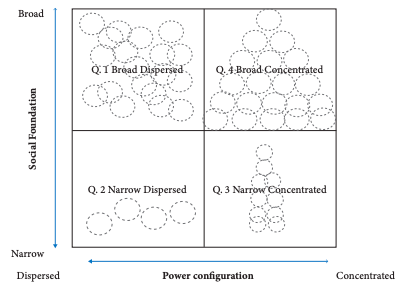
This question, to me, is part of a wider set of discussions. First, about the ways in which context (including political economy dynamics) shapes the prospects of governance reform and effective policy implementation. Second, about the implications of context mattering a lot for the development of cross-contextual knowledge and understanding, and the use of such knowledge and learning to inform locally-led efforts to address complex social challenges in different contexts.
For me, typologies of contexts are useful to the extent that they support the emergent learning that is needed to address specific challenges with complex causal dynamics in particular contexts. So then the question is what sorts of typologies of context can best support efforts to understand and address the dynamics that hold specific challenges in place in particular contexts, and how can they help?
Somewhat surprisingly, given my long-standing enthusiasm for establishing learning loops that link practice and theory, I’ve been a bit sceptical about the value of typologies of context. (For an early exploration of the quandaries of “mapping context” with colleagues at the Overseas Development Institute, see this piece from 2006, particularly pages 1-3). While I like them conceptually, and have very much appreciated the typology-heavy contribution that Brian Levy has made to sharper thinking and practice on governance and working with the grain, (see also his more recent pieces on governance contexts and reform in the education sector, here), I’ve always had questions about whether and how such typologies add practical value to the work of policymakers - especially local policymakers who know their contexts well - in particular places.
On further reflection, and perhaps not before time, I’m beginning to see more clearly how the use of such ideal types might support efforts to address specific challenges in particular contexts, by providing a frame of reference for the application of information, evidence and insights from other contexts. That is, a typology - or perhaps better still, a continuum with different contexts placed on that continuum (see my recent reflections on continuums, complexities and contexts) - might facilitate reflection, enhance situational awareness, and make it easier for actors in a particular place to find and apply relevant learning from the experience of other players in different places.
Combine that with the super-helpful mechanism-mapping approach set out by Martin J. Williams to assessing the scope for policy adaptation across contexts (long version; short version), and you would have a pretty powerful approach for cross-context learning that informs more effective in-context action. No doubt someone is already doing this. If that’s you, or if that piques your interest, do drop me a line.
More next week on ways of assessing change and understanding the complex and contextual causalities that characterise living and learning systems.
Sign up here to be kept in the loop for future reflections, and go here to see my collated musings on awareness, resonance, engagement, reflection.
First published on LinkedIn, 21 March 2023.
Themes: Learning systems and adaptive practice, Power, corruption and political economy
Topics: context, political economy, adaptive learning, governance