Summary: Nora Bateson’s work, and her father Gregory’s, has shaped my interest in living and learning systems. I trace how I came to it and look closely at her list of words to be careful with, such as impact, metrics and solution. It may be useful to anyone who wants to think about how the language we use shapes our work on complex change.
- My path to the Batesons began with my PhD and deepened through Nora’s books and ideas.
- Nora’s list of words to be careful with shows how everyday language can hide interdependence and emergence.
- Words like impact, metrics and solution can mislead when we work in living systems.
About 7 minutes to read the full piece.

The work of Nora Bateson, and her father, Gregory Bateson, has - along with the work of others including the Collective Change Lab, the Human Learning Systems initiative, the Chôra Foundation, UNDP’s Strategic Innovation unit, Cynefin, the Relationships Project and a few others - been an important part of my journey over the last few years, and my emergent focus on helping to nurture living, learning and loving systems. I’ve learned lots from engaging with Nora’s work; about noticing patterns, patterning and differences; about connections and relationships and contexts; and about life, learning and change.
My Bateson-related journey began long before I knew it had, when - doing a Ph.D. on systems, contexts, boundaries and flows, in a Geography Department - I came across the work of Gregory Bateson on the Naven, a ceremony that has an important role in the life of the Iatmul people of New Guinea. I was enthralled by the approach to developing a multi-perspectival understanding of a culture, excited by the reflexivity of the process, and wondered if I should perhaps have studied Anthropology instead.
Fast forward thirty years, with my work still circling around systems, contexts, boundaries and flows, I have found Nora’s work super-helpful and stimulating. I began my exploration of Nora’s work with the wonderful film, An Ecology of Mind: A Daughter’s portrait of Gregory Bateson. Since then, encouraged along by Marcus Jenal and others, I’ve read and re-read Small Arcs of Larger Circles: Framing through other patterns (Publisher’s page here; my extensive notes here), and, just this year, Combining (Publisher’s page here; my highlights here, shared previously in my early May update which includes one of Nora’s poems).
In addition to Nora’s books, I’ve also been excited to explore other pieces, particularly those that have introduced new concepts, to enable new ways of seeing, engaging and being. These include pieces on “symmathesy” or “living and learning systems”, on “aphanipoiesis” or “ready-ing” for emergence, and on “transcontextuality” and the role of “warm data”. Follow these links for wonderful accessible introductions to warm data, symmathesy and aphanipoiesis.
I’ve also enjoyed diving deeply into the collected works of Gregory Bateson, including Steps to an Ecology of Mind (my highlights here), and A Sacred Unity: Further steps to an ecology of mind (my extensive notes here).
Nestled within Combining is a chapter on words to be careful with (see my notes, here), where Nora grapples with the dilemma that commonly used language may obscure the realities of living and learning systems, but that “if the language used to describe the interdependency of our work is too foreign, it will wash over the surface of other people’s understanding” (p.241). As well as coining new words that more fully reflect the fundamental interdependencies of life, and are intended to “increase our sensory perception and capacity to express vital relational processes” (p.241), Nora’s approach to this dilemma is to urge caution in our use of language.
To this end - and with some interrelations with the recently published piece on 5 Words that Shape Social Change (and how they limit us) by Jara Dean-Coffey and John Kania (impact, indicators, lived experience, transformation and scale) - Nora has pulled together a helpful list of words to be careful with; words that we should use with careful attention to the ways that they may be understood and mis-understood, to better serve our communication needs. Nora’s full (but evolving) list includes the following: Agency, Change-Making, Collective Intelligence, Consciousness, Deliverable, Development, Energy, Ethics, Function, Impact, Incentive, Interconnected, Metrics, Prototype, Parts & Wholes, Pattern, Purpose, Scale, Solution, Stewardship, Strategy and We.
The full list with Nora’s pithy explanations of the ways in which the word might obscure the realities of interdependence and emergence is well worth exploring. To whet your appetite and encourage further reflection, here are a few that I found particularly striking.
- Agency: How can we be careful this word does not denote an objectified, instrumentalised notion of action? Why does it matter? Because it blocks the perception of contextual interdependency. How can any organism do anything not informed by and existing within the communicational and relational processes of its context? The possibilities for perceiving any action are within the contextual limits of the organism. … There is agency in the individual, but it is informed and restricted by context. We can take action but our actions are within the set of action we can actually perceive. I am careful not to attribute agency where it is not. There is a paradox of agency: I am me, but I am not me; I am also my context.
- Deliverable: A linear outcome, a harkening of metrics, and impossible to define within projects that engage complex systems change. Forget it … after decades of trying to define the “impact” of work in systems change, it is time, I would argue, to give up on deliverables … deliver questions.
- Energy: Energy is a word from physics. Be careful. Be specific if you are talking about motivation, enthusiasm, feeling, sentiment, or aesthetics. I suggest using words with relational meaning to replace words from mechanism or physics.
- Impact: The word impact comes from physics. It happens when you kick a ball. The velocity of the kick and the vector and distance of the movement can be measured. Instead, imagine kicking a friend, the repercussions are relational. You can measure the distance your friend stumbles, and the impact of their weight hitting the ground, but how will your kick change your relationship? How will your position in the community be changed? How will your children think of you? When impact is applied to living systems, unexpected relational consequences abound. Culture is relational and thinking about making an impact on culture can blur the possibility of taking into account the interrelational consequences. Even if what we mean is make a difference - be cautious as it carries ghosts that confuse our understanding of systemic change. Social, cultural and other living systems do not respond to impact like billiard balls. I suggest using the word(s) “influence” or “create conditions for new interactions.”
- Interconnected: This is a perfectly good word and has brought us a long way. It is, however, better suited for a description of Legos or dots connected by lines than for living systems. In living systems, the connections are relational in ways that are constantly re-fitting. I use interdependent, interrelational, interlocked, entangled, interacting, conjoined or symmathesy.
- Metrics: To measure something requires decontextualization. There are too many variables moving in response to too many variables in the interrelational processes of complexity. Forget metrics; they simply do not correspond to dispersed consequential calibrations of systems change. Metrics are fine for some things, but not this. This process is outside of causalities that are obtainable in numerical forms. Just no, contextual information is necessary to study living things.
- Solution: Instead [of talking about “solutions”], let’s talk about changing the conditions within which interrelational interdependence can take place. Most problems today were once solutions. Proposals that some promise solutions to systemic issues are a kind of betrayal to others working in systemic ways who are attempting to stay honest about the benefits of this work. Obviously, the person whose proposal offers solutions is more likely to win the grant or contract than someone whose proposal offers ambiguity. I stand in loyal admiration and solidarity with the latter. The world needs to get used to systemic work having outcomes that are not visible, measurable or guaranteed. I am pushing hard on this and I think it is high time we all did. As an alternative, I use the idea of improvement in “responding” to a systemic or complex problem instead of “solving” it.
The full list of words is well worth a read, not only to reflect on the words we use and how they shape and constrain our thoughts and actions, but also to plant some seeds of thinking, acting, and relating differently to the living and learning systems our actions and inter-actions help bring into being. What words jump out at you, from Nora’s list or from the words you find yourself using to talk about what you do?
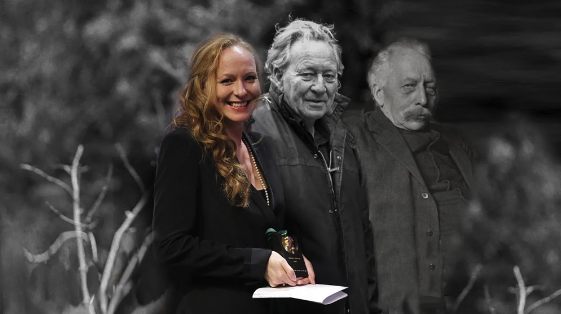
Nora, Gregory and William Bateson (from June 2024 “warm data labs” newsletter)
Getting to know Nora’s work, and seeing how it is informed by, and builds on, the work of her father, and her grandfather - also a creator of new words which opened up fresh perspectives and possibilities - has been super-interesting and useful for me, providing an insistent corrective to the clamour for simple solutions to the challenges we face.
Continuing my explorations, I’ve now signed up for a session on “people need people” - there are six of them over the next couple of months - to explore how multiple stories come together, connecting across contexts, to shape the interrelationships and ecologies that we are part of. My hope is that this post, and my sharing of resources and reflections, might encourage you in your explorations. Drop me a line. I’ll be interested to hear what emerges and keen to see what connections we might make. And if you’d like to receive my occasional - monthly, more or less - updates by email, please sign up here.
First published on LinkedIn, 20 June 2024.
Theme: Learning systems and adaptive practice
Topic: language