
March was a busy month of working with clients on two sets of related issues: on systemic and relational approaches to understanding and addressing corruption; and, on infrastructures for learning that can support adaptive and systemic approaches to addressing complex social challenges (including corruption). More on these avenues of exploration in the coming months!
My February sharing and reflections included a number of books. This month, other than “Be Water, My Friend: The true teachings of Bruce Lee”, has been bookless, but that gap was happily filled (like Bruce Lee’s empty cup?) by three great events that I participated in.
-
First, Tony Quinlan, road-testing his thinking about seven principles for engagement with complex social systems, in a Complexity Lounge event.
-
Second, Beth Smith, sharing Cynefin’s narrative, participatory, appropriately granular, and epistemically just (not extractive) approach to evaluating complex human systems, in a CECAN webinar.
-
And third, an excellent update from the TransCap Initiative on their pioneering work on systemic investing - aligning the logic(s) of financing with the complex reality of social systems, and moving decisively away from the mirage of single-point solutions.
My notes and links to the videos of these three events - including a 20 minute intro to systemic investing - can be found here.
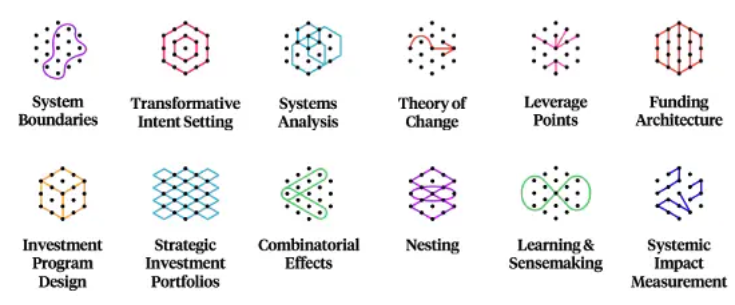
Key concepts for systemic investing (The TransCap Initiative)
Beyond these excellent events, I also found time for further explorations, in particular around two clusters of curiosity: on openness and power; and, on regenerative approaches.
Having spent many years in and around the open movement (data, budgets, contracts, governance, hubs) in a journey that for me went from enthusiasm, through doubt, to skepticism and disengagement, I was glad to see the focus on power in Tim Davies and Renata Avila’s clear, honest, and inspiring reflections in the introduction and conclusion to the second edition of the State of Open Data Report. That complements a recent piece on Opening Up About Open Government by Warren Krafchik and Peter Evans in which they note, with love, that “A value-driven mission is worthy, but it is naïve to expect this to be a roadmap to deliver real-world outcomes. Transparency has inherent merits, but it is not enough to shift accountability equilibria and catalyze complex reform.”
I was also glad to continue my early-stage explorations around regenerative approaches to enhancing the capacity and capability of people, organisations and systems to engage with complex social challenges and to do so in ways that are aligned with wider systems and their non-human elements. I was particularly interested in Ernesto van Peborgh’s piece on the paradox of system design, with its focus on creating the conditions for regenerative flows, and enabling emergence. This - along with a piece that “the deliverable is capability” - was another nudge to actually read Daniel Christian Wahl’s manifesto on designing regenerative cultures. Perhaps this regenerative Spring!
Beyond these two clusters, articles and podcasts about issues including trust/results/accountability, good relationships for simple tasks and complex challenges, hope and hopelessness, and the neuroscience of belonging and systemic identity also caught my attention. Links to the various articles, podcasts and videos that i found particularly interesting, along with summaries and links, can be found HERE.
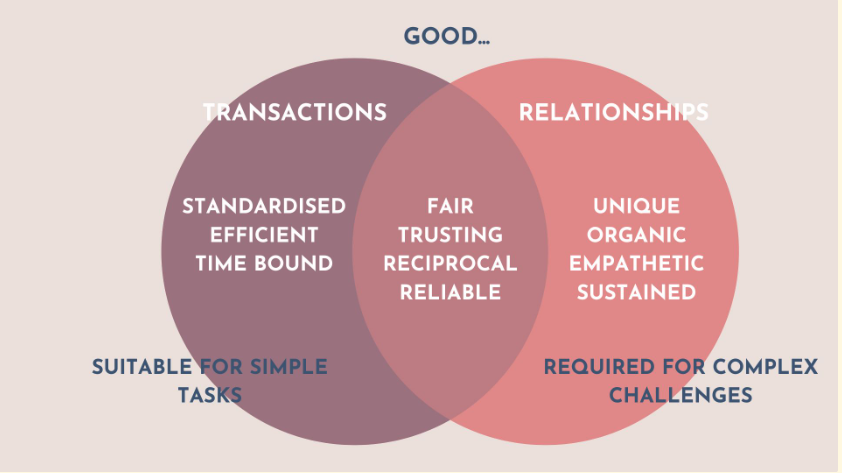
What we mean by “good relationships” (The Relationship Project)
I also shared my collated resources on the use of portfolios to support experimentation, innovation and learning in complex systems and was happy to see that a number of people - including a number of new contacts and emerging friends - found this useful. I was particularly struck by a question from Karima Kadaoui, at Tamkeen, in Morocco, in which she asked “If you were to formulate your quest in a question, what would it be?”
I’m looking forward to a slower paced April, investing in my own capacity and capability to participate in complexity through a course on Complexity: Inside and out, and nurturing my knowledge garden. My exchanges over the last month have planted some seeds about how I might share more fruits of my explorations - informed by your thoughts about what would be most useful - as Spring steadily turns to Summer.
Thanks for reading. Wishing you all regenerative Springs, or fruitful Autumns! If you’re interested to learn more about my explorations and how they might be useful for you, just drop me a line. And if you’d like to receive my occasional updates by email, please sign up here.
First published on LinkedIn, 4 April 2024.
Themes: Power, corruption and political economy, Learning systems and adaptive practice, Ecosystem funding and systemic investing
Topics: corruption, complexity