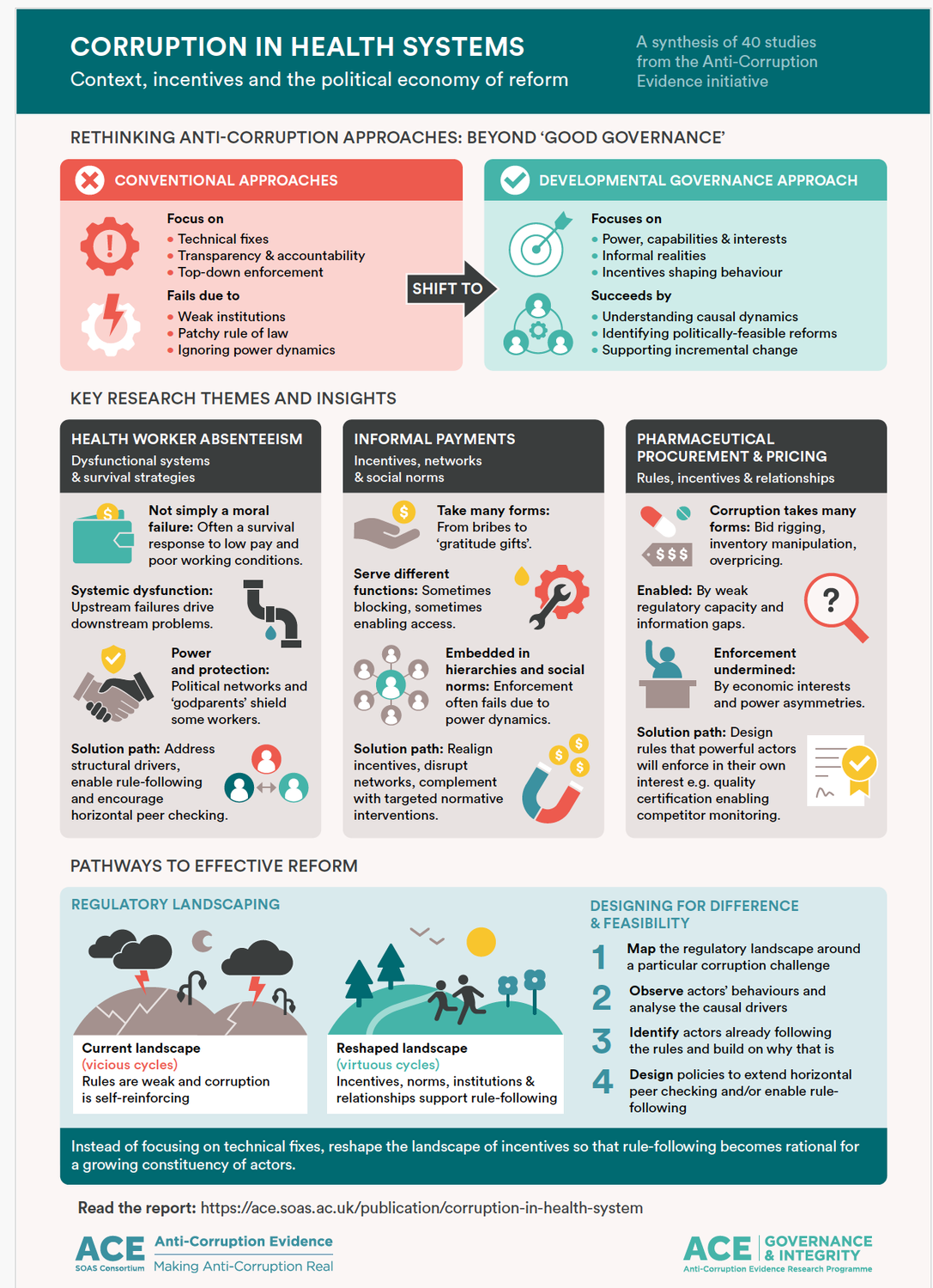
Over the last three months, I’ve been glad to have the opportunity to review and synthesise 40 papers about corruption in health systems, which report on research funded by the FCDO, through the Anti-Corruption Evidence initiative. The resulting synthesis - Corruption in health systems: Context, incentives and the political economy of reform - can be found here.
The rich papers produced by research teams in Bangladesh, Nigeria, Tanzania, Uganda and wider regional contexts cover health worker absenteeism, informal payments, and pharmaceutical procurement and pricing. Together, they show that rather than being a moral failing, in many cases corruption in health systems is a rational response - a survival response - to dysfunctional systems, power asymmetries and poor working conditions. This is the reality that must inform efforts to address corruption.
Disrupting persistent patterns of corruption in systems where powerful actors benefit from the status quo is clearly a major challenge. Powered by inequality, patterns of corruption do not readily melt away. But the research conducted under the ACE programme - specifically the SOAS-ACE and GI-ACE programmes - shows what can be done.
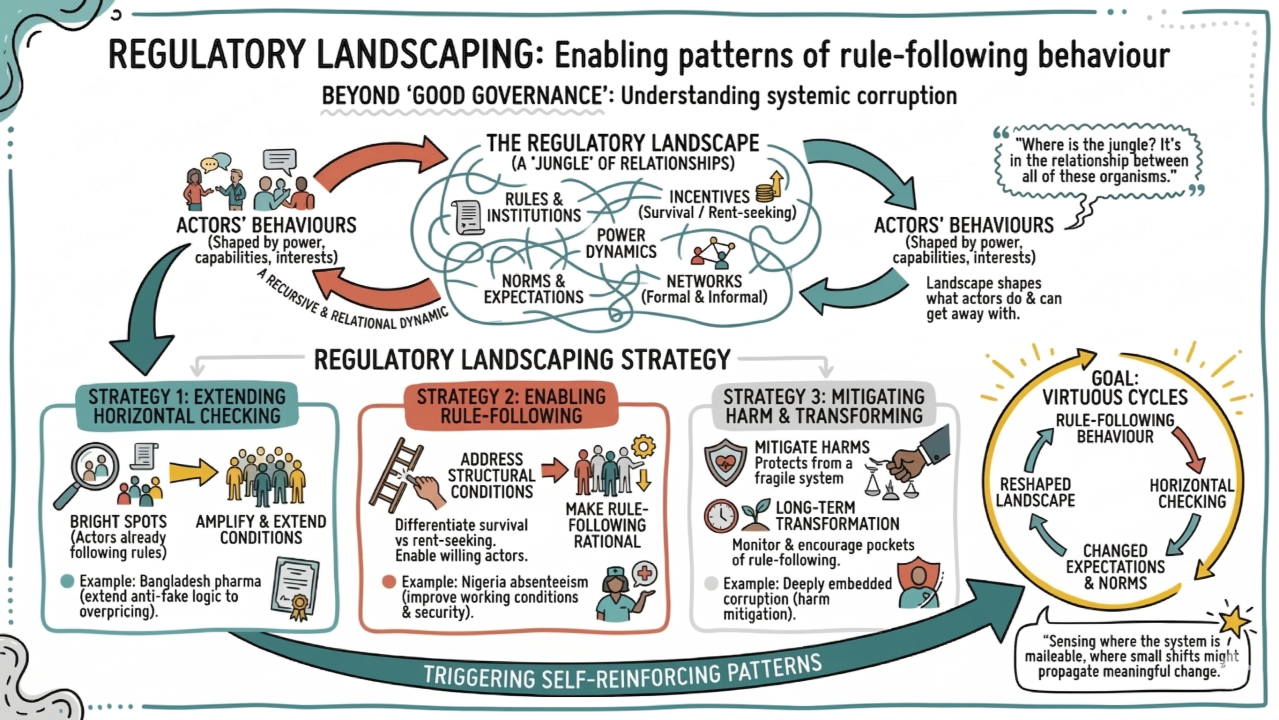
Inspired by the research reviewed and by the SOAS-ACE approach to corruption and the design of effective public policies, this report develops and outlines a “regulatory landscaping” approach to understanding and engaging with complex systems of corruption. It involves four main steps:
- Mapping the regulatory landscape of rules, incentives, norms, institutions and relationships around a particular corruption challenge.
- Observing actors’ behaviours and analysing the causal drivers of those behaviours, both as regards actors’ characteristics and the regulatory landscapes they inhabit.
- Identifying actors who are already following the rules - bright spots of positive deviance - and understanding why that is.
- Designing policies that, by extending horizontal peer checking and enabling rule-following by a critical mass of actors, support the emergence of self-reinforcing patterns of rule-following behaviour.
That last step - triggering horizontal checking whereby changes in the behaviour of some actors reshape the landscape of expectations and relationships for others, with potential multiplier effects - is the seriously systemic move at the heart of the approach. So, while it’s not a magic bullet, regulatory landscaping does offer a practical and pragmatic approach for addressing corruption in ways that take its complex causal dynamics, embedded in particular contexts, seriously.
As the complexity practitioner Jen Briselli puts it in her letter to a young systems thinker, the approach is one of: “sensing where the system is malleable, where small shifts might propagate meaningful change”, and then taking action to incentivise and amplify those small shifts. Tending the regulatory landscape; the habitats that shape, and are shaped by, actors’ behaviours and relationships.
First published on LinkedIn, 31 March 2026.
Theme: Power, corruption and political economy
Topics: regulatory landscaping, health systems, corruption