Part 6 of 6 in a series, Awareness, resonance, engagement, reflection (March–April 2023).
← Previous: Understanding and evaluating complexity · Read it all in one piece
In early March, I began a series of pieces arranged around the theme of awareness, resonance, engagement and reflection. These pieces were part of my effort to develop ways of being that are in line with the workings of the living, learning and loving systems that I want to play a part in co-creating. Be the systemic change you wish to see, as I ambitiously put it!
Over time, a useful way of being in complexity may emerge. Perhaps a pattern that revolves around something like probe, sense, respond (Dave Snowden and Cynefin), connect, diversity, interact, adapt (Tyson Yunkaporta - see the final paragraph of systems, stars and constellations), or the cycle of sense, feel, respond, reflect that I had stuck to my monitor a couple of years ago.
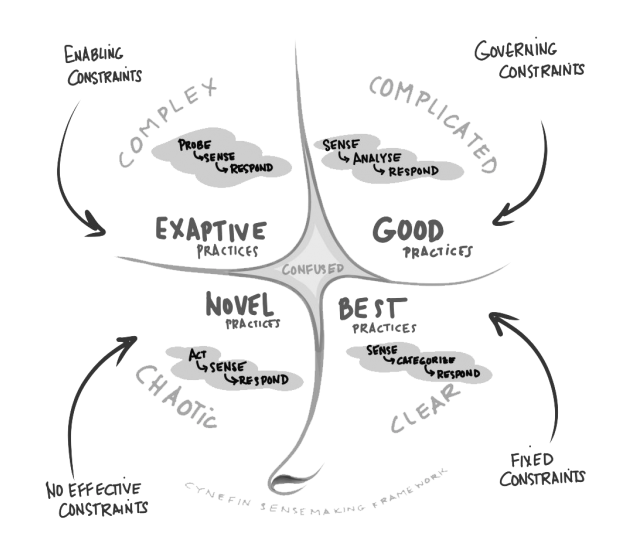
Image: The Cynefin framework
But for now I needed to start somewhere and chose to begin my explorations with the following three rules of thumb: operate with systemic awareness; respond to resonance; and, engage creatively, to nurture more vibrant and adaptive systems.
Guided by these rules of thumb, and selecting topics that had caught my attention and stimulated my engagement during the previous month, I explored the following themes, framed as learning questions:
- Continuums, complexities, contexts: How can thinking in terms of continuums help us to understand and act more effectively in the contexts of complex systems?
- Patterns, power and systems: To what extent and how can new models of governance, and different organisational forms, help to shift the power dynamics that hold systems in place?
- Contexts, typologies and learning: How might typologies of different political economy contexts support the in-context emergent learning that is needed to address complex challenges?
- Understanding and evaluating complexity: How might we further develop and encourage the use of approaches to evaluating and understanding change that are suitable for the complexities of living and learning systems?
Cultivating connections and finding a balance
In sharing these reflections, my hope was that they might resonate with others, spark further connections, catalyse collaborative learning and lead to more effective action. More ambitiously, my hope was that sharing my reflections might help to cross-fertilise and connect the various questions and conversations they are part of, nurturing an evolving network of ideas to inform more effective systemic and collaborative action for social change.
So, how’s it gone?
I’ve been very pleased with the engagement that has resulted from the posts that I’ve shared. I’ve deepened my connections with existing contacts, made new connections, and connected friends and colleagues of mine who hadn’t previously been in touch, all of which I’ve found very enriching and energising. Whether, how and to what extent this relational work has been useful for the people I’ve been connecting with is a different question, but if choosing to be in touch is a good proxy for the value that people place on a relationship, then things are going well!
More immediately, the process of sharing, reflecting and connecting around the four pieces I published and the learning questions they explored, has been very productive for me. The process has sparked additional reflection and helped me to make richer conceptual connections, for instance in two areas. One, between typologies of context and continuums of action. Two, between the dynamic balancing that drives a system (think yin and yang, and the notion of interdependent origination) and the integrity, adaptiveness and effectiveness of that system. And three - a bonus work in progress - amongst the typologies and continuums of one, and the dynamic balancing and adaptiveness of two!
For more on balance, integrity and harmony, check out this short video (half way down the web page) on integrative transformation as a balance of differentiation and linkage, by Dan Siegel who I’m excited to see will be part of the Inner Development Goals Summit in October.
Put more practically, and not very neatly (but such is life!), the sharing, reflecting and connecting has enhanced my appreciation of the fact that when you are deciding what action to take (a way of being, for a specific point in time?) in a complex system, it’s useful:
- firstly, to get a sense of, and consider, the dynamic balancing - including around interdependence/autonomy - that drives the system that you are part of, and the sorts of actions you might take, and connections you might make, to shift those dynamics and the powers that drive them; and
- secondly, to do that in a way that emerges from an awareness that comes from zooming in and out finding a dynamic balance between focused awareness on the specific challenge and/or context in question, and a broader more systemic awareness of other and wider contexts and connections, so as not to lose either perspective or focus. Check out Zoom by Istvan Banyai, for a graphic reminder of why this matters (thanks to Florencia Guerzovich for helping me to find this video!)
Watch on YouTube: Zoom, by Istvan Banyai
Living the questions
The process of sharing my reflections on specific learning questions has provided further food for thought as regards finding a helpful balance of types of awareness. Inspired and encouraged by Anna Birney’s focus on questions and living inquiries, as well as by the work of Tiago Forte on building a second brain and choosing what information to capture, and Krista Tippett - from Rainer Maria Rilke - on living the questions as a way of being, I’ve certainly found it useful to have some learning questions in mind.
This has helped to give some structure to my explorations; a focus for my awareness, some scope for my resonance, a guide for my engagement, and a support for my reflection. But, in making use of learning questions, it seems important to employ them creatively and hold them lightly, staying open to awareness and insights that go beyond one’s learning questions, while at the same time (loopy continuums and polarities again!) using them with discipline, at least until better questions emerge.
Beyond the writing that I did in March, I’ve also been making progress on other fronts.
- The work that I’ve been doing with Jeni Tennison, Tim Davies and Obioma Egemonye at Connected by Data has helped to inform the thinking of the Joseph Rowntree Foundation about the sort of informational or insight infrastructure that might support more effective action against poverty and inequality.
- I’ve been having wonderful and interconnecting conversations about the role of data, evidence, models and stories as part of systems practice with Cheyanne Scharbatke-Church and Diana Chigas at the Corruption, Justice and Legitimacy programme, and with Cynthia Rayner at the Collective Change Lab’s Systems Storytelling Initiative.
- I’ve been excited to discover the thoughtful, pragmatic and creative work of Robbie Gregorowski and his colleagues at Sophoi on results, sensemaking, and learning. Watch this space for more on the approach that they’ve developed to understanding and supporting change in complex social systems.
- I’ve enjoyed a number of MEL for complexity discussions: a UNDP sandbox event on how to track and report on progress; a Wasafiri Consulting event on measuring impact featuring Toby Lowe; and an ITAD event hosted by Megan Colnar on technical innovations in MEL, which included contributions by Marcus Jenal and Kecia Bertermann (blogs by Marcus and Kecia, here and here).
- I’ve been happy to play an active role in the community of folks developing Tana (video review by Shu Omi, here), a new tool for networked thought, which I’m hoping will support richer systemic awareness and more effective action.
- And last, but definitely not least, on the international day of happiness I shared a piece about creating synergies by better integrating the various things I do across my life-system!
If the things I’ve been exploring resonate with you, and you’d like to connect and share, feel free to drop me a line. If we’re doing complementary things, I’m open to collaboration. And if you’d like to be looped in for future updates, please add your name and email address here.
First published on LinkedIn, 12 April 2023.
Themes: Learning systems and adaptive practice, Love, compassion and social change
Topics: complexity, adaptive learning