Summary: I prepared this after facilitating a session for the Basel Institute on Governance’s anti-corruption course. It sets out the SOAS-ACE approach, which treats corruption as a complex social system and designs policy around what actors actually do. It may interest anti-corruption practitioners and students.
- Traditional anti-corruption work focused on transparency and enforcement has limits, so approaches should fit how change really happens.
- I presented corruption as a garden to be tended rather than a machine to be engineered.
- Participants used case studies from Nigeria and Bangladesh to ask what actors’ behaviour makes a policy feasible.
About 3 minutes to read the full piece.
Last week, I very much enjoyed facilitating a session on complexity, corruption and change with participants in the Basel Institute on Governance’s course on Mastering Today’s Anti-Corruption Challenges. The slides I prepared can be found here.
I’d been invited to contribute by Claudia Baez Camargo - a long-time contact through the Governance & Integrity Anti-Corruption Evidence Programme (GI-ACE) - and Jacopo Costa, who helps to run the course.
My contribution to the session was informed by my deep engagement with Mushtaq Khan, Pallavi Roy, Duncan Edwards and the SOAS-ACE approach to addressing corruption and enhancing the effectiveness of public policy in challenging governance contexts. This has included the process of developing the How to Guide on Navigating the Political Economy of Corruption with Katherine Bain. It also includes an ongoing synthesis of cross-ACE research on corruption in health systems - absenteeism, informal payments and pharmaceutical procurement - that I’m currently busy with. In addition, it was informed by my wider explorations on complexity, corruption and change, including my review of the TransCap Initiative’s work on systemic investing.
My presentation did the following:
- Outlined the limits of traditional approaches to anti-corruption that focus on transparency and enforcement, and explained why aligning your approach to supporting social change (and your approach to learning about its effectiveness) with your understanding of how change happens in the sort of system you’re engaged in is key;
- Introduced the idea of thinking about corruption as a complex social system - a garden to be tended, rather than a machine to be engineered - paying particular attention to how change happens, how new patterns of behaviour emerge, and how change that addresses corruption might be supported in such systems; and
- Explored the key features of the SOAS-ACE framework - its political settlements framing; its approach to understanding the political economy dynamics of corruption in terms of actors’ power, capabilities and interests; and then the way it leverages that understanding to inform the design of policies that might incentivise some powerful players to act differently, and encourage others to follow their lead, in ways that will enhance the workings of the system as a whole.
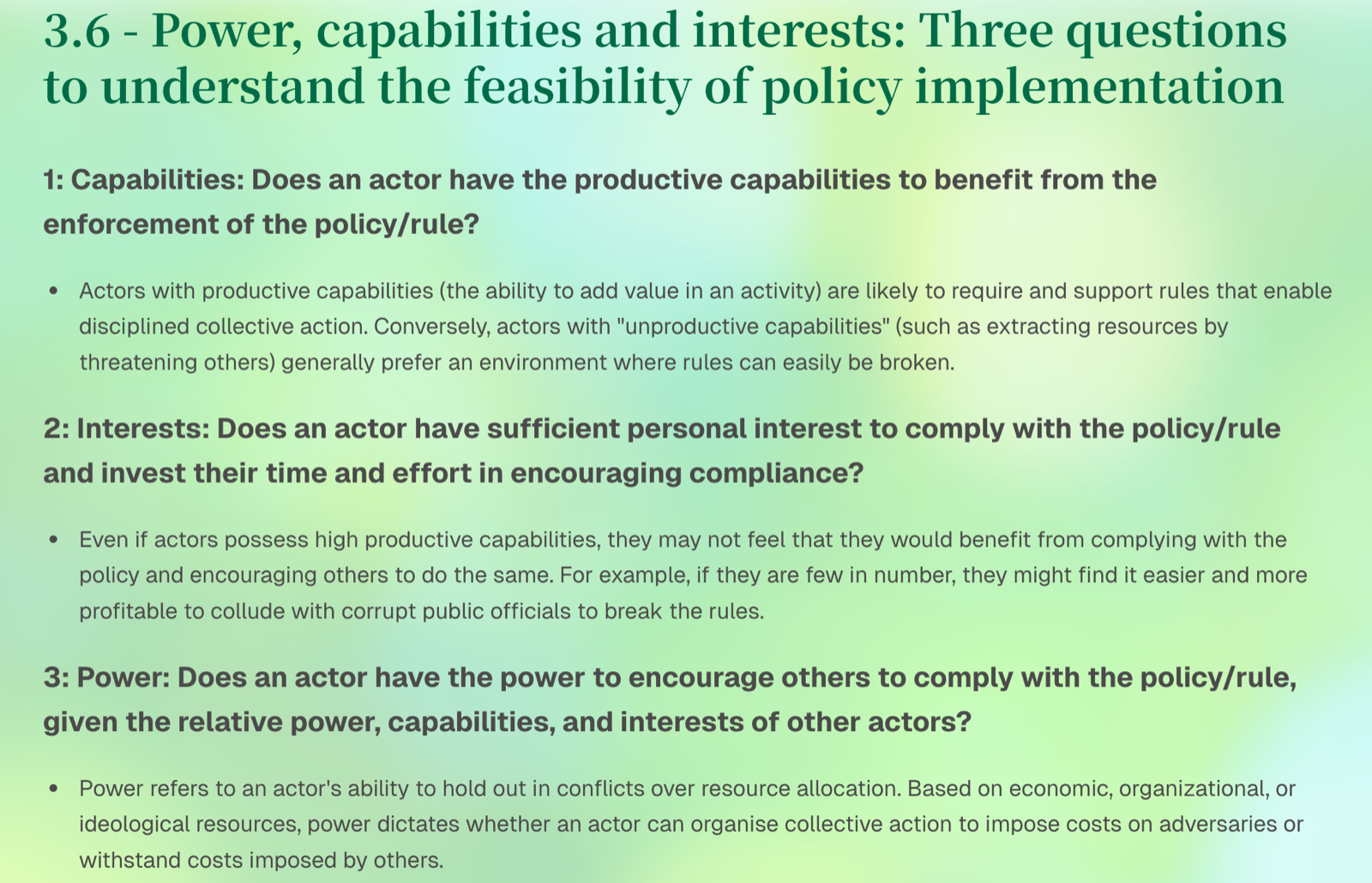
Three questions to understand actors’ behaviours, and the feasibility of policy reform
To ground the SOAS-ACE approach and its key features more fully, participants reviewed and discussed two case studies of the application of the SOAS-ACE framework - electricity in Nigeria, and climate change adaptation projects in Bangladesh. Participants were asked to respond to the following three questions:
- Q1: What was the problem that your case-study focused on and what was the policy proposal that emerged to address it?
- Q2: What did economic ethnography reveal that made this policy seem feasible? (“Economic ethnography” means observing how actors actually behave in practice, not just how formal rules say they should behave)
- Q3: Which actors’ behaviour inspired the policy proposal, and how did their power, capabilities and interests shape their behaviour?
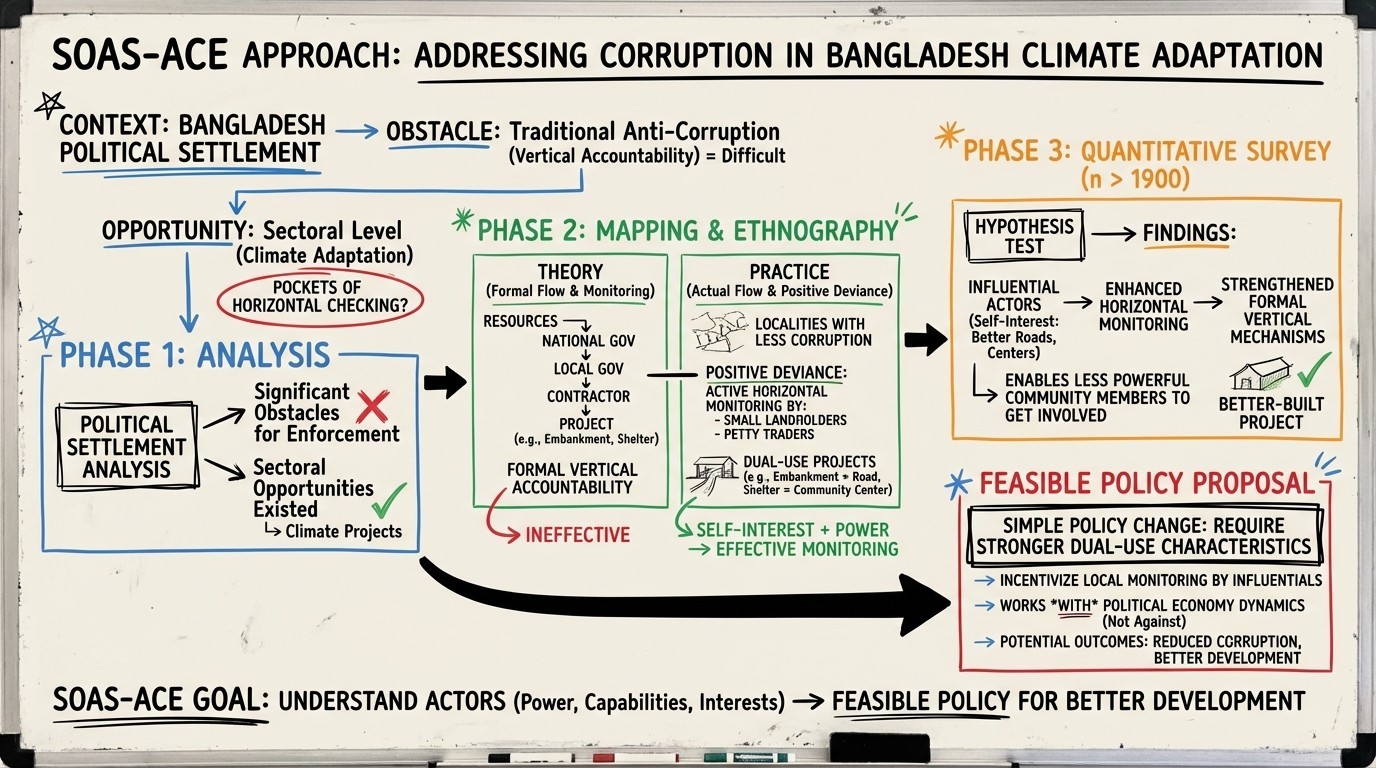
Identifying and extend horizontal checking in Bangladesh, through careful policy design
It was a pleasure to engage with an excellent group of students - mid-career professionals with a focus on corruption, from countries including Tanzania, Madagascar, Zambia, Kenya, Nigeria, Lesotho, Romania, Armenia, Germany, Switzerland and the USA. It was inspiring to get a sense of their resilience and determination to do what they could to address a challenge which for many was experienced as a daily challenge.
I appreciated the engagement and the insightful questions that emerged. These included questions about:
- the role that social and cultural norms - as well as political economy dynamics - play in shaping patterns of behaviour; and,
- whether and how the SOAS-ACE approach has been able to inform approaches to anti-corruption when more mainstream approaches - which may struggle to get to grips with the causal dynamics of corruption - provide a more simple narrative.
Over the coming weeks, I’ll be finishing off the cross-ACE synthesis of research about corruption in health systems around the world, and then turning my attention to the TransCap Initiative Summit on Systemic Investing in mid-April. It looks like it will be a great event, and - with the SOAS-ACE approach to identifying feasible ways of improving governance firmly in mind - I’m particularly looking forward to conversations about systemic investing in challenging governance contexts.
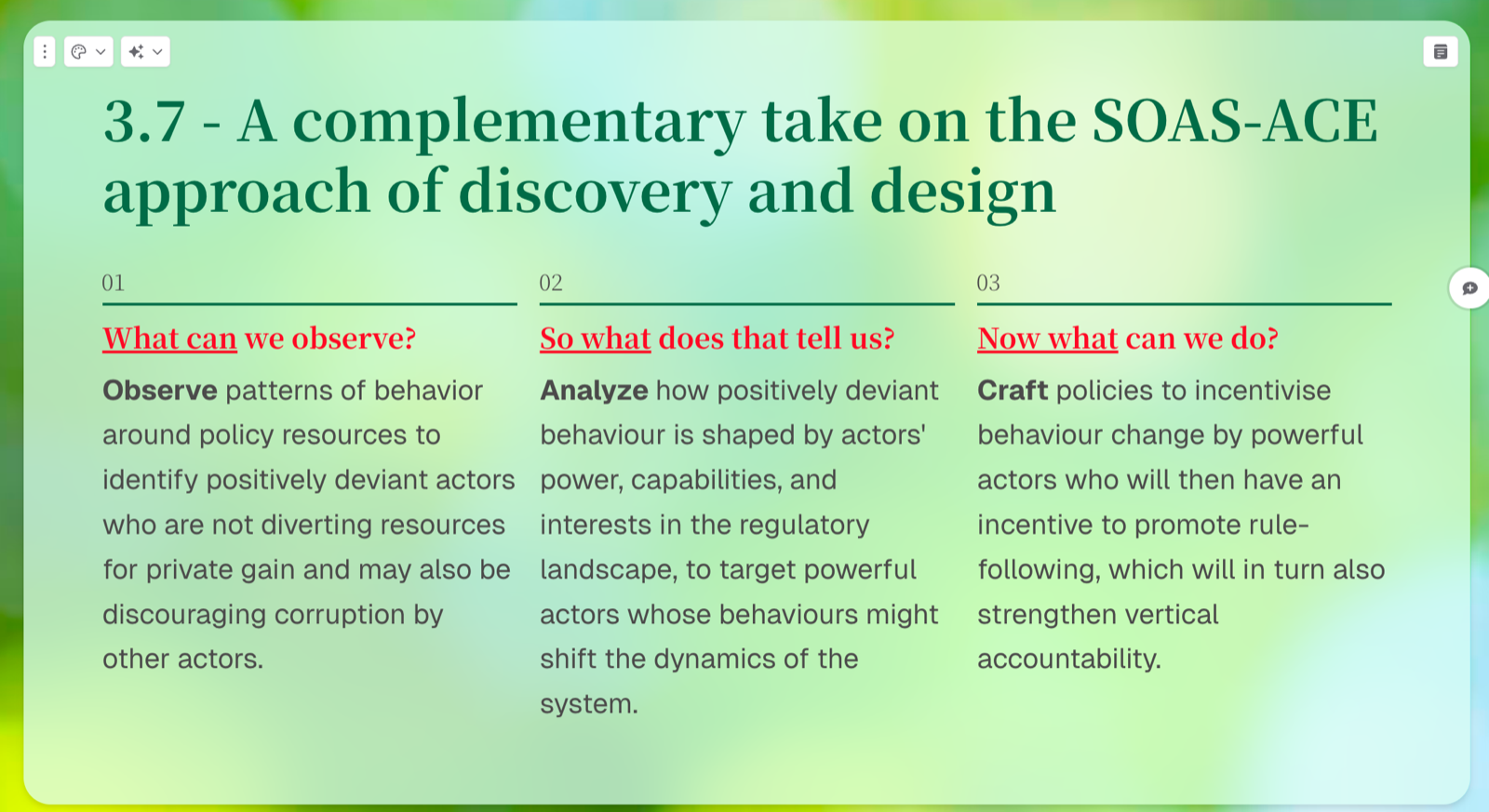
What, so what, now what? An evaluative take on the SOAS-ACE approach
First published on LinkedIn, 3 March 2026.
Theme: Power, corruption and political economy
Topics: corruption, political economy, complexity