Part 3 of 3 in a series, Measurement for systemic investing (November 2025).
← Previous: Measuring “impact” to inform systemic investing
Summary: This is the third and final part of my series on measurement for systemic investing, building on Jess Daggers’ work with the TransCap Initiative. I recap where TransCap’s thinking is, sketch a vision of learning-centred systemic investing, and outline pathways for moving towards it. It may interest investors, evaluators and others working to support systems change.
- Measurement should generate information flows that support learning, sensemaking and decisions, not just accountability.
- Alongside impact, we should assess system health and treat returns as ripples of difference that evaluative inquiry helps create.
- Measurement and learning need grounding in the political economy of particular contexts, including power, incentives and resource flows.
About 18 minutes to read the full piece.

Jess Daggers’ explorations of impact measurement for systemic investing provide a solid basis for crafting an approach to measurement that - by generating useful flows of information that support sensemaking and learning which informs decisions and actions - will enhance the effectiveness of systemic investing (for a summary see **making sense of emergence**, part one of my series on measurement for systemic investing). In this, the third and final part of my series, I do three things: first, I provide a quick recap of my reflections on the TransCap Initiative’s (TCI) emerging approach to measuring impact (where we are); second, I sketch a vision of a learning-centred approach to systemic investing (where we might move towards); and third, I outline a number of pathways that might be explored to move further towards that sort of vision (how we might move in that direction).
My reflections are based on my current understanding of where things are at for TCI. That understanding is based on a detailed review of their publications, and recent conversations with Jess, rather than deep engagement with TCI’s communities of practice. As such, what follows may cover ground that is already being actively explored, by folks who are closer to TCI and therefore have a richer understanding of the challenges and opportunities in the systemic investing space. Nevertheless, I hope that my reflections may provide some additional food for thought, for TCI and the systemic investing community, and for other approaches to supporting systems change that seek to put measurement, sensemaking, learning, and adaptive action, centre-stage.
1. Where we are (A quick recap)
As a brief recap, in my reflections on Jess’s work, and the work of TCI more broadly, I highlighted four key resonances, and then four issues where further exploration might be useful (see part two of my series, on measuring “impact” to inform systemic investing). The four ideas that resonated strongly for me were:
- the idea that investment landscapes are complex adaptive systems, where change emerges through networks of relationships and cycles of action and learning;
- the idea that it is important to align our systems practices, including our approach to measurement, with our understanding of how the world actually works;
- the idea that measurement is about generating flows of information that can support learning, sensemaking and decisions, and inform effective action; and
- the idea that democratizing and distributing evaluative practice can play an important role in systemic investing, helping to nurture collective and systemic intelligence.
The four issues that I noted for further consideration included:
- the tension between orchestrating capital for strategic coherence and nurturing emergence;
- the challenge of finding ways of thinking about “impact”, and outcomes, that are appropriate for complex social systems;
- the potential value of understanding returns as ripples that make a difference, and measuring not just “impact” but broader aspects of system health; and
- the crucial importance of measurement illuminating the political economy dynamics of systems change - how power, resources and incentives shape actors’ behaviours, system dynamics and emergent outcomes.
2. Where we might move towards (A vision for learning-centred systemic investing)
Bringing together Jess’s work and my reflections, a compelling vision emerges for systemic investing that is deeply integrated with ongoing learning - a vision that is grounded in the realities of complex social systems, informed by well-crafted approaches to measurement, and focused on providing value for the various actors, in various contexts, who constitute the landscape of systemic investing.
2.1 Integrating systemic investing and systemic learning
The vision, for me at least, is of an approach to systemic investing that puts measurement, sensemaking and learning centre-stage, with decisions and actions informed by the flows of information these processes and practices generate. In this approach, these practices are not solely, or primarily, about accountability. Instead they are about informing the decisions and actions of various stakeholders who are invested - financially and otherwise - in “advancing environmental sustainability and social justice”, as TCI describes the purpose of systemic investing.
In this sort of vision, while investments of finance and other resources may generate “impact” or returns, they also function as experiments or probes that generate knowledge and support learning in cycles of adaptive action, enhancing the capacity of an integrated system of investment and learning to adapt and respond to emerging opportunities and challenges. As Jess notes in the first of her pieces, in this way, relationships provide the infrastructure for knowledge sharing, and capital functions as both resource and connective tissue, linking actors and enabling collaborative sensemaking across the investment landscape.
2.2 Measuring systemic “impact” and assessing the health of the system
Key to this vision is not only measuring “impact” and “outcomes” - the differences that seem to flow from the actions and interactions of investors and other stakeholders - but also assessing the health, vitality or adaptive capacity of the system from which such impacts and outcomes emerge (See Toby Lowe and Max French’s 2019 piece on reflecting on the health of a system, and an associated case study by UNDP). One might ask whether this is about measuring systemically, or measuring changes that emerge from the workings of the system. I would suggest that it needs to be both, with the measurement approach (methodology in Jean Boulton’s terms) being systemic, and therefore - via a systemic approach to knowledge production, sensemaking and learning (epistemology) - appropriately aligned with the systemic nature of the landscape of investing (ontology). (See my part one of this series, on making sense of emergence, for more on aligning ontology, epistemology and methodology).
More concretely, this means that the approach to measurement - a systemic approach - needs to be one that attends to the health of a system and “systems-level properties (structure, feedback loops, adaptive capacity)” rather than “focusing solely on end-of-causal-chain outcome metrics” (as Dominic Hofstetter’s 2023 piece on what is systemic investing? puts it). In such an approach, returns might be seen as ripples of difference that emerge from a process of co-creating value in a system that is simultaneously about investment and learning (see part two of my series, with references to the work of Emily Gates, Tom Schwandt, Pablo Vidueira and colleagues). Last but not least, given the important role that political economy dynamics play in shaping the workings of social systems, assessments of the health, vitality and adaptive capacity of systems of investing must include efforts to track how power, incentives, relationships and flows of resources shape actors’ behaviours, the system’s capacity both to learn and adapt, and to generate sustainable change.
2.3 Generating actionable insights
By integrating systemic learning and systemic investing, and measuring both systemic “impact” and system health, systemic investing practices will be better able to generate flows of information that support more adaptive decisions and more effective actions. Such an approach emphasizes the value of continuous learning and adaptation in creating sustainable systems. It enables practitioners to refine their strategies and tailor their tactics, based on measurement, sensemaking and learning practices that are thoroughly systemic and generate insights that effectively illuminate system dynamics.
Crucially, these insights must be actionable within the contexts where stakeholders operate and where context-specific political economy dynamics constrain and enable change. This is about recognizing how power asymmetries, patterns of incentives, and flows of resources shape what changes are feasible, rather than simply focusing on those that might seem desirable. In this way, systemic investing supported by systemic learning that contributes to collective intelligence - with political economy dynamics an important part of the mix - has a better chance of shaping the dynamics of complex social systems and contributing to better outcomes in terms of sustainability and social justice.
The vision outlined above - making systemic learning more central, measuring and assessing both “impact” and system health, and generating insights that can inform action in particular contexts - could be an important part of the systemic investing agenda. Realizing this vision, I would suggest, requires deeper exploration across a number of interconnected areas, each addressing a key dimension of how systemic measurement and learning can support systemic investing.
3 How we might move in that direction (Pathways to explore)
Moving toward a fully systemic approach to measurement, learning and investment, requires deeper exploration: first, as regards how measurement might be integrated into the overall process of systemic investing; second, about how to operationalize the idea of returns as patterns of ripples that propagate through systems, assess system health with appropriate rigour, and co-create value through systemic learning; and, third, about how systemic investing and associated practices for systemic learning can be grounded in particular contexts and their distinctive political economy dynamics.

Radical uncertainty and potential pathways for exploration, in the foothills of the South Downs
3.1 Integrating measurement into systemic investing practice
Realizing the vision outlined above requires clarity about how measurement integrates into the overall process of systemic investing, as an embedded component of an adaptive process. Two principles should guide this integration, both of which address the question: how can measurement support intentional coordination without unhelpfully prejudging outcomes or stifling the adaptive capacity that complex systems - and the actors who constitute them - require?
Firstly, we should start with stakeholder needs. Rather than beginning with predetermined metrics, the design of measurement approaches should begin by understanding what decisions different stakeholders need to make and what information they need to make those decisions effectively. The measurement approach and processes for learning can then be designed to meet those needs, in ways that align with the complexities of systemic investing and the decision-making contexts where different stakeholders operate.
Secondly, we should ensure that the approach to measurement adopted works both for learning and accountability. While the vision emphasizes learning and adaptive action, accountability remains important - particularly for funders and others who may not be involved in the day to day activities that make investments more or less successful, but need to have oversight of how things are playing out, to inform their engagement with the system. Ultimately, measurement is about generating information that different stakeholders can use to take more effective action in their respective contexts. As such, while it may not be simple, designing a measurement approach that meets both sets of needs should not be an insurmountable challenge; perhaps an approach that focuses on accountability for learning that can contribute to better outcomes, and learning as an important ingredient of accountability. (Thanks to Toby Lowe for rich and ongoing conversations on “impact”, outcomes, measurement and accountability).
Translating these principles into practice - meeting the needs of various users, for both learning and accountability - requires exploration in two areas. First, as regards what needs to be measured at different points in the systemic investing process to generate the flows of information that various stakeholders require. This could be explored by mapping the investment cycle, or process, to identify where measurement can usefully capture information about opportunities, investments, returns, impacts (ripples of difference) and outcomes, as well as about the actors, behaviours, relationships and dynamics (including political economy dynamics) that shape the system, and context(s), for investment.
Last but not least, approaches to measurement need to be developed, tested and refined through practice in particular contexts and cases. While there will be commonalities across cases and contexts, what works for embedding measurement and learning into systemic investing may vary depending on the nature of the investments, the characteristics of the system, the features of the context, and the needs of different stakeholders. This means experimenting with different approaches, learning from what works and what doesn’t across a diversity of contexts and cases.
In conversation with Jess, I was glad to hear that TCI’s thinking is heading in this direction; using particular cases and contexts (workstream 6 in the diagram below) to explore how to support effective systemic investing. My understanding is that this will include developing, testing and refining approaches to measurement and learning in particular contexts, to then use the insights generated to tailor approaches that align with the principles that guide TCI’s approach to monitoring, evaluation and learning, and apply them in context-appropriate ways. Such experimentation is itself a form of systemic learning - generating knowledge about how to integrate measurement into systemic investing in ways that genuinely support more effective action.
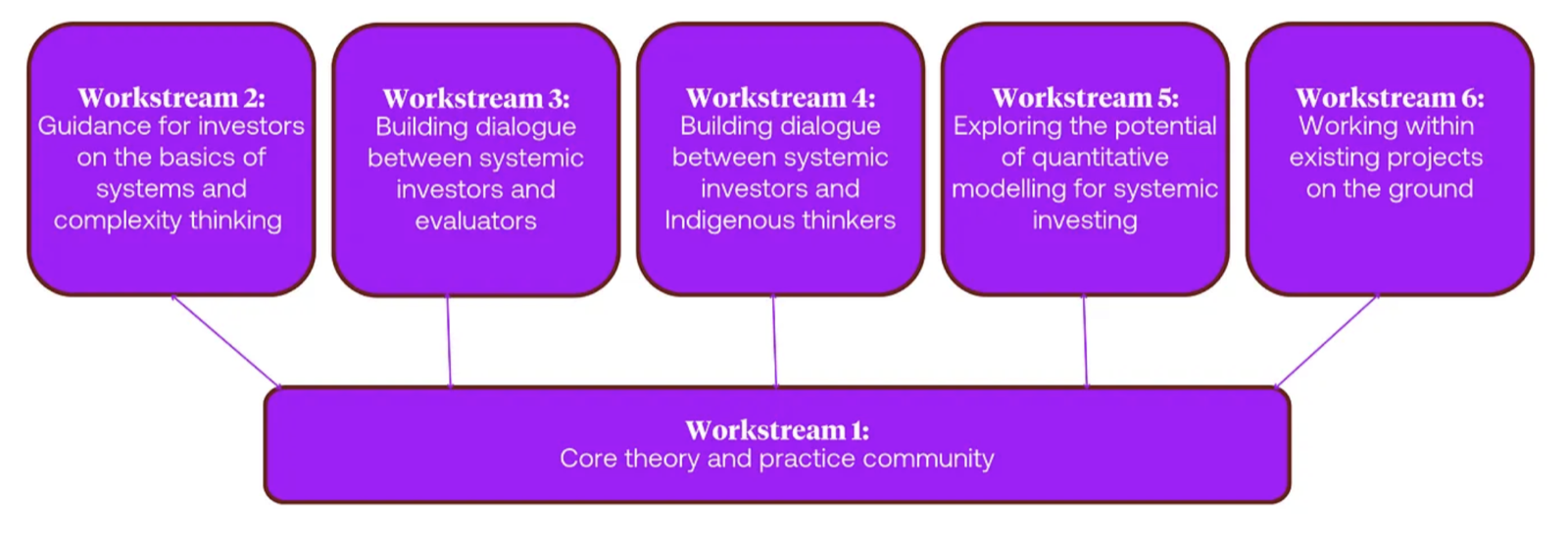
Six workstreams on impact measurement, as sketched out by Jess Daggers in March 2025
3.2 Measuring returns, assessing system health, and co-creating value
As discussed above, in section 2.2, moving towards a vision of systemic investing that leverages and drives systemic learning requires an approach to measurement that goes beyond “impact” to consider the health of the system, and takes account of the ways in which ripples of return (returns that include but go beyond financial returns) can be co-created through evaluative inquiry. Making progress in this direction calls for deeper exploration of how to put this into practice, considering how the influence of ripples of impact on system health can be assessed with appropriate rigour, and how systemic measurement, evaluation and learning can become part of the process of creating value.
Putting the idea of returns as ripples of difference into practice entails grappling with how to track influence that spreads through networks of relationships and synergistic effects, and emerges over time in ways that make it impossible to attribute causal impact to specific individual actions. Ripples of difference work differently than simple ideas of “X leads to Y” causality suggest; they propagate through relationships and connections, interact with other ripples, and shape the health and adaptive capacity of the system itself, setting the scene for further rounds of action and influence.
This raises fundamental questions about what we’re actually trying to measure and what quality standards are appropriate. How do we assess whether a system is becoming more or less healthy, more or less capable of adapting and generating sustainable change? What indicators might reveal systems-level properties such as feedback loops, relationship patterns, adaptive capacity and the emergence of collective intelligence? And crucially, if we are dealing with causal relations that are complex and deeply contextual, what principles and standards of rigour can give us confidence that the insights generated through the learning process are solid enough to inform actions that are intended to lead to further ripples of return? (See part two of my series for more on rigour, including some useful references).
The concept of co-creating value through evaluative inquiry - also addressed in my part two - represents a fundamental shift from viewing measurement as separate from the work of systemic investing, or systems change endeavours more broadly, to understanding it as integral to how value emerges. Inspired by the work of Emily Gates, Tom Schwandt, Pablo Vidueira and colleagues, this perspective suggests that evaluation goes beyond observing change and assessing its value. Instead, evaluation is seen as an important part of the process of generating insight and meaning, enhancing communication, strengthening relationships, nurturing collective intelligence and informing systemic action. In this way, practices of measurement, sensemaking and learning don’t just track ripples of return. Instead, they help to create them. The questions we ask, the conversations we convene, the data we gather and share, and the learning which informs stakeholder actions, all contribute to the system’s adaptive capacity.
Putting evaluation and learning into action in ways that co-create value requires creative thinking and experimentation about how to design approaches to measurement, evaluation and learning that are truly generative rather than extractive. What does it mean for measurement practices to be participatory and democratized in ways that build collective intelligence rather than centralizing knowledge? How do we ensure that evaluative inquiry strengthens rather than burdens the relationships and networks that constitute the investment landscape? How can feedback loops and information flows be managed to support continuous learning and adaptation across diverse stakeholders operating in different contexts? These questions point toward measurement as a practice of system stewardship; not standing outside a system to judge it, but working within it to enhance its health, vitality and capacity to generate sustainable change. (For a great example of what this might look like see the work of Toby Lowe and the Human. Learning. Systems. community on system stewardship as a role and process that focuses on designing and governing structured learning cycles, and, for more on these themes see the richly emergent body of work that Indy Johar and colleagues at Dark Matter Labs are developing).
These explorations of how to measure ripples, assess system health with appropriate rigour, and co-create value through evaluative inquiry all point toward the need for approaches that are deeply grounded in and across the contexts where systemic investing takes place. The final area for exploration focuses on grounding systemic investment and learning in particular contexts, and in the political economy dynamics that shape what changes are feasible and how value can be co-created.
3.3 Grounding systemic investment and learning in particular political economy contexts
The vision outlined in section 2, above, emphasizes that systemic investing and associated practices of measurement, sensemaking and learning must be grounded in the realities of particular contexts; contexts shaped by political economy dynamics that fundamentally influence what changes are feasible and how value can be created. As I put it in part two of my series, citing a recent review of systems change evaluations by Emily Gates and colleagues: “If monitoring, evaluation and learning doesn’t engage with distributions of power, flows of resources, and landscapes of incentives, and illuminate the role they play in shaping system dynamics, then such efforts are likely to leave system dynamics - and the outcomes that emerge - fundamentally unchanged.”
While earlier sections have highlighted why political economy matters, realizing this vision requires deeper exploration of how to understand these dynamics through deep contextual engagement, how to integrate political economy insights into measurement and learning practices, and how to act strategically within the constraints and opportunities that political economy realities present.
Understanding political economy dynamics - the evolving structures of power, flows of resources, and patterns of incentives that shape actors’ behaviors and system functioning - requires deep, ongoing engagement with specific investment landscapes. This goes well beyond one-off mapping exercises to entail continuous learning and sensemaking as political economy dynamics themselves evolve through the interactions of multiple actors, including investors and their partners, and the ripples of difference they create. The challenge here is to develop approaches to political economy analysis that are rigorous enough to inform strategic action, yet flexible enough to adapt as contexts shift. This raises questions about methods (what approaches can illuminate power structures and leverage points?) and grounding (how do we ensure analysis reflects lived experience?). It also points to the importance of integrating political economy analysis into ongoing practices of measurement, sensemaking and learning.
This requires designing approaches to measurement and evaluation that track political economy dynamics alongside other system properties - not as a separate analytical layer, but as an integral part of assessing system health and adaptive capacity. The practical challenge is to design processes of evaluative inquiry that illuminate how power asymmetries, patterns of incentives, and flows of resources shape systems and their evolution, to identify indicators that reveal whether political economy dynamics are shifting, and to ensure that learning processes surface and engage with these constraints and opportunities. This is particularly challenging given that political economy analysis can reveal uncomfortable truths about the preferences of powerful actors with vested interests, and structural barriers that may constrain the space for feasible change. Creating space for honest reflection on these dynamics requires approaches to measurement and learning that are not only technically sound but also politically astute and relationally sensitive.
The purpose of incorporating political economy analysis into processes of measurement, sensemaking and learning is to inform strategic action that can navigate and, where possible, shift the political economy realities that shape what changes are feasible. This raises perhaps the most challenging set of questions in systemic investing: how might insights about power, incentives, resource flows and relationships actually inform investment decisions and strategies?; what does it mean to work strategically within existing political economy constraints while simultaneously seeking to shift them?; and, how do we navigate the tension between working with current incentive structures (to achieve near-term progress) and working to change them (to enable deeper, more sustainable, transformation)?
These questions point toward the need for investment strategies that pragmatically recognize current political economy realities while maintaining the ambition for transformative change. What this looks like in practice will vary across contexts, depending on the specific configurations of power, incentives, resources, and relationships in particular investment landscapes. This might involve identifying leverage points where shifts in power relations or incentive structures are possible (see Ivana Gazibara’s piece from 2024 on transition mapping, and the work I led for SOAS-ACE on navigating the political economy of corruption), building coalitions that can challenge existing arrangements, or supporting actors and initiatives that are working to shift political economy dynamics over time.
Addressing these interconnected challenges - understanding contextual political economy dynamics by integrating political economy analysis into processes of measurement and learning, and using that analysis to inform strategic actions that might be taken in particular contexts - is itself a process of co-creating value. When done collaboratively with diverse stakeholders, evaluative inquiry into political economy dynamics generates shared understandings that enable more strategic action. This value - the enhanced capacity to navigate and potentially shift political economy constraints - emerges through the process of learning together about the specific configurations of power, incentives, and relationships that shape what’s possible in particular contexts, in turn enhancing the prospects of systemic investing co-creating value, in and across particular contexts.
The three areas addressed in section 3 - integrating measurement into systemic investing practices; measuring returns and co-creating value; and grounding systemic investment and learning in particular political economy contexts - are deeply interconnected. Progress in any one supports progress in the others. Together, they chart pathways toward measurement approaches that can genuinely support learning-centered systemic investing: approaches that are theoretically sound, practically useful, contextually grounded, and politically aware. Most importantly, they point toward measurement as a relational and collaborative endeavor - one that generates the flows of information needed to support adaptive action, in particular contexts, by multiple stakeholders invested in systems change.
4. Moving towards full-stack systemic investing
In this series, I have explored how measurement and learning might better support systemic investing in a way that might be characterized as “full-stack systemic”. In part one I summarized Jess Daggers’ work on measuring impact for systemic investing. In part two I shared my reflections, identifying four areas for further exploration: orchestration, emergence and measurement; “impact” and causal relations; returns, co-creating ripples of value, and rigour; and, the political economy dynamics of systems change. And in this, the final piece, I have sketched a vision for learning-centered systemic investing and outlined three interconnected pathways for moving toward that vision: integrating measurement into systemic investing practice, measuring returns and co-creating value, and grounding systemic investment and learning in particular political economy contexts.
I’ve shared these reflections as a contribution to an ongoing conversation about putting evaluative inquiry and systemic learning at the centre of systemic investing, and other systems change efforts. The pathways outlined above are not prescriptions but invitations to experimentation and collaborative learning. As TCI and others in the systemic investing community explore these approaches in diverse contexts, new insights will emerge about what works, what doesn’t, and how practices can be refined and adapted.
Ultimately, measurement and learning are not ends in themselves but means to support more effective systemic change. Putting these practices at the center of systemic investing - designing them to serve diverse stakeholder needs, to illuminate system dynamics including political economy realities, and to co-create value through collaborative inquiry - can support systemic investing to meet its goals of contributing to the emergence of systems and societies that are more just, sustainable and adaptive. This is important and challenging work that requires ongoing experimentation, honest reflection, and collaborative learning. I look forward to staying engaged and to building bridges with other initiatives and communities taking systemic and learning-centred approaches to nurturing social change.
A consolidated version of my series of three pieces can now be found here.
My summarized highlights of the various pieces on systemic investing, measurement and learning referenced across my three blogposts can be found here.
Please follow me on LinkedIn, or sign up here, if you want to be in the loop for occasional updates about my explorations in the landscape of complexity and social change.
First published on LinkedIn, 25 November 2025.
Themes: Ecosystem funding and systemic investing, Learning systems and adaptive practice
Topics: systemic investing, impact measurement, learning systems, monitoring, evaluation and learning