Part 1 of 3 in a series, Measurement for systemic investing (November 2025).

Watch on YouTube: Making sense of emergence
Introduction
What if measuring systems change were less about demonstrating impact and ensuring accountability against pre-determined metrics, and more about generating flows of information that practitioners, funders and communities who are invested in systems change can use to adapt the approaches they take to nurturing that change?
This is the intriguing proposition that Jess Daggers, Head of Research at the TransCap Initiative on Systemic Investing (TCI), explores in a thought-provoking series of posts on impact measurement and management in the systemic investing space - the application of complexity science and systems thinking to investing. In this piece, I provide an introduction to TCI’s emerging approach to impact measurement and management. In a second installment, out next week, I share some reflections, and conclude with some thoughts about potential next steps for systemic learning and investing.
Informed by my explorations of how to understand and engage in complex social systems, my intent in drafting this piece is to contribute to collaborative learning about ways of making sense of the dynamics of complex social systems, which aims to inform actions and engagements that might enhance the workings of such systems and contribute to better outcomes in terms of social justice, shared prosperity and sustainability.
Crafting a systemic approach to measuring impact
Jess Daggers’ work with TCI has focused on developing an approach to impact measurement that aligns with TCI’s complexity-informed systemic investing framework. Her work is informed by and contributes to TCI’s understanding of how change happens in complex social systems and the role that systemic investing can play in shifting the dynamics of such systems.
As Jess notes in her 2023 paper on Systemic investing, impact measurement and evaluation, one of the central challenges for the field of systemic investing is about how to conceptualize impact, and whether and how to measure impact, in complex social systems where establishing causality is particularly challenging (see Toby Lowe’s piece on explode on impact, and Tom Aston’s response, for related discussions). Her five-part series on impact measurement for systemic investing, from March 2025, explores this question in depth, charting a path forward for measuring impact and making sense of change in ways that reflect the complex realities of systemic investing.
My summarized highlights of Jess’s work can be found here, alongside a fuller selection of TCI resources, including various pieces by Dominic Hofstetter (TCI’s Executive Director) and Ivana Gazibara (TCI’s Director of Systemic Investment Programmes).
What could and should impact measurement look like in systemic investing? (Part one)
To address this question, in part one of her series, Jess begins by establishing a fundamental premise: approaches to measuring impact in complex social systems need to be aligned with how change actually happens (or more precisely, with how change is thought to happen) in such systems. The implication is that traditional linear and reductionist approaches to measuring impact are inappropriate for systems where causalities are complex and context-dependent, with change emerging from those complexities.
This foundational insight necessitates a critical reframing of impact measurement. Rather than simply asking “what is the impact of my investment?”, more fruitful questions emerge: what flows of information can we hope to generate about what is happening?; what does my investment allow me to learn about the system I want to change?; and, subsequently, how might that inform the actions that we take?
To ground this reframing, Jess then identifies three domains where researchers and practitioners are exploring similar issues, and which the field of systemic investing might learn from: complexity science; systems and complexity-informed monitoring, evaluation and learning; and, indigenous knowledge.
Impact measurement in systemic investing: A guide to existing work (Part two)
Having reframed the core questions for impact measurement, in part two of her series, Jess provides an overview of what others have learned. She explores existing knowledge and practice across complexity science, complexity-aware monitoring, evaluation and learning, and indigenous knowledge, finding rich bodies of work that address similar challenges in understanding change in complex social systems.
She highlights in particular discussions about rethinking rigour - the principles and practices used to ensure that evaluative findings are credible and meaningful. Rather than abandoning the concept, she encourages us to rethink what rigour might usefully mean, and how it might be achieved, as regards the evaluation of complex social systems.
Jess also highlights the importance of clear communication, particularly as regards the meaning of, and approaches to, “systems thinking”. Here, she points to Jewlya Lynn and Julia Coffman’s 2024 piece on passing in the dark, which differentiates between systems-dynamics and systems-emergence variants of systems thinking - pretty much “complicated” and “complex” in Cynefin’s terms - with the latter being the perspective to which TransCap is most aligned. (See David Bent’s review from 2024 for a more critical exploration of TransCap’s stance and approach as regards complexity).
Going deeper into the landscape of systems and complexity thinking (Part three)
The review of existing work in different domains raises a deeper question: how do we ensure our measurement approaches are genuinely fit for purpose? Drawing on the work of Jean Boulton, in part three of her series, Jess emphasizes the importance of alignment across ontologies, epistemologies and methodologies. (See also my piece on ecosystems, emergence and social change, and my notes on Jean Boulton’s recent book on the dao of complexity). The argument here is that if our methods and practices are to be effective, they need to be informed by our knowledge about the world (and by the epistemologies that guide how we produce that knowledge), and that knowledge about the world needs to be informed by our understanding of the nature of the world and how change happens (ontology).
This applies to our systems change practices, and, more specifically, to the ways in which we measure impact. For Jean, as Jess notes, self-consistency, or alignment, across ontology, epistemology, and methodology/practice is key - “otherwise, we risk missing the very information that is key to furthering our understanding”, limiting the effectiveness of our learning and action. More simply, for our actions to gain traction, they need to be informed by a sound (albeit non-predictive, and evolving) understanding of how the world is, and how change happens.
So, if we are dealing with complex social systems where new patterns emerge from changes in behaviour, processes of relating, and learning in relationships - particularly at sites of positive deviance - then impact measurement ought to pay close attention to these things (see my piece on learning from the political economy of positive deviance). It should also take an approach to learning that seeks to nurture emergence rather than exercise control.
As Jess notes, crediting this framing to Zazie Tolmer, this entails shifting the focus from “what can we learn about our intervention?”, to “what does our intervention allow us to learn about the system?” (See also my collated resources on the value of portfolios for systemic learning, and UNDP’s August 2025 report on modernizing development).
Building dialogue and collaboration across sectors and practice areas (Part four)
In part four of the series, Jess reflects on how the emerging field of systemic investing relates to existing areas of practice - evaluation, indigenous thinking, and complexity science - to advance collaboration and learning in this area. As regards evaluators and investors, Jess argues that a complexity-aware, systemic approach to investing changes many of the parameters for investment decisions and that this provides an opportunity to enhance collaboration between impact investors of a systemic persuasion and evaluators.
In contrast to traditional impact investing, complexity-aware systemic investing asks investors to start with the needs of a system, to work collaboratively, to entertain longer time-frames, and to think about returns on investment in different ways. And, most significantly, it asks investors to adopt a curiosity mindset that is focused on understanding emerging patterns and their consequences across time and stakeholder groups, and is supported by appropriate ways of conceptualizing and measuring impact. This opens a space for constructive collaboration between systemic impact investors and evaluators.
Taking stock and next steps (Part five)
In a fifth installment, Jess notes that her explorations of the landscape of approaches have provided useful food for thought about what an approach to measuring impact that can support systemic approaches to investing might look like, and how such an approach might be crafted. Rather than revealing an approach which would be definitively right, her explorations have uncovered a variety of approaches to understanding and engaging with complexity in systemic ways, each with different implications for ways of measuring impact.
This is an important staging post on the path to developing an approach to impact measurement that is “not just a superficial layer on top of conventional practice, but part of a deeper rethink of how we view the world, and the possibilities for creating change.” Looking ahead, Jess sketches out six workstreams that, in combination, will advance collaborative thinking and practice on the sorts of approaches to impact measurement and evaluation more widely that are needed to support complexity-aware and systemic approaches to investing.
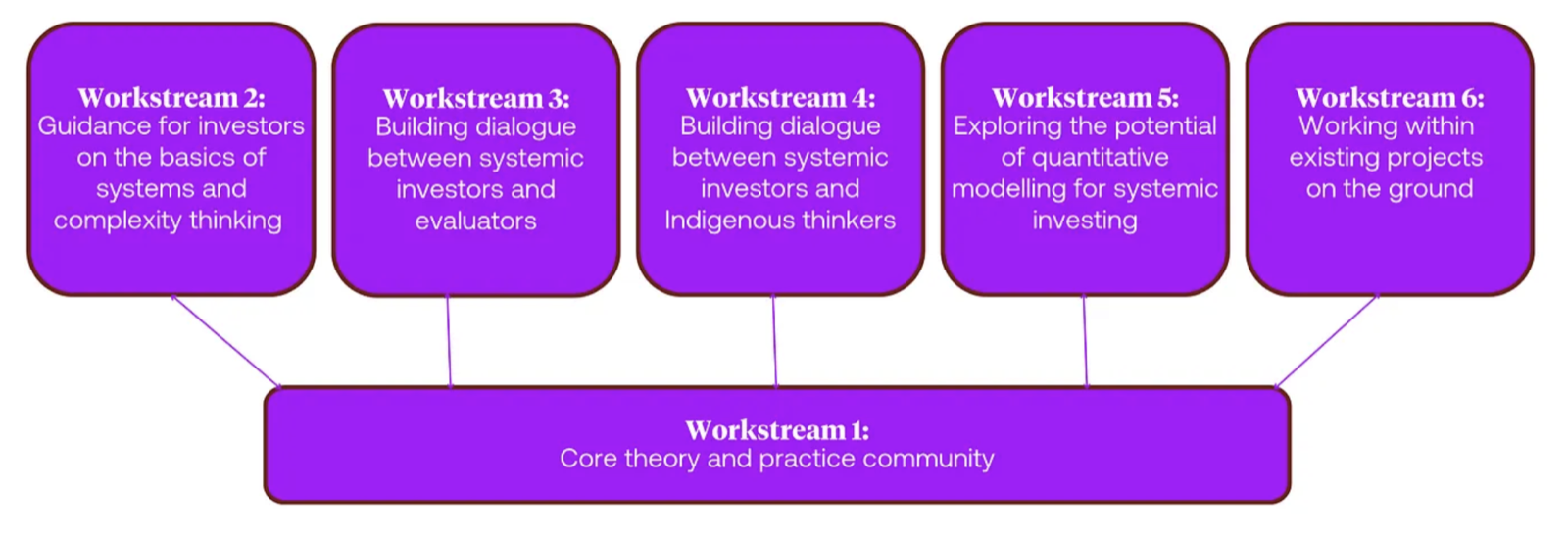
Six workstreams on impact measurement, as sketched out in March 2025
By facilitating these collaborative workstreams, TCI and the wider systemic investing community will be able to craft approaches to impact measurement that align with how change happens in complex social systems. As Jess notes, it’s not yet clear what these approaches will look like.
However, it seems clear that they will be ones that: are informed by and can adapt to the complex dynamics of systemic investing; can engage multiple actors in collaborative learning; prioritize collaborative sense-making that informs action; and, in Thomas Schwandt and Emily Gates’ terms, support the co-creation of value (Schwandt and Gates, 2021), rather than reporting on indicators that support accountability theatre but are ill-suited to informing effective actions and investments, or supporting rich and meaningful accountability.
Looking ahead to next week
Jess’s explorations of what a systemic approach to measuring impact might look like provide much food for thought. In a follow-up piece, planned for next week, I will share what resonates for me, and then suggest some issues and questions that merit further exploration. These include issues relating to: orchestration, emergence and measurement; emergence, impact, returns, ripples and rigour; and, the political economy dynamics of systems change.
Thanks to Jess for her rich explorations of measuring impact to inform systemic investing, for finding the time in her busy schedule to chat about TCI’s emerging approach, and for introducing me to her local neighbourhood. I look forward to additional opportunities for collaborative sense-making, learning and action. Oh, and if you want to be in the loop for occasional updates about my explorations in the landscape of complexity and social change, please sign up here.
_________________________
Update, 18th November 2025 - part two of this three part series, on *measuring “impact” to inform systemic investing: reflections, resonances and questions* is now out.
Update, 25th November 2025 - part three of this three part series, on *full-stack systemic: measurement, learning, investing* is now out.
And, a consolidated version of my series of three pieces can now be found here.
First published on LinkedIn, 11 November 2025.
Themes: Ecosystem funding and systemic investing, Learning systems and adaptive practice
Topics: systemic investing, impact measurement, emergence, monitoring, evaluation and learning