Summary: After forty research papers on health-systems corruption landed on my desk, I synthesised them with the SOAS Anti-Corruption Evidence programme, using Claude as an assistant. This piece shares my seven-step process and what I learned. My main point is that the work should be human-led, not just have a human in the loop. It may help anyone considering AI for a synthesis of many sources.
- I used a sequential, iterative process, from reading the papers to a cross-thematic synthesis, to keep a chain of integrity.
- I designed, tested and refined the loops myself, and checked each stage against what came before.
- Think through how you would do it manually, then break the task into steps for AI.
About 11 minutes to read the full piece.
Introduction
Towards the end of last year, I started discussing with colleagues at the SOAS Anti-Corruption Evidence programme (SOAS-ACE) whether I could — building on Duncan Edwards’ initial idea, and the excellent work by research teams in various countries — synthesise the findings from a number of research projects that FCDO’s Anti-Corruption Evidence programme had funded on corruption in health systems. Having collaborated closely with the SOAS-ACE team over recent years, they thought I would be well-placed to do the synthesis.
This piece shares my reflections on the process of producing the synthesis and the ways in which I used AI to support that process. In sharing these reflections, I hope to provide some food for thought for others who might be considering using AI to support similar sorts of processes.
The task and the challenge
The core task was to review and synthesise findings from 40 research papers from Bangladesh, Nigeria, Tanzania, Uganda and wider regional contexts, on issues including health worker absenteeism, informal payments, and pharmaceutical procurement and pricing, and the cross-cutting category “Beyond ‘Good Governance’”. The resulting report needed to be a synthesis, not just a summary; identifying patterns and making connections across the findings from the various projects, and drawing out implications for policy and practice.
This presented two distinct but inter-related challenges: developing a synthesis that was more than the sum of its parts, while staying true to the diversity of the findings on which it was based; and designing a manageable process which would enable me to handle the many interconnected threads, through multiple iterations, without getting overwhelmed.
The synthesis process
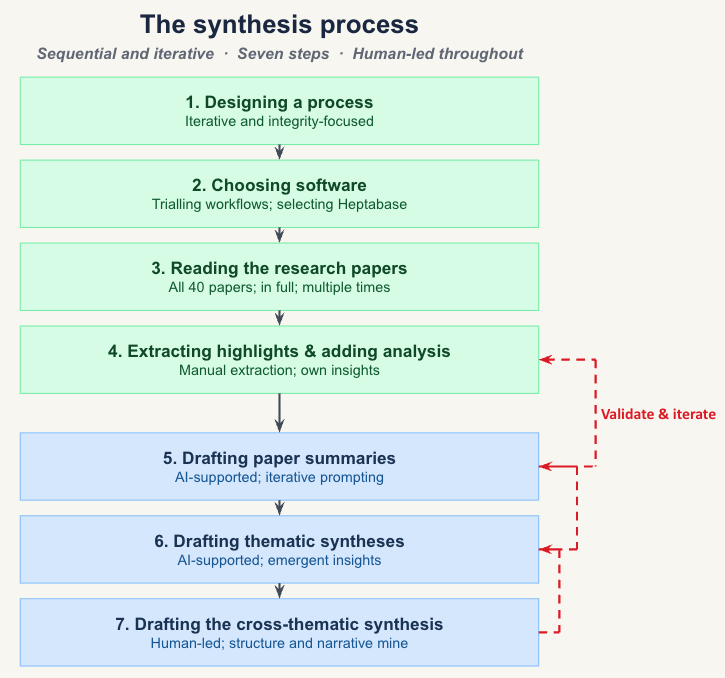
The synthesis process had the following seven steps, as Annex B of the resulting report on health systems corruption outlines:
1. Designing a process. The core design decision here was that the process needed to be sequential and iterative, with the outputs from each stage becoming the inputs for the next, and outputs from each stage assessed against what had come before. This, I hoped, would help to maintain a chain of integrity from the original 40 papers to the resulting synthesis report.
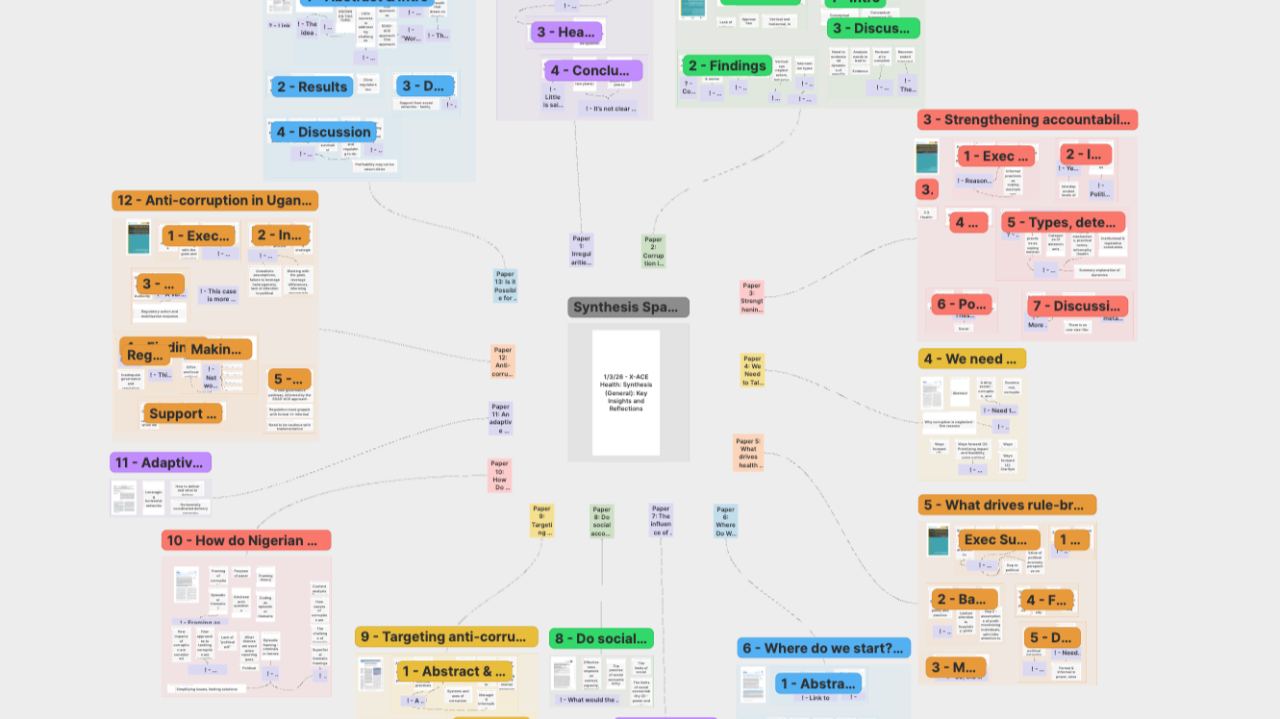
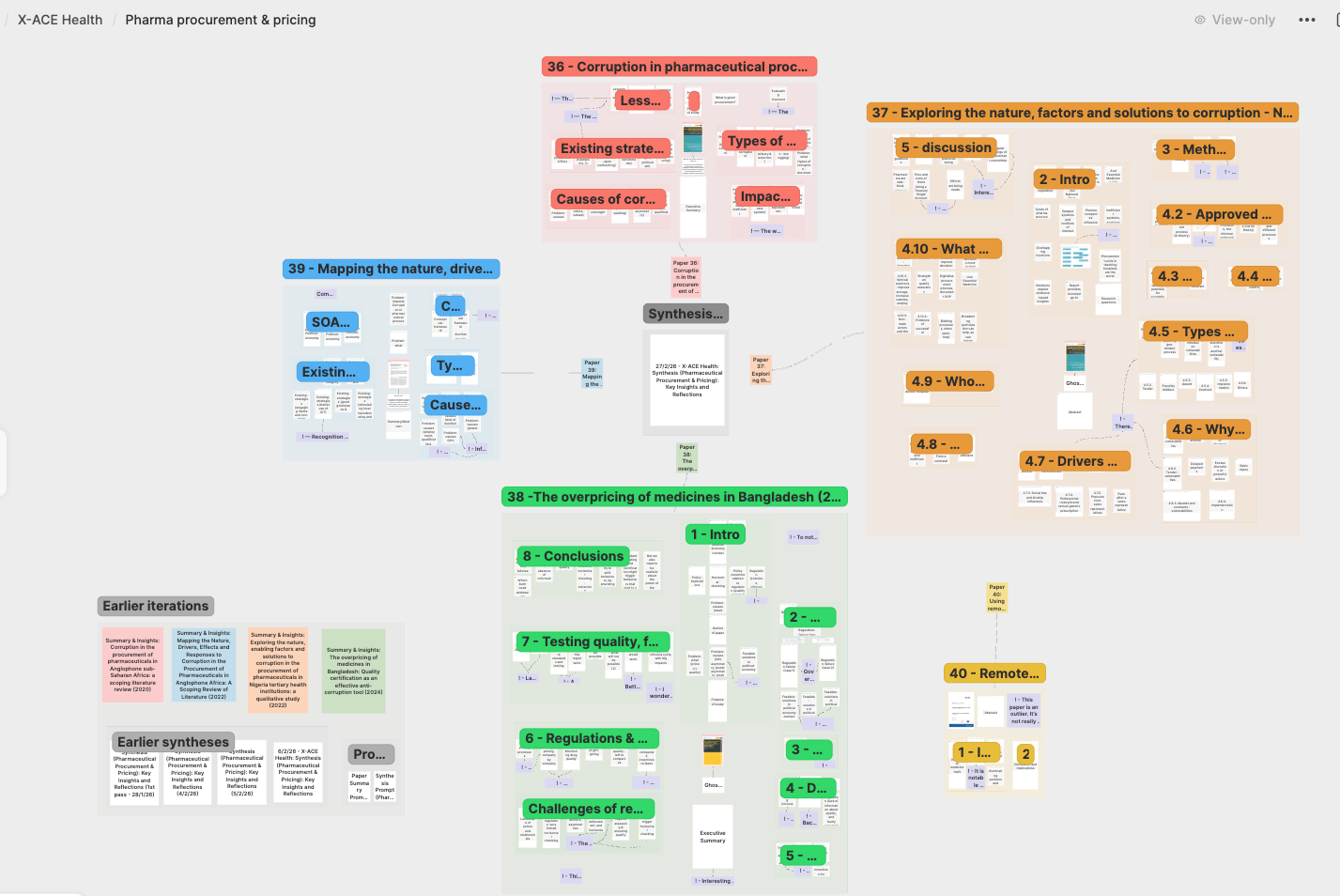
2. Choosing software. To make this decision, I trialled two workflows with a handful of the 40 research papers. Option A was to use Tana Outliner, personal knowledge management software that I have used intensively for more than three years for my “knowledge gardening” practices. Option B was to use Heptabase, software that was less familiar to me, but which offered a whiteboard — a visual and spatial interface — for organising, connecting and analysing data (See Figure 1). Both options would allow me to work with Claude, my AI assistant of choice, or other LLMs, to assist with the analysis.
Figure 1: The “synthesis space” in Heptabase, with the analysis of four papers on pharmaceutical procurement and pricing feeding into a thematic synthesis
Despite being a big fan of Tana Outliner, I decided to use Heptabase. The whiteboard provided an easy and intuitive way to cluster, compare and connect extracts from the research papers, and to add my own analysis, in ways that provided a visual connection between the extracts and my analysis on the one hand, and the papers that they came from on the other, rather than divorcing them from the wider context.
As a result, I had more aha moments about similarities and differences between extracts, emergent patterns, and causal connections in the material being explored than would otherwise have been the case. Using Heptabase also enabled me to move through the synthesis process in ways that allowed me to see the wider canvas of what I was working on, helping me to maintain a chain of integrity between the various stages of analysis and sense making.
3. Reading the research papers. This was an essential foundation for all that followed, enabling me to familiarise myself with the findings that had emerged from 40 research papers which took a variety of approaches to explore different issues across a diversity of contexts. By reading the papers, and returning to them regularly, I was able to spot analysis that went off-track, holding myself and AI to account. This helped to ensure that the emerging synthesis stayed true to the research papers and their findings, rather than being shaped by AI’s hallucinations and algorithmic embellishments.
4. Extracting highlights and adding my analysis. This phase of the process involved manually — albeit digitally — extracting highlights from each of the 40 research papers in turn, and then clustering, comparing and connecting them to identify patterns. Most importantly, it included adding to Heptabase my own commentary, questions and emerging insights about what I was seeing, what that revealed about the dynamics of corruption, and how that might inform efforts to address corruption. These comments, questions and insights, appearing in purple boxes on the Heptabase whiteboards, with “!” prefixes that made them easy to find and share with AI, would provide the key ingredients for subsequent steps of the synthesis process.
5. Drafting paper summaries. To complete this step of the process, I crafted a prompt that I could use to instruct Claude to review the highlights, commentary, questions and insights from a particular paper and draft an initial summary on that basis. Developing an effective prompt took multiple iterations, formulating an initial prompt, trying it out, assessing the results, revising the prompt and trying again.
I quickly realised that having a structure of standard sub-headings for the paper summaries would help both for the process of drafting the paper summaries, and for making sense of patterns across multiple paper summaries. Working iteratively with Claude, I landed upon the following structure for the paper summaries: Focus and Context; Purpose and Approach; Key Findings; Implications and Recommendations; and, Emergent Insights. While the content for the first four sections would be largely derived from the paper itself and the highlights I had extracted from it, the Emergent Insights section was based on the comments, questions and insights that I had added to Heptabase.
As such, while AI was supporting the synthesis, my commentary, questions and insights drove the analysis. So, for instance, an idea that occurred to me while reviewing one of the papers on pharmaceutical procurement and pricing, but which I felt might have wider relevance and which I instructed AI to pay attention to, was: “Governance and regulatory failures ENABLE corruption. They are vulnerabilities. They are not in themselves corruption, or the drivers of corrupt behaviours.”
Figure 1, above, shows the Heptabase whiteboard for pharmaceutical procurement and pricing, with the four paper summaries clustered around the central “synthesis space”, ready to shape the thematic synthesis.
6. Drafting thematic syntheses. The next stage in the process was to draft four thematic syntheses, of around 2000 words each, on each of the thematic areas: the cross-cutting category “Beyond ‘Good Governance’ ”, Absenteeism, Informal Payments, and Pharmaceutical Procurement and Pricing. This involved an iterative process of designing, testing and modifying prompts — one for each thematic area — that would tell Claude how to work with the paper summaries for that thematic area to draft a thematic synthesis.
The prompt instructed Claude to pay particular attention to the Emergent Insights section of the paper summaries. This ensured that the observations that I had made about each paper — and the clusters, connections and patterns I was seeing across the various papers — were used to craft a thematic synthesis that was more than the sum of its parts, but that also stayed true to the paper summaries. In contrast to the paper summaries, I chose not to impose a standard structure on the thematic syntheses, instead allowing the sub-headings to emerge from the analysis for that particular theme. In figure 1, above, the thematic synthesis for pharmaceutical procurement and pricing can be found in the central “synthesis space”.
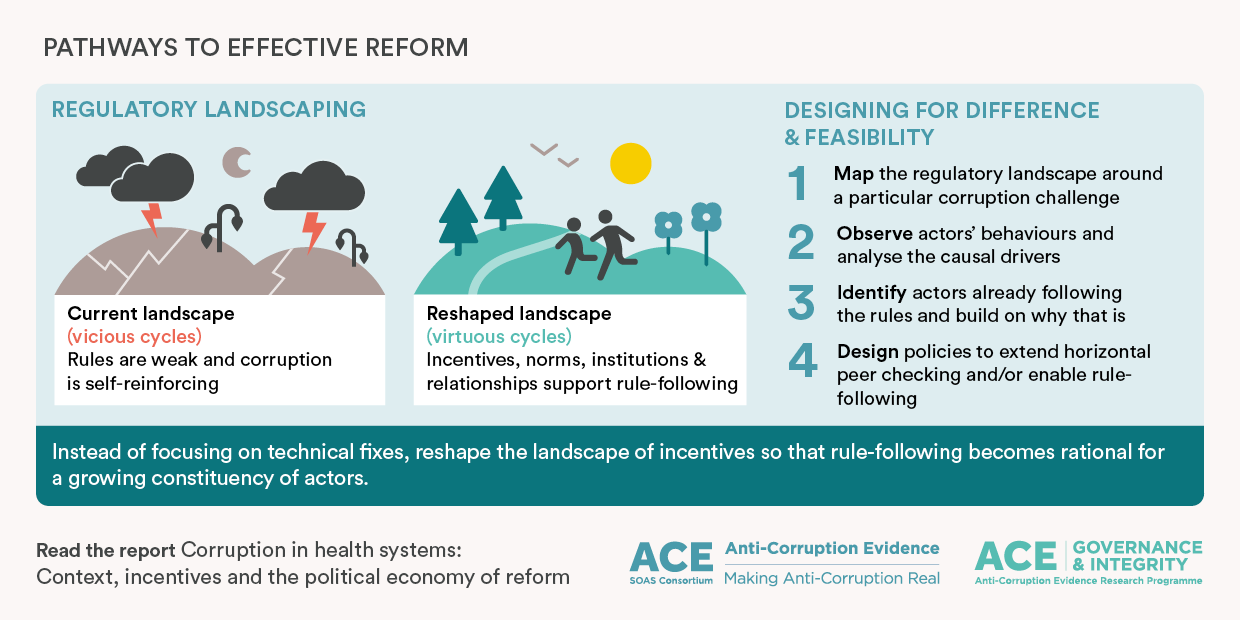
7. Drafting the cross-thematic synthesis. In this final stage of the process, the onus was on me. To develop a cross-thematic synthesis, I spent a considerable amount of time reviewing the four thematic syntheses, looking for points of connection, similarity and difference, identifying patterns and considering implications. While I was very much in the lead, it was good to be able to call on Claude to assess whether the narrative I was crafting — a narrative around “regulatory landscaping” as a way of understanding and supporting social change that is recursive and relational in nature — was one that truly emerged from the synthesis process and which made the whole more than the sum of its constituent parts. I could have done this analysis in Heptabase, but by this stage of the process, with just one output to focus on, I worked primarily in Google Docs, with the assistance of Claude.
The Heptabase whiteboards for each of the thematic categories can be found and explored here: Beyond “Good Governance”; Absenteeism; Informal payments; and Pharmaceutical procurement and pricing. Various versions of the prompts and of the paper summaries, and of the thematic syntheses and associated prompts, can be found towards the left hand side of the whiteboards. Links to all the paper summaries are listed in Annex A.
How it worked out
Overall, the synthesis process worked out very well. It was an intense process, taking up the bulk of my time from January through to the end of March, but I was pleased with the resulting report. The process I’d followed — with me in the lead, collaborating carefully with Claude — enabled me to synthesise the findings from the 40 research papers, maintaining a chain of integrity while also crafting a report that, with its focus on “regulatory landscaping”, made an action-oriented contribution to thinking about how to address corruption.
At times during the process, I imagined authors contacting me to say that I’d misunderstood their work, or drawn implications from it that they were uncomfortable with. Having a clear process to follow allayed these concerns and left me feeling confident that the authors of the papers would feel that their work had been represented accurately and used appropriately. Confirming that confidence, I was glad to receive appreciative and encouraging messages from a number of the authors of particular papers, and other colleagues from the SOAS-ACE team and its research partners in the weeks following publication.
Maintaining the chain of integrity — a trust trail, rather than an audit trail — entailed being vigilant to ensure that each stage of the process was building on what came before, with the 40 research papers providing the bedrock of the analysis and synthesis process. This meant carefully and repeatedly checking that:
-
the paper summaries being generated accurately reflected the papers (were the points about the power of pharmaceutical companies and the dynamics of competition, really the key findings from the Bangladesh paper on mandatory quality certification?);
-
the thematic syntheses made appropriate use of the paper summaries (do the suggested complementarities between political economy and social norms approaches to addressing informal payments really reflect the findings from across the various papers on informal payments?)
-
the synthesis report as a whole was true to the four thematic syntheses, the paper summaries and the papers themselves (does the notion of “regulatory landscaping” really express a common theme that emerged from across the papers?).
Figure 2: Regulatory landscaping - Finding and creating pathways to effective reform
The primary challenge was that of making sense of the findings from a rich diversity of papers, and crafting a synthesis that stayed true to those findings. Other challenges included: accepting that working iteratively with prompts that were being refined through the process entails re-doing paper summaries and thematic syntheses; deciding when to call it a day in terms of a potentially never-ending cycle of iteration and refinement; and, more administratively, keeping track of where I was in terms of the multiple iterations around various processes.
There were also minor irritants with Heptabase unable to provide reliable word counts, which meant that at times I was flying blind, or at least with badly restricted vision, in terms of generating summaries and syntheses of the desired length. And, most substantively, it was important to guard against the temptation to over-delegate to Claude, managing the process effectively so that the resulting report maintained the chain of integrity, with the analysis and synthesis led by someone with a rich, deep and human understanding of the data and the issues.
Ultimately, maintaining integrity throughout the process required that the process was human-led, rather than merely one in which a human was in the loop.
The human and the loop
The emphasis on having a “human in the loop” that is common to discussions of working with AI undersells the role that I played in the synthesis process, and downplays the importance of the human role in conducting this sort of synthesis. Yes, there was a loop — many loops in fact — and Claude helped me to move through the loops of analysis, and cover more ground more effectively than would otherwise have been possible. But I wasn’t just in the loop. I designed the loops, crafted them, tested them and refined them, and that is what gave the process its integrity and ensured that the assistance that AI provided contributed effectively to a successful synthesis. The temptation to rely on AI is real, particularly when faced with challenges that feel too big for the time and resources available. To guard against that temptation, I’d offer two suggestions for others who may be considering working with AI on this sort of synthesis.
-
First, spend time thinking through how you would do a synthesis manually; what data are you working with, what sort of synthesis are you aiming for, and what steps might be needed to help you move confidently, with integrity, in that direction.
-
Second, break the process down for AI. Instructing AI to move from beginning to end in one prompt sets up a black box process that makes careful testing, assessment and iteration — identifying that it might be useful to ask AI to pay particular attention to the notion of “survival absenteeism” in crafting a thematic synthesis, for instance — all-but impossible.
The iterative, adaptive and richly human nature of the process is key. Producing a synthesis from a complex landscape of research papers involves iteratively identifying patterns and crafting pathways towards greater understanding. This has pleasing echoes of the adaptive approach to navigating the dynamics of complex social systems that the notion of “regulatory landscaping” captures.
The adaptive, iterative and human-led process I designed and followed could be tailored and applied to other bodies of work — not limited to corruption, governance and public policy — where you have multiple sources on related themes across different contexts. If that’s something you’re interested in doing and would like to discuss, please drop me a line. I would be happy to support the process, sharing further details, including as regards my use of Heptabase and Claude, and the sorts of prompts I developed. My experience suggests that used carefully, in ways that are human-led, by researchers who are familiar with the issues, AI can extend what a researcher can do, without losing the context and connections which make research meaningful.
First published on LinkedIn, 27 May 2026.
Theme: Power, corruption and political economy
Topics: health systems, corruption, knowledge gardening