Summary: When The Policy Practice asked whether I could share resources on governance, thinking and working politically, and political economy analysis, I took the chance to show what my Tana-based knowledge garden could do. I explain how I selected and shared the resources, and offer help to others exploring complex social challenges.
- I filtered my tagged items by keyword and usefulness, then reviewed them before sharing a table with summaries and highlights.
- Tana’s new interactive pages let readers open up my summarised highlights, though access is read-only for now.
- My knowledge garden holds 2500+ highlighted, connected items, and I can use it to find resources and make connections.
About 5 minutes to read the full piece.

Sharing resources on governance, Thinking & Working Politically, and political economy analysis
Last week I caught up with Laure-Hélène Piron, a Director at The Policy Practice, who I worked with at the Overseas Development Institute (now ODI-Global) twenty years ago.
Laure-Hélène had reached out to ask whether I would be happy for her to re-post my piece on Local Systems to the website of The Policy Practice, where she has been doing a valiant job of rescuing, collating and sharing various USAID documents, as part of a wider collection focused on governance, thinking and working politically (TWP), and political economy analysis (PEA). A wider collection of resources on reimagining democracy support, pulled together by former staff of USAID’s Democracy, Rights and Governance group, can be found at the DRG Hub.
I said that I’d be happy to see my piece shared more widely, and offered to also share some relevant resources from my knowledge garden, if that might be useful. So, once we’d chatted, I set about using Tana - the amazing software I use for for knowledge management and gardening (gardening, cos it’s more organic, relational and emergent) - to identify a number of items that I’ve read, watched or listened to over recent years which might complement the resources currently shared on The Policy Practice website. The video linked below shows me getting excited about Tana’s potential a couple of years ago, when the functionality was more limited.
Watch on YouTube: Using Tana for knowledge gardening in complexity
As regular readers will know, my focus and framing has moved away from the mainstream of governance, TWP and PEA over recent years, with my explorations now focused on the rich terrain of complexity, systems, relationships, power, incentives, learning and emergence. Check out my articles on LinkedIn, including my six-monthly review from June, for a flavour.
So the current iteration of my knowledge garden - an abundant and always evolving garden of delights as opposed to the rather dormant but very well-stocked Evernote collection which I built for many years (I can still give you access if you want!) - does not include very many pieces on more mainstream approaches to understanding and enhancing governance. Nevertheless I figured there would be some pieces that might be useful additions to The Policy Practice repository.
This is what I shared with Laure-Hélène on governance, thinking and working politically, and political economy analysis, alongside some entry points into the many hundreds of pieces that I’ve come across through my more recent explorations of complexity.
Selecting resources from my knowledge garden
Generating the output that I shared with Laure-Hélène involved the following steps:
- Searching my knowledge garden to identify all of the pieces that I’ve read, watched or listened to in recent years that I have tagged as relating to a number of keywords. The keywords I used were: adaptive, context, governance, incentives, local systems, political economy, political settlements, power, and TWP.
- Filtering those pieces to leave only those that I had tagged as being “useful”, “very useful” or “extremely useful”, for my purposes.
- Reviewing the remaining list, including their Readwise Summaries and Summarized Highlights, to check their relevance and suitability for The Policy Practice website.
- Displaying those selected references in a table which shows, for each item, a summary (generated in Readwise), my summarized highlights (crafted with the help of AI from the highlights and notes I’d made in Readwise), and a URL for the item in question.
Taking advantage of Tana’s new ability to publish interactive pages which came on-line just yesterday, I was able to share things so that the user who wants to dive more deeply into items that they are particularly interested in can open up the bullets in column 3 of the table I shared with Laure-Hélène to see the full outline of my summarized highlights. This means that users can in effect use Tana to explore items in my knowledge garden.
And that’s it!
For now, until my ambitions dreams for collaborative knowledge gardening become reality, this access is read-only, so I can’t yet invite folks to explore the clusters and connections that I’ve made in my knowledge garden, follow along with my learning journey, harvest resources for themselves, or contribute to nurturing a rich, vibrant, multi-perspectival, interactive and emergent knowledge garden. But fingers-crossed that functionality for collaborative knowledge gardening is not too far away 🌱
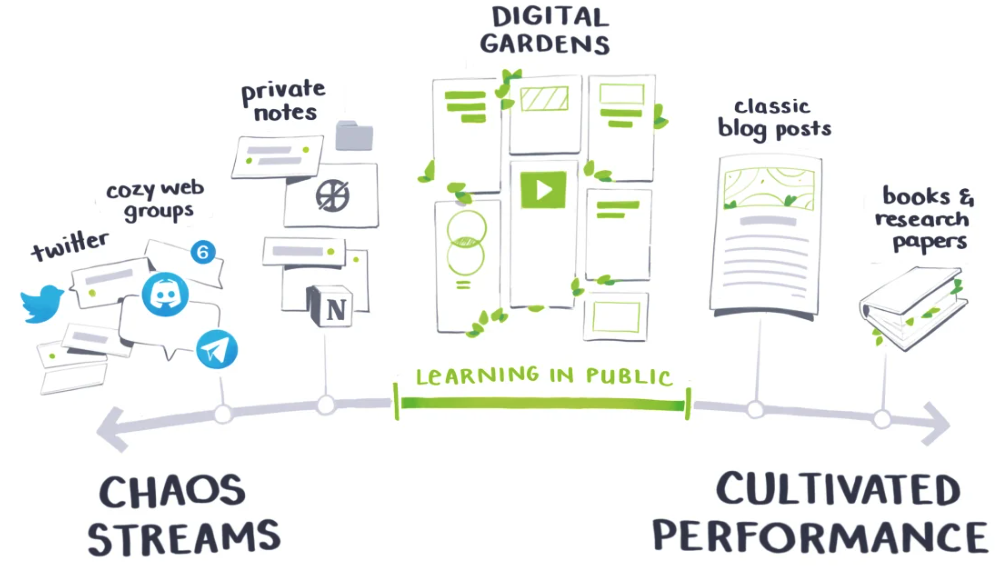
Credit: Maggie Appleton (Planted 2020, Tended 2021): A brief history and ethos of the digital garden
Knowledge gardening assistance and thanks
I’m sharing this post, not because I think that the resources I shared with Laure-Hélène are an amazing collection of resources on governance, TWP and PEA. They are not; my Evernote collection contains the vast majority of my resources on those issues. However, my suggestions do include some very good pieces, including a number of podcasts from the excellent Abt Global series on Systems Practice in International Development, and extensive notes from the body of work on political settlements that informed the SOAS-ACE approach to informing the design of more effective policies in adverse governance contexts.
Rather, I am using this episode to demonstrate what I can now do with my knowledge garden, and to show how I might be able to help, particularly if you’re exploring the landscape of complex social challenges and approaches to understanding and engaging with such challenges.
Beyond my suggestions for Laure-Hélène and The Policy Practice, I can now make VERY good use of my knowledge garden of 2500+ highlighted, tagged and interconnected articles, podcasts and videos, finding resources, making connections, exploring questions, and sharing analysis.
If you’re interested in learning more about my knowledge gardening in Tana - and my wider use of Tana to manage information about projects, tasks, meetings, contacts and so much more, as well as ideas, evidence, and analysis, in an inter-connected, integrated and fully customizable manner - please drop me a line. Or, if you’re looking for resources, analysis or literature reviews around approaches to understanding and addressing complex social challenges, I’ll be happy to help! The full list of topics that I’ve coded the items in my knowledge garden with, can be found here.
As you might expect, there’s a huge amount of work that’s gone on behind the scenes - by me, and the amazingly collaborative Tana community, over the last 3 years to make this possible. Thanks especially to Theo Køppen Jørgensen-Dahl, Kamara Simpson, and Ev Chapman for their inspiration, encouragement and support.
First published on LinkedIn, 27 August 2025.
Theme: Power, corruption and political economy
Topics: knowledge gardening, governance