Summary: After six months without monthly updates, I share what I have been reading, watching and discussing. I group the resources into living systems, relational systems and learning systems, and add political economy analysis, impact measurement and Ubuntu. I also say where I want to go next. It may help people exploring complexity-aware, relational approaches to social change.
- I cluster my recent finds around living, relational and learning systems, drawing on many thinkers’ work.
- I want to explore how relationship-focused and power-and-incentives perspectives on systems change complement each other.
- I now have some availability, and welcome conversations with people working on similar terrain.
About 11 minutes to read the full piece.

As some readers may have spotted, over the last six months I have not been sharing monthly updates on my explorations around complexity, systems, relationships, power, learning and emergence. I decided that this year I would try to go deeper on fewer things. It’s also because I’ve been busier than normal, completing a couple of pieces of work - on reflective relational practice and navigating the political economy of corruption - sharing that work, and finding time for trips to Oxford (the margins of the Skoll World Forum), Manchester (Towards Relational Public Services conference), and Exeter (a bit left-field!).
However, I have found time to share various resources and engage in a number of discussions. This has included presentations on reflective relational practice to the Local Systems Community (post with video) and, with some tweaks, at the conference on Towards Relational Public Services (slides), and the launch of the SOAS-ACE guide on navigating the political economy of corruption (my slides).
It has also included sharing my reflections on an Abt Global podcast with Pallavi Roy about political economy analysis (here), some preliminary joining of dots amongst reflective relational practice, political economy analysis, and the work of Dan Honig and colleagues on relational state capacity (here), and, in response to a discussion between Rachel Glennerster and Stefan Dercon, making the case for embracing complexity through a focus on local learning systems (here). More information about the resources and reflections that I’ve shared over the last six months can be found in this engagement overview table.
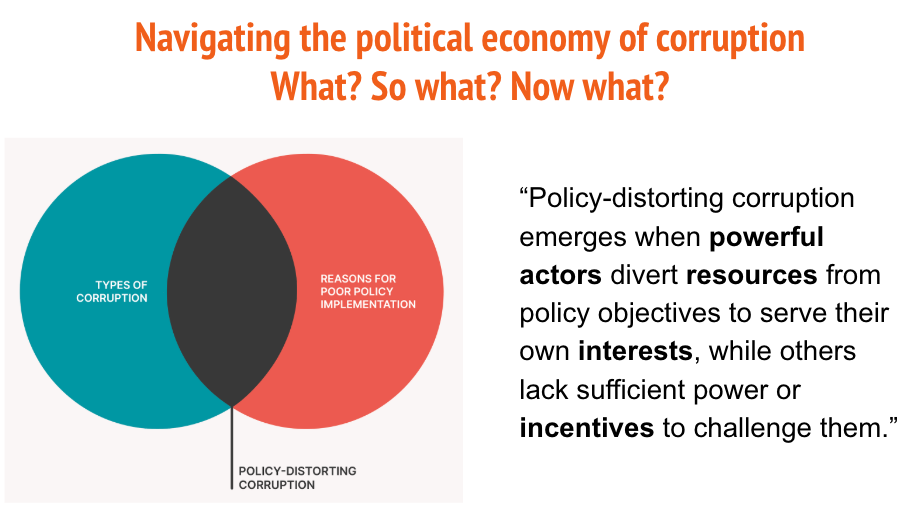
A slide from the launch of the SOAS-ACE guide to navigating the political economy of corruption
I’ve also continued and deepened my explorations. This table of selected sources shares some of the highlights from the articles I’ve read, the podcasts I’ve listened to, and the videos I’ve watched over the last six months. This time around the table includes links to summaries that I’ve had AI generate for me on the basis of the highlights I’ve taken from the articles, podcasts and videos and which live, connect, and evolve, in my knowledge garden.
I’m pleased with the way that AI has been able to weave together my highlights and hope that these extended summaries might spark your curiosity and encourage you to explore some of the resources I’ve shared. The resources I’ve shared in the table are ones that I found particularly useful and interesting. You won’t go wrong by looking through the table! But I thought it might be useful to highlight a few clusters of resources, which relate to the living, loving and learning systems which I hope to nurture through my work.
Living systems
On living systems - the idea that social systems are dynamic and evolving patterns that emerge from, and in turn shape the context for, the actions and interactions of actors - I found Jen Briselli’s letter to a young systems thinker which emphasizes that “the point isn’t to model, map, or master the system, but to be in conversation with it” particularly interesting. I also appreciated her super-clear account of using Cynefin’s estuarine mapping process to find the next right moves by looking more carefully at the terrain of the present - its constraints, opportunities and tensions - to reveal a field of potential engagement, particularly insightful. I’m excited to connect with Jen (a fellow Escher enthusiast!) in the coming weeks.
I also appreciated Graciela Selaimen’s recent piece on the risk that a focus on metrics, scale and measurable results can obscure the transformations that happen in the underground networks of living processes, and the value of “experimenting with tools that can listen to transformation in relationships”. Given my recent work on reflective relational practice, I was particularly interested in the question that Graciela posed: “What if we created indicators of relational quality, deep listening, and subjective transformation? What if we valued what is unfinished, what escapes, what can only be felt together?”
I was also glad to belatedly come across David Jacobstein’s 2019 piece on market systems, helpfully rescued from the USAID website by the Policy Practice. Reflecting on the value of a market systems perspective for governance-focused work, this piece by David - a leading champion of local systems for many years - emphasizes that from such a perspective success is not about achieving a static end point by devising an institutional fix. Instead, it’s about nurturing an interconnected, dynamic and evolving system - a living, learning and relational system - that is shaped by the actions and interactions of its members as they respond to the incentives that they face. I was glad to connect with Kristin O’Planick on related issues recently, and am looking forward to upcoming conversations with Luis Osorio-Cortes and with Donna Loveridge.
Relational systems
On loving, or, less aspirationally, relational systems - the idea that relationships and the qualities of relating are the things that give life to social systems, and are where learning and change happens - I’ve found the work of Dark Matter Labs (which Indy Johar leads) particularly inspiring. As a (human) geographer who grew up exploring the role that space, place, context and borders play in shaping social life (and vice-versa), I was particularly interested in a recent article on place, localism, relationality, proximity and systems change, which makes the case that terms like “place” or “localism” are proxies for the deeper relational dynamics that enable systems to function. (See Indy Johar’s substack to learn more about his recent explorations).
This, as some readers will be aware, is the way in which “local” has been used in USAID’s pioneering Local Systems Practice, as my review, and an excellent Abt Global podcast with David Jacobstein, Rachel Leeds and Monalisa Salib make clear. Given my enthusiasm for gardening metaphors for nurturing living, loving and learning systems, I was particularly struck by the suggestion in the piece by Dark Matter Labs that with such a relational and learning-centred understanding of how systems change, the role of changemakers shifts from “architect” to “gardener”; cultivating the soil of capabilities, pruning the choke points of rigid norms and asymmetrical power, and stewarding, but not seeking to control, the system’s vitality and evolution. (Closer to home, and with an actual gardening focus, I am considering getting involved in the work of Living Vital, a few miles from Brighton in Stanmer Park).
Gautam John’s wonderful piece on connection, not abstraction was another highlight of my recent explorations, emphasizing that effective philanthropy for social change is about “weaving connections, fostering belonging, and enabling environments where communities can thrive on their own terms”. As Gautam suggests, “a deep commitment to the messiness of human connection, the unpredictability of relationships, and the humility of shared learning” - rather than a focus on abstracting insights from context in ways that freeze the vital relational dynamics of living systems - is crucial for supporting the emergence of resilient communities, societies and systems. I enjoyed connecting with Gautam earlier this year, and was glad to be able to introduce him to a fellow relational practitioner, Karima Kadaoui at the Tamkeen Community Foundation for Human Development (listen here for a wonderful conversation between Karima and Tim Logan).
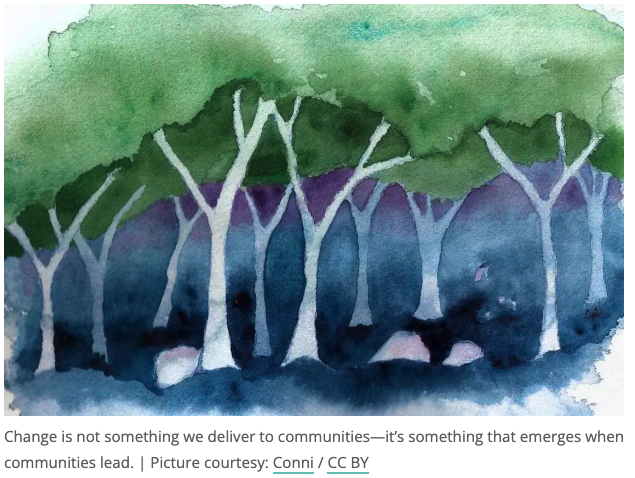
Taken from Gautam John’s piece on “connection, not abstraction”
In a similar relational vein, the work of Dan Honig and colleagues on relational state capacity does a fantastic job of foregrounding the character and quality of human relationships between citizens and state agents as an important source of capacity for addressing social challenges. Of particular interest to me given my work on navigating the political economy of corruption by identifying, understanding and leveraging instances of positive deviance, and on reflective relational practice, was the idea that pockets of effectiveness in public administration often emerge and flourish where patterns of positively deviant relationships (unexpectedly healthy outliers) can be found.
That is, the qualities of relationships - which, I’d add, emerge from how actors behave in a landscape of power and incentives - shape the dynamics, capacities and resilience of the system. As Dan, Mekhala Krishnamurthy, and Rahul Karnamadakala Sharma put it, “Making relational state capacity legible as a complement to existing notions of state capacity is not a prescription for all society’s ills, but it is a foundational element of what it is to be a state that we have collectively undervalued. It is essential that we acknowledge and engage the relational in order to strengthen societal capacities to respond to the existential challenges of our times.”
Learning systems
On learning systems - the idea that relational cycles of action and learning play a key role in systems change, and even that “learning is change” - Anna Birney and the School of System Change continue to be a source of much inspiration. Anna’s 2021 piece on entry points for systems change has, along with Ivana Gazibara’s piece on transition mapping, provided much food for thought about identifying entry points for engagement in living and learning systems, where emergence is the order of the day. With my relational hat/head/heart on, I was particularly struck by Anna’s emphasis on the value of focusing on the nature of the relationships, flows and exchanges - the ways of inter-relating - that bring systems to life.
A recent piece by Anna on investing in the system of root change builds on her 2021 piece, emphasizing the value of focusing on relationality and processes of relating, constellating, learning, and patterning, in, I might add, a landscape of power and incentives. Of related interest is Indy Johar’s recent piece on infrastructures for multi-agent learning and intelligence, which reminded me of my Robert Chambers-inspired piece on whose learning and adaptation counts, from 2017 (with thanks to the Wayback Machine!).
I also appreciated a recent piece by Anna, Rachel Phillips, and Rachel Maria Taylor, which describes action inquiry as a process through which “we continually act, reflect, iterate and learn as a way of engaging with complex issues”, and in which action-learning loops are “alive, relational (interrelated), reflexive, practical, developmental, emergent, and happening at multiple levels”. Reflecting Anna’s earlier exploration of systems of power, and with my recent work on navigating the political economy of corruption very much in my mind, I was also struck by the idea that, “If we define ‘systems change’ as the emergence of a new pattern of organising, and ‘power’ as a relational dynamic not a given state, then changing systems is all about shifting power dynamics.”
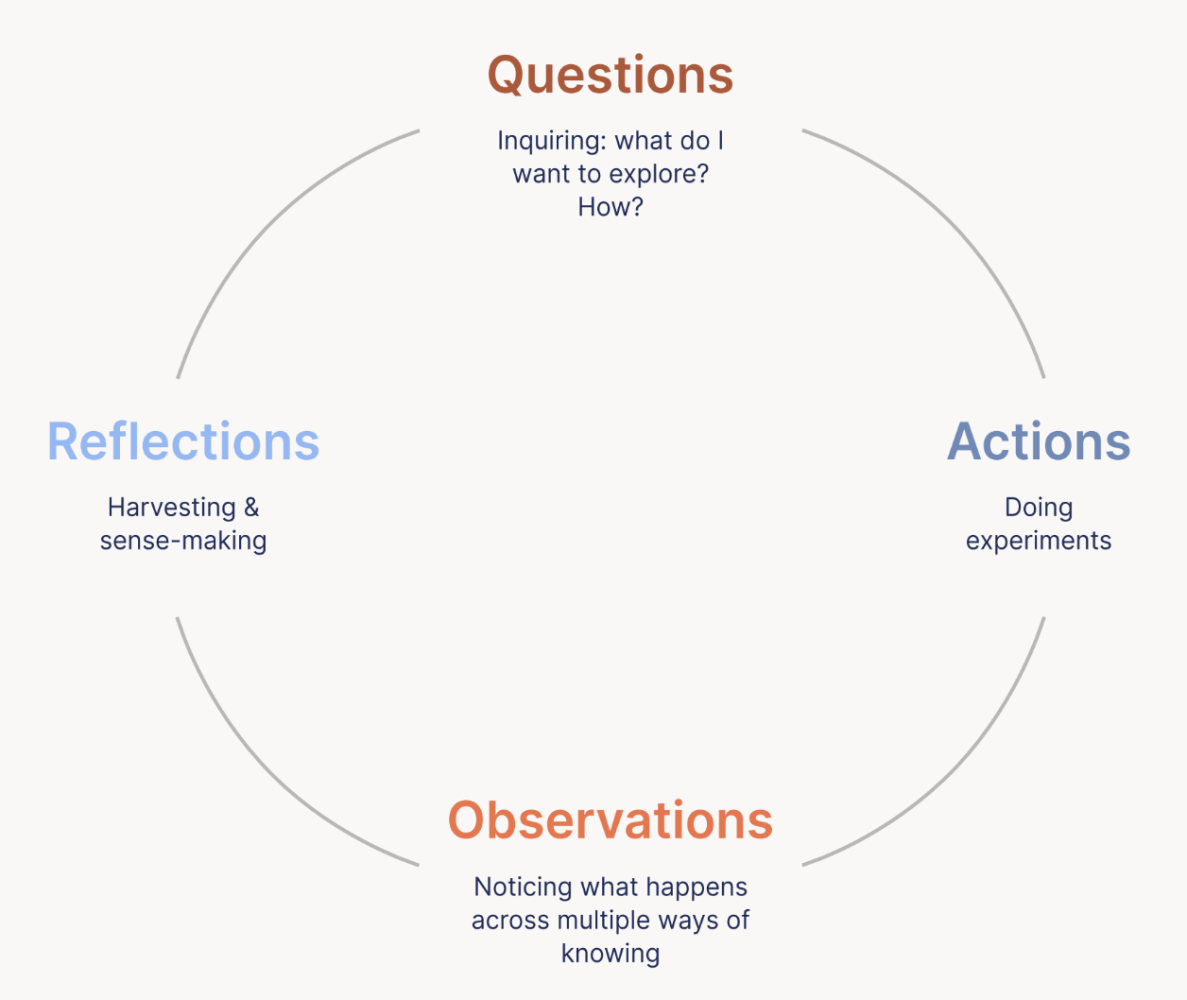
The School of System Change’s (clockwise) cycle of action/learning inquiry
Informing engagement, assessing impact, and living Ubuntu
Beyond these clusters on living, loving and learning systems, I also found resources from Abt Global and Pallavi Roy on the real-world application of political economy analysis (see also my reflections on Pallavi’s analysis), Dieter Zinnbauer on the limitations of traditional political economy analysis and how it might become more of a “political opportunity analysis”, and the groundbreaking series of pieces by Orit Gal on a social acupuncture approach to re-patterning social systems particularly useful. I am looking forward to continued collaboration with Pallavi, Mushtaq Khan and Duncan Edwards at SOAS-ACE, and to exploring the political economy of positive deviance with Dieter Zinnbauer (blogpost forthcoming!), as well as diving more deeply into Orit Gal’s refreshing take on the dynamics of systems change, and the ways in which one might identify sites and strategies for effective engagement.
Last, but not least, I’ve really appreciated Jess Daggers’ series of pieces on impact measurement in systemic investing. Developed to inform the work of the TransCap Initiative on systemic investment, Jess’s series of five articles provide a fresh perspective on the challenge of assessing impact in complex social systems. As Jess puts it, for work that involves engaging with complexity the role of impact measurement might usefully be reconceptualized as one of generating flows of information about the changes taking place in a system, in order to inform effective engagement. This, as Jess makes clear, would be a more appropriate and useful approach to assessment than one that seeks to answer questions about “what is the impact of my investment?” that, stuck in linear and reductionist worldviews, fail to grasp the dynamics of complexity and emergence.
Moving from strategies and assessments to ways of being, I loved watching The Spirit of Ubuntu. In this film, Pato Banton and Antoinette Rootsdawtah visit various initiatives across a number of African countries which put the spirit of Ubuntu - an African way of being that centres on the thoroughly relational appreciation that “I am, because we are” - into practice. The film is full of inspiring people sharing rich stories about nurturing relationships and communities that are full of life, love, and learning. The film is well worth a watch, but if you’re pressed for time, the video linked below does a great job of communicating the beauty of Ubuntu; “when you realize your family, is all of humanity, that’s Ubuntu!”
Watch on YouTube: The Spirit Of Ubuntu, Pato Banton (Ubuntu International)
Next moves: Exploring, connecting, collaborating
Extended summaries of all the pieces mentioned above - and more - can be found in this table of selected sources. Or, if you’re keen to explore more of the resources available in my knowledge garden - interconnected highlights, notes and summaries on 1500 articles, podcasts and videos on topics including complexity, systems, relationships, power, corruption, conflict, incentives, learning and emergence - feel free to drop me a line.
Informed by my recent explorations, one of the things I plan to do in the coming months is to dive more deeply into the complementarities between two perspectives on systems change: first, a perspective that highlights relationships, communication and learning; and second, a perspective that focuses on power, incentives and actors’ behaviours. Working on reflective relational practice and on navigating the political economy of corruption at the same time has helped me to realize that developing an approach that combines these perspectives could be a fruitful way forward for efforts to understand, support and participate in complex processes of social change. This video shows an early articulation of some of this thinking.
Having had a busy first six months of the year, I now have some availability. So if you’re exploring similar terrain - developing, applying and evaluating complexity-aware approaches to social change, or supporting organizations to operate in learning-centred and relational ways - and you could use some help, I’d be happy to chat. I have a good sense of the landscape of ideas and their application, and the potential complementarities, along with a wealth of resources and experience that I’m happy to share. And, I’m keen to engage with people who are exploring similar issues in different ways that might challenge and inform my perspective and approach.
If you’d like to receive my occasional (perhaps every two months) updates by email, please sign up here. Oh, and do check out the new Relational Podcast - first episode out tomorrow - for richly emergent conversations amongst members of the Wasan Network.
First published on LinkedIn, 30 June 2025.
Themes: Nurturing relationships and building community, Learning systems and adaptive practice, Power, corruption and political economy
Topics: relationships, learning systems