
Update, 11th December 2025: We have made lots of progress on this initiative! Please have a look at our update here.
1) Introduction
Drafted by Luis E. (Lucho) Osorio-Cortes and I, this note sets out our initial thinking about the complementarities between two approaches to supporting economic development and social change. First, the Market Systems Development (MSD) approach to making markets work better for the poor, including through policies that aim to support more competitive, inclusive and resilient market systems. And second, the SOAS-ACE approach to informing the design of policies that can be implemented effectively because they are based on a sound understanding of the political economy dynamics, and associated corruption risks, in particular contexts.
In what follows, we introduce MSD and the SOAS-ACE approach, before then considering their potential complementarities. In conclusion, we share some thoughts about next steps, including wider discussions, case studies, and developing practical guidance for MSD practitioners and funders. We believe that this would help MSD practitioners and market players to craft effective policies to strengthen market systems, by ensuring that those policies are aligned with the interests and capabilities of players in those systems, and can therefore be implemented effectively in ways that shape their behaviours and the dynamics of the system.
2) The Market Systems Development approach to poverty reduction
The ambition of Market Systems Development is to create lasting economic opportunities for resource-poor and vulnerable communities and to thereby contribute to reducing poverty. Instead of directly providing subsidized goods or services, or promoting reforms driven by donors and other external players, MSD nurtures the evolution of market systems. MSD does this by facilitating connections, strengthening relationships, and building partnerships amongst a diversity of local actors and - with an eye on sustainability, scale and systemic change - creating enabling conditions for market players to drive the changes that matter to them.
As the diagram below makes clear, at the core of a market system is a set of exchanges between market players who provide goods and services (supply, in the diagram), and market players who make use of those goods and services to support their effective participation in those market systems (demand, in the diagram). So, for example, the set of exchanges between farmers who demand and consume goods and services, and the providers of agricultural inputs, processing facilities, and marketing services.
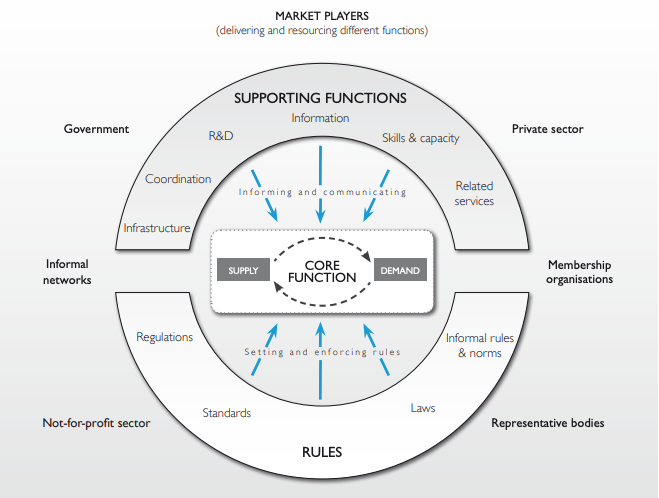
A stylized view of the market system, from “A synthesis of the Making Markets Work for the Poor (M4P) approach”
This core function is part of a richer and more complex market system. The system includes, on the one hand, a number of “supporting functions” such as research, information, skills and infrastructure that enable market players to operate effectively, and on the other, “rules”, including standards, regulations, laws, and policies - as well as social norms - that shape the participation and incentivize the behaviour of market players.
In a well-functioning market system, the various rules and policies - and the incentives they establish - encourage market players to behave in ways that help to make the market system more inclusive, for instance by providing supporting functions that meet the needs of other market players. When rules and policies are tailored to the contextual political economy dynamics of the market system - and can therefore be implemented effectively rather than knocked off-course by actors whose interests have not been taken into account, and the resulting corruption - they play an important role in the functioning of market systems, helping to scale and amplify existing pockets of effectiveness.
For excellent introductions to MSD please see: BEAM Exchange (2017) An introduction to Market Systems Development (video); BEAM Exchange (2018) What is different about the Market Systems approach? (video); and, Ryan Borque (2024) Market Systems Development overview (MSD 101 Brief)

Tomato grafting - An example of how policies can be undermined by self-interested behaviours
3) The SOAS-ACE approach to informing effective policy
The SOAS-ACE (SOAS Anti-Corruption Evidence research consortium) approach supports efforts to understand and navigate the political economy of corruption, specifically policy-distorting corruption, in order to inform the design of public policies that can be effectively implemented rather than being derailed by powerful actors corruptly diverting policy resources to serve their own interests. Developed for application in challenging governance contexts where the rule of law is lacking, and with a distinctive view of how change happens in complex social systems through the co-evolution of actors’ behaviours and relationships, and the rules and institutions that govern their behaviours, the approach eschews what it regards as unrealistic calls for more effective top-down enforcement of policies and unhelpful exhortations to “Good Governance”.
Instead, the SOAS-ACE approach aims to inform the design of policies that can be implemented effectively because - tailored to the political economy dynamics of particular contexts, and specifically the power, capabilities and interests of market players - they command the support of enough actors with sufficient power and influence in the markets and systems they are part of, to lead the way and encourage compliance, to meet their own interests.
The approach involves three phases:
- Observing patterns of behaviour around a flow of policy resources to identify instances and sites of positively deviant behaviour and associated pockets of effectiveness in systems of corruption, where some actors are not diverting resources for private gain, with some of those actors investing their time in horizontal peer checking that encourages other actors to follow their lead;
- Analyzing and understanding how those patterns of positively deviant behaviour and effective horizontal checking are shaped by the characteristics of the actors (their relative power, capabilities and interests in SOAS-ACE terms), and their inter-relationships, operating in a contextual landscape of power, incentives and institutions; and
- Leveraging that understanding to inform the design of policies that might incentivize enough changes in behaviour, by sufficiently powerful actors, to enable those policies to be implemented effectively, amplifying and extending the positively deviant behaviour beyond the sites where it was identified, or enabling it in circumstances where it could not be found.
For more on the SOAS-ACE approach, please see: Alan Hudson, Kathy Bain, Mushtaq Khan, Pallavi Roy and Duncan Edwards (2025) Navigating the political economy of corruption: Observing and understanding actors’ behaviours, to inform effective policy; Alan Hudson (2025) *Navigating the political economy of corruption, part 2 of Complexity, Corruption and Change*; and, if you would like to explore the approach through dialogue, this Notebook LM on the SOAS-ACE approach.
4) Commonalities, differences and complementarities
The Market Systems Development and SOAS-ACE approaches to supporting economic development and social change have a number of commonalities, particularly as regards their understanding of how change happens. Both approaches view the social world as a complex adaptive system, which evolves through the ongoing two-way interaction between networks of market players, their behaviours and relationships, and the rules and institutions which govern their behaviour.
In addition, their approach to supporting change is very much about understanding the dynamics of systems, in context, and identifying ways of enhancing those dynamics that are tailored to particular contexts, and aligned with market players’ capacities and interests. MSD and SOAS-ACE also have a strong focus on questions of feasibility and sustainability. That is, they seek to support changes - including policy changes - that will generate the support of market players, crowding in innovation and amplifying bright spots of positive deviance, and are not reliant on external partners and time-limited projects.
There are however some important differences between the two approaches. MSD is perhaps more focused on working with a diverse network of market players, has a more extensive suite of tools and frameworks to support its application, including as regards participation, measurement and learning (within programmes, by market players and across market systems), and a vibrant community of practice.
Notwithstanding helpful language about political economy, power, incentives, feasibility and positive deviance in key MSD publications - for instance in The operational guide for Making Markets Work for the Poor approach (2nd edition) - SOAS-ACE for its part has a comparative advantage as regards its process of identifying sites of positive deviance, understanding their political economy dynamics, and leveraging that understanding to inform policies that can be implemented effectively because they are aligned with the interests and capabilities of market players.
There is much to be gained from greater engagement between the MSD and SOAS-ACE approaches, and communities of practice. In particular, our analysis of commonalities and differences points to a key area of potential complementarity; applying the SOAS-ACE approach to understanding and addressing the risks of policy-distorting corruption, to enable more effective engagement at policy level by MSD practitioners.
Our sense, informed by (Luis’s) many years of participation in the MSD community, is that MSD has been relatively weak in terms of supporting the design of policies that are both promising in terms of impact and can be implemented effectively given the political economy dynamics in particular contexts. Indeed, many MSD practitioners avoid engaging at the level of policy (ILO and Sida, 2025). This is a missed opportunity for achieving impact by informing policies that can be implemented effectively and incentivize changes in behaviour. As the ILO and Sida put it, “one could even argue that systemic approaches like MSD are, in fact, best-suited to foster meaningful policy-level change, notably through working on the central issue of policy implementation, which is often weak (and overlooked by development actors)” (ILO and Sida, 2025).
MSD’s relative weakness as regards policy-level engagement and the political economy dynamics of policy implementation is one that the SOAS-ACE approach is well-placed to address, due to its emphasis on identifying, understanding and amplifying sites of positive deviance where market players decide to act in ways that support policy implementation rather than undermine it through corruption.
One avenue to explore in this regard would be to review cases where MSD has included policy-level engagement, to better understand the determinants of success and failure. Another could involve using the SOAS-ACE approach to identify sites of positively deviant behaviour within market systems, understand the causal dynamics of such behaviour, and use that understanding to inform more effective policies. Such analysis could significantly enhance the ability of MSD practitioners to support the design of policies that will effectively amplify and extend bright spots of innovative practice, and contribute to making markets work better for the poor.
5) Next steps
This note sets out our initial thinking about potential complementarities between the MSD and SOAS-ACE approaches. Over the coming weeks we plan to reach out to colleagues in the MSD and anti-corruption communities for 1:1 conversations, and to convene group discussions. We expect that this will enrich our analysis with practical experience and insights, and help us to identify case studies where MSD engagement has included support for policy change. We hope it may also open up some possibilities for deeper collaboration, as we continue to explore the value that the SOAS-ACE approach might bring to MSD, and the insights that MSD might bring to SOAS-ACE.
We are excited to broaden the conversations as we seek to support the MSD community to better understand and address the political economy dynamics of policy implementation, and the associated risks of corruption, as part of our collective efforts to nurture inclusive and effective markets that support people’s livelihoods. If this note has sparked your interest - perhaps you think we’re onto something, or that we are somehow missing the mark - we’d very much welcome your feedback and would be glad to include you in the conversations and convenings that we plan to schedule.
A full list of references that were used in crafting this piece can be found in the google doc version, or in this table, which allows the reader to view Alan’s summarized highlights from many of the articles included by expanding the bullets in column 2.
This note emerged from conversations between Alan Hudson, who has engaged deeply with the SOAS-ACE approach as well as various other approaches to understanding and addressing the political economy dynamics that shape complex social challenges, and Luis Osorio-Cortes, who has for many years been an active participant in the application and evolution of Market Systems Development approaches.
First published on LinkedIn, 9 September 2025.
Theme: Power, corruption and political economy
Topics: market systems, corruption, political economy