Summary: I wanted to explore how people and organisations can assess and improve the quality of their relationships, since relationships are what make systems more than the sum of their parts. I set out four dimensions of relational quality and sketch a rubric for assessing them. It builds on a note written with Alexandra Nastase of Abt Global, and may help anyone working on social change.
- Healthy relationships support learning, shifting power, changing behaviours and the emergence of better outcomes.
- Four dimensions shape relational quality: positionality and power, connections and flows, boundaries and conflict, and actors and emergence.
- Reflecting on relationships won’t resolve structural conflicts, so it works best alongside other ways of understanding behaviour.
About 5 minutes to read the full piece.

“The most important unit of analysis in a system is not the part (e.g. individual, organization, or institution), it’s the relationship between the parts.” (Brenda Zimmerman, quoted in The relational work of systems change).
Introduction
In the complex tapestry of social change, relationships are the essential fabric that makes the whole more than - and qualitatively different from - the sum of its individual parts. Relationships breathe life into systems, with healthy relationships supporting learning, shifting power, changing behaviours, and enabling the emergence of better social outcomes.
This insight is the starting point for my exploration of what I’m calling Reflective Relational Practice – an approach that enables people and organizations to assess, inform and enhance the ways in which they relate to one another, nurturing healthy relationships and, in turn, systems that are vibrant, adaptive and effective. To learn more, feel free to explore a slightly longer version of this note, here.
This isn’t rocket science. Reflecting on relationships to improve them is at least as old as humanity itself. But sometimes, in our rush to identify things that people and organizations can do to address social challenges, we neglect the relationships that play such an important role in shaping what we can do together.
What is Reflective Relational Practice and why might it be useful?
Reflective Relational Practice is informed by an understanding that change happens through the complex interplay of diverse actors and behaviours in particular contexts, their interactions, and the patterns that emerge from these relationships. Its power lies in its simplicity and widespread applicability. If you want to change the outcomes that emerge from a social system, you need to change - directly or indirectly - the relationships that shape its dynamics and capacity. Reflective Relational Practice supports people to do just that.
Healthy relationships enhance communication and resource flows between actors with different perspectives, build trust and cohesion, enable collaborative sense-making and learning, and enhance agency and capacity at individual and systemic levels. Conversely, dysfunctional relationships undermine the coherence and integrity of social systems, impoverish social capacities, and hinder efforts to address complex social challenges.
How might it be put into practice?
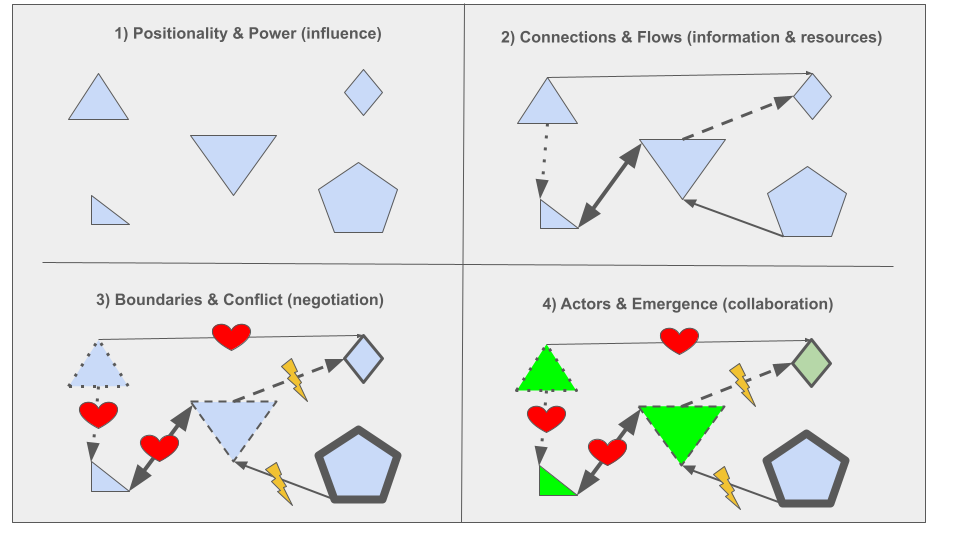
Through my explorations, I’ve identified four key dimensions which, in combination, shape the quality of relationships, and which together describe important aspects of evolving social systems:
- Positionality and power: How actors establish, communicate and understand their interests, priorities, power and influence within relationships and systems;
- Connections and flows: How actors are connected, including through the ways in which they access, exchange and use information and resources;
- Boundaries and conflict: How actors define, maintain and negotiate their respective interests, perspectives, and boundaries, managing points of tension and difference; and
- Actors and emergence: To what extent actors think about their positions, roles and relationships as being part of an emergent collaborative system that is more than the sum of its parts.
Figure 1: Key dimensions of relational practice
Moving from concept to practice, the next step in developing a Reflective Relational Practice would be to design an assessment framework to support gathering and analyzing data about the nature and quality of relationships along these four dimensions. This is not about comparing relationships to an unhelpful notion of “best practice” along each dimension, but rather about identifying ways of relating across each of the dimensions that support the emergence of healthy social systems in particular places at particular times.
One way of making such assessments would be to develop a rubric that would include criteria that set out the key dimensions of relationships on the one hand (the rows in Figure 2), and associated standards that describe levels of performance on the other (the columns in Figure 2).
Figure 2: An indicative rubric for assessing the health of relationships
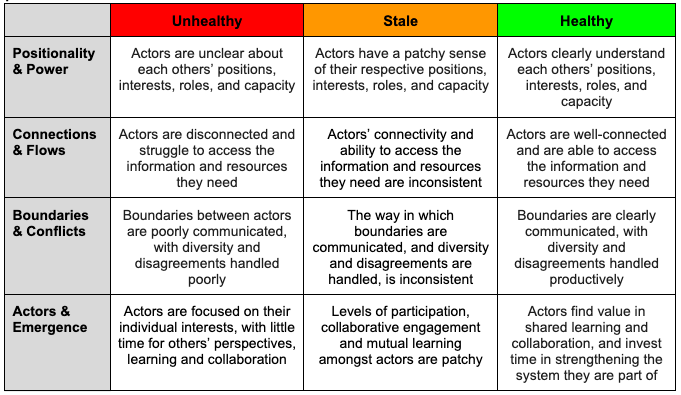
By developing a framework that blends structure and flexibility, and doing that in a participatory manner, such a rubric would support the systematic collection and analysis of rich and nuanced evidence to inform reflection about ongoing processes of relating. That in turn would help to generate useful ideas about how patterns of relating might be shaped, in particular by making changes to the contextual landscape which shapes actors’ behaviours and the ways in which they relate to each other.
Conclusion
Reflecting on the quality of relationships will not, in itself, resolve conflicts and address challenges that are fundamentally about worldviews, resources, power and incentives. These are structural features of the social landscape that can’t be wished away. But by using Reflective Relational Practice alongside other approaches to understanding actors’ behaviours and identifying entry points for engaging with the system, (see my recent piece on joining some dots for some pointers), we may be able to enhance the relationships that we are in, re-shape the structural features of the social landscape, contribute to healthier social systems, and enable the emergence of better social and developmental outcomes.
Just as with growing a garden, nurturing a social world of healthy and flourishing relationships in a landscape beset by polarization and conflict requires persistence and patience, and an ability to handle uncertainty and disappointment. However, the process can be hugely fulfilling and the results richly rewarding. By starting where we are, and doing what we can, with others, in and across the communities and systems that we are part of, we can definitely make a difference.
If this note sparks your interest, please explore the fuller document (along with the list of references) and feel free to drop me a line to continue the conversation. I’m keen to hear about your reflective relational practices and to explore the application of an intentional approach to assessing and enhancing the relationships that breathe life into the social systems that we all bring into being. Oh, and if you’d like to receive my occasional - monthly, more or less - updates by email, please sign up here.
___________________________________________________________
This note is informed by several years of exploration and conversations, particularly since I started freelancing in 2023. Most recently, it builds on a note which was finalized in early March, in collaboration with Alexandra Nastase, of Abt Global. That work was funded as part of Abt Global’s Portfolio Monitoring Evaluation and Learning (PMEL) initiative with FCDO, in Nepal.
First published on LinkedIn, 25 March 2025.
Theme: Nurturing relationships and building community
Topics: relational practice, relationships