Summary: I attended the Systemic Investing Summit in Rio in April 2026 hoping to open conversations about tailoring systemic investing to challenging governance contexts. I reflect on the fact that issues relating to government, policy and power got little attention at the Summit, and introduce regulatory landscaping as a way to understand context. It may interest investors and practitioners seeking to ensure that systemic investing is tailored to contexts.
- Systemic investing means investing systemically and investing in systems, and that needs more attention to context.
- Regulatory landscaping maps rules and incentives, observes behaviour, finds bright spots and designs policies or investments to amplify them.
- Engaging indigenous communities needs reciprocal protocols such as “making embassy”, and summits need more voices from the contexts concerned.
About 11 minutes to read the full piece.
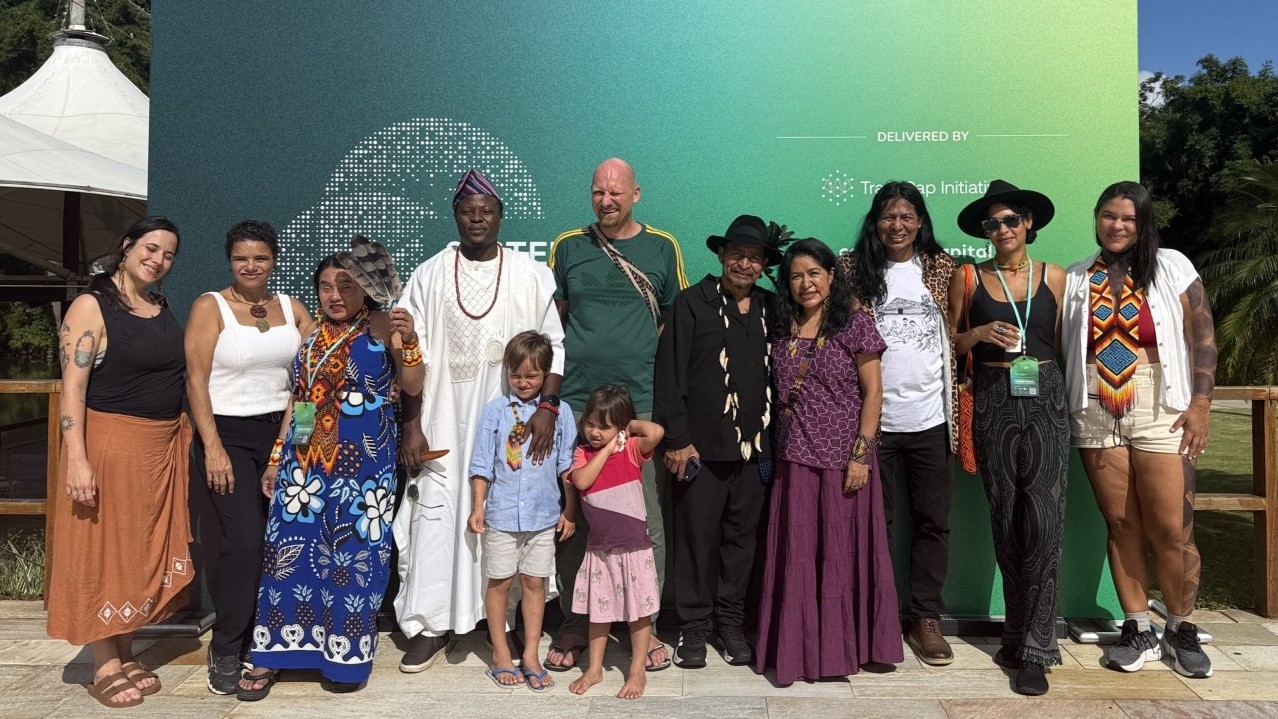
I was glad to be able to participate in the Systemic Investing Summit, in Rio de Janeiro, in mid-April. Having followed the field-building work of the TransCap Initiative for a few years and having shared some reflections on TransCap’s approach to systemic impact measurement and management in late 2025, I had decided to attend the Summit to deepen my engagement with the systemic investing community. In particular, I was keen to open up conversations about whether the sorts of approaches for understanding complex contextual dynamics that I am familiar with might support the tailoring of systemic investing to particular contexts, including challenging governance contexts.
What is systemic investing: Systemic investing is the application of systems thinking to the practice of investing—in pursuit of social justice and a healthy planet. It is moving beyond single-point solutions to the coordinated deployment of multiple types of money in collaboration with other stakeholders.
I thoroughly enjoyed the conference, which brought together not only investors, but also folks who are developing more systemic approaches to addressing and adapting to climate change, preserving biodiversity, and encouraging more regenerative, circular and sustainable approaches to economic development. The organisers - big up Hannah Paterson and the whole team, not least the Brazilian colleagues who tailored the Summit to the context - did a fantastic job. Even as a slightly shy newbie, I felt very welcome, enjoyed the sessions, and loved the rich and varied conversations I had, exploring overlapping interests, in various contexts, from a range of different perspectives.
Reflecting on gaps: Government, public policies and power
Amidst the high of being part of such a vibrant community of curious folks with collaborative tendencies, I was aware of some gaps, or at least differences from the sorts of conversations I am normally in. With some notable exceptions, including the strong and clear voice of Rogerio Rabelo, who I fortuitously met while exploring the fringes of the forest, there was, for instance, little mention of the role of government, public policy, taxation or democracy in addressing systemic challenges or supporting effective systemic investing. And discussions of power asymmetries and related inequalities were rather limited. I’m still getting my head around this - do investors have a tendency to side-step these sorts of issues? - and wondering whether the systemic investing community might encouraged to pay greater attention to these issues and the role that they play in shaping the context for investments in different places, and the ability of those investments to generate financial and non-financial returns.
Nevertheless, just a short conceptual hop away (public authority, governance, policy and spending in particular contexts, that shape the dynamics of those contexts), I was glad to have interesting conversations about systemic investing in challenging governance contexts, in a fishbowl discussion expertly facilitated by Madeleine Lewis which I helped to kick off along with my new biome-as-context friend Andrea Alvares and Brendan Lehan, in a small-group discussion which I hosted, and in lots of one-to-one conversations. It seemed to me, going into the Summit, that paying greater attention to context might - as a rich tradition of exploring how context shapes the effectiveness of public policy suggests - also inform more effective strategies for systemic investing in particular contexts.
A systemic approach to shifting the dynamics of systems, in particular contexts
Preparing for, and reflecting on these conversations, it struck me that the ‘systemic’ in systemic investing has two aspects:
-
Investing systemically, to generate combinatorial (1+1=3) effects across portfolios of interdependent investments that make the value of the whole portfolio more than the sum of its parts, as regards both learning and impact; and
-
Investing in systems, to improve how they function, by building on what is working and addressing elements that are not working in particular contexts, to generate returns both for investors and for the people and places that constitute the systems they are part of.
To be effective, systemic investing needs to combine these dual aspects. This, in turn, demands more attention to the ways in which the contexts in which systems are embedded shape their dynamics, and therefore the challenges and opportunities for investment. Indeed, this is something that Dominic Hofstetter, the Executive Director of the TransCap Initiative, addressed in his excellent SSIR piece from 2025 on the limits of investing in universal solutions. He also made the case, in Rio, that being more “contextualized” is one of three key imperatives for the systemic investing community, along with being more strategic and integrated.
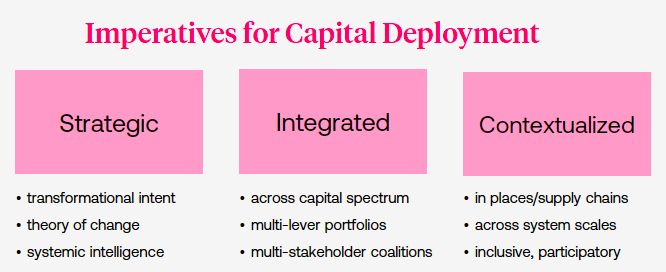
A slide from Dominic Hofstetter’s presentation “A (re)introduction to systemic investing”, Rio Summit, April 2026
I could not agree more. However, while the importance of context is increasingly recognised, the conversations about what taking better account of context might look like, which aspects of context are key, how that might be done, and what the bullets under “contextualized” should cover, are at a relatively early stage. Such conversations, informed by practical experimentation and learning from experience, would, I am sure, prove very useful in fleshing out the TransCap Initiative’s thinking, and that of the wider community, on what it really means, and what it takes, to take account of context appropriately.
Regulatory landscaping, habitats and habits …
My suggestion at the Rio Summit was that the work I’ve been involved in - including the work on regulatory landscaping which has emerged from collaboration with colleagues at the SOAS Anti-Corruption Evidence programme on ways of addressing policy-distorting corruption - might provide a useful approach, or at least some food for thought, for systemic investing, including in challenging governance contexts, where the rule of law is patchy, institutions are weak, power asymmetries are pronounced, and corruption is endemic.
As the full report I drafted for SOAS-ACE on corruption in health systems illustrates and explains, regulatory landscaping is a four-step process of understanding the political economy and relational dynamics of particular contexts - the dynamics that shape actors’ behaviours, the scope for collaborative action and the effectiveness of public policies or investment - and then using that understanding to inform the design of policies or investment strategies that will contribute to more sustainable, inclusive and equitable outcomes in those contexts. In effect, it’s about paying attention both to habitats (rules, institutions and incentives) and habits (behaviours), and the ways in which they co-evolve, and leveraging that dynamic to nurture a vibrant and healthy ecosystem.
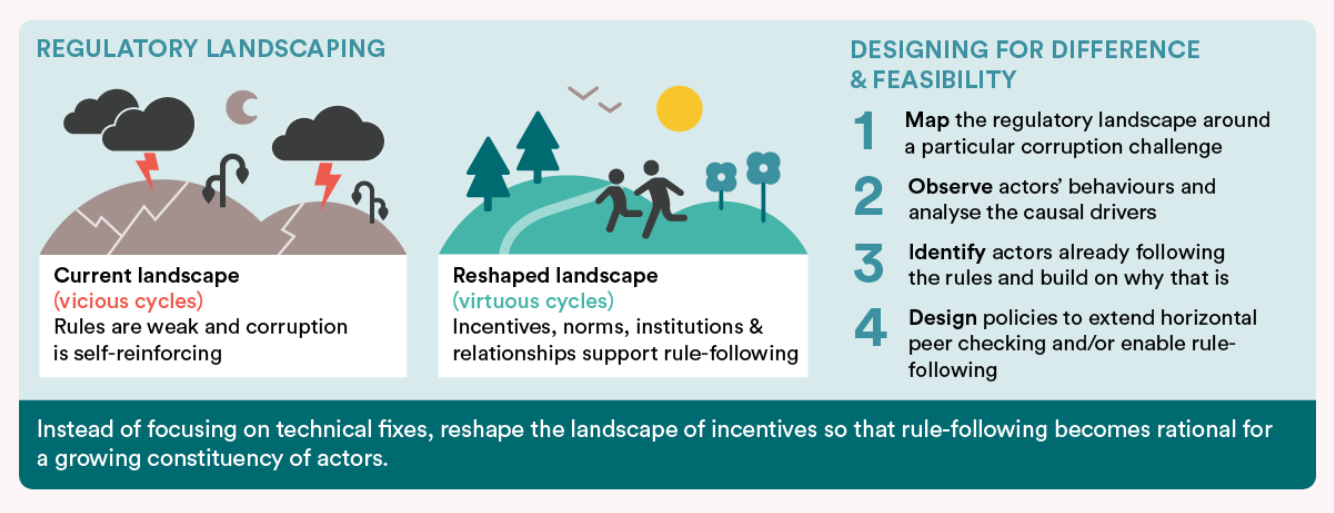
Regulatory landscaping to address corruption, from the SOAS-ACE report on “Corruption in health systems: Context, incentives and the political economy of reform”, written by the author (March 2026).
The four steps of the process are as follows:
- Map the regulatory landscape of formal and informal rules, incentives, norms, institutions and relationships around a particular challenge;
- Observe how different actors are behaving in that landscape and analyse why different actors behave as they do;
- Identify bright spots of positive deviance where some actors are behaving in promising ways (this might be about rule-following, or engaging with others collaboratively); and
- Design public policies - or investment strategies - that have the potential to amplify and extend those patterns of promising behaviour, in ways that draw on the potential of networks of horizontal relationships to support the emergence of self-reinforcing patterns of behaviour.
… and collaborative political intelligence
Over the coming months, I’ll be dedicating a significant chunk of my time to these explorations, and am excited to be joining forces with Zahed Yousuf to bring together our complementary thinking on regulatory landscaping and collaborative political intelligence (here are my collated notes on Zahed’s ground-breaking work on collaborative political intelligence, including in the Democratic Republic of the Congo). Our sense is that an approach to understanding the dynamics of context and informing and supporting action and engagement in particular contexts that focuses on collaborative political intelligence (from his work on conflict) and regulatory landscaping (from my work on corruption) has a lot of potential, including as regards systemic investing.
For Zahed and I this is not only about understanding context, and certainly not about outsiders producing static maps of aspects of context that cover what they, with their external perspective and lack of local insight, see as the important aspects of context. Rather, it is about working with local actors to develop maps of the regulatory landscape that they can use, collaboratively, and adaptively, to make sense of their contexts in ways that enable them to identify things that might be done to enhance the systems and contexts they are part of, addressing corruption, reducing conflict, protecting the environment and/or, perhaps, increasing the returns to systemic investing.
This is a process that systemic investors, looking to engage in particular contexts, could benefit from being part of. Not, as J.J. Gonzalez from the Abundance Circle noted, as external investors mapping a context and placing their bets on particular points in a static landscape of potential investments and deals to manage their risks. But instead as participants in collaborative processes of understanding the landscape and co-designing investment strategies that - in ways that are appropriate for the context, and are co-owned with people living in the relevant context - search for synergies, actively reshaping the regulatory landscape and the emergent dynamics of the (eco)system, in ways that enable value, financial and otherwise, to be co-created. Habitats, habits, gardening, ecosystems, fruitfulness.
Contexts, diversity and “making embassy”
However, as one of the most interesting sessions I participated in - a session on engaging with indigenous communities led by James Rattling Leaf and Gwen Bridge, with fantastic practical contributions from Sarah Siqueira, Drea Burbank and Pete Corke - made clear, such engagement needs to move forward carefully to avoid repeating extractive colonial practices. The people, communities, environments and ways of being that bring contexts, in all their diversity, to life, and enable them to flourish, must not be sacrificed for returns that harm the contexts from which they emerge. (Heartfelt thanks to Sarah for politely and firmly focusing my attention on flourishing diversity).
This requires co-creating practices, protocols and mechanisms that enable reciprocal engagement between investors and the people whose lives - their ways of seeing, knowing, being and relating - are entangled in the contexts for potential investment. (See also Philippe Greier’s insightful notes from the edge of the field). As James Rattling Leaf noted with reference to the work of Tyson Yunkaporta, this can be seen as “Making embassy”; a way of relating across difference - particularly across cultural or knowledge system borders - where both parties maintain their sovereignty while engaging through respectful, protocol-governed interaction. (For more on “making embassy”, from Perplexity, see here).
Summits, contexts and engagement
I was very glad to be at the Systemic Investing Summit. It was refreshing to be part of a community where incentives for action, including collaborative action, are an important part of the conversation. And it was amazing to make so many rich and wonderful connections, with investors, with practical dreamers, and with people from indigenous communities from north and south America, in such a short space of time. I am glad to be part of the community and am looking forward to further engagement, and future summits.
For me, the engagement with people from, and working closely with, indigenous communities was the highlight of the summit. That engagement provided rich inspiration about both the importance of tailoring systemic investing to context, with people and communities that are an essential part of that context, and the sorts of principles and protocols that might shape and govern that engagement. Future summits could support richer discussions about taking appropriate account of context in three ways.
-
By making context - one of Dominic’s three imperatives - a more substantive focus in the work of the TransCap Initiative;
-
By increasing the proportion of participants from contexts where systemic investing is being put into practice - citizens, stewards, potential investees, and perhaps political representatives, from those contexts;
-
By ensuring that summits are regularly held, alternately, in Latin America, Africa and Asia, regions that in their great diversity pose considerable challenges and promise substantial returns to systemic investing, and have hard-won and challenging experience of tailoring engagement with external actors and responding to systemic crises.
By moving in these directions and taking steps to flesh out the strategic imperative of context before the Canada Summit - another country where “sovereignty” is an important issue - the systemic investing community will be on track to enhance its capacity to tailor the approach to particular contexts, including challenging governance contexts. In this way, systemic investing will be better able to make a respectful and powerful contribution to shifting the dynamics of systems that are embedded in particular contexts, in ways that truly benefit the people living in those contexts.
My December 2025 piece on full-stack systemic - particularly the section on grounding systemic investment and learning in particular political economy contexts - provides some additional reflections about how the Systemic Impact Measurement and Management agenda (MEL for systemic investing) might be informed by, and support, a stronger focus on the relational and political-economy dynamics of context].
With deep gratitude to the TransCap and Converge Capital teams, to the local partners, to the people from indigenous communities, to the people working at the venue, and to everyone who showed up, with curiosity, creativity and commitment. And with warm thanks to the many people who I had the pleasure to meet. I look forward to staying in touch.
Natasha Hanisi, Juan Jose Gonzalez, Javier Castro, Victoria Mendonça Martins de Almeida, Fumi Sugeno, Pranay Samson, Robert Ricigliano, Mari Hicks PMP, Amber Quiñones, Natalia Pinzon-Granados, David Ontaneda, Andrea Alvares, Anna de Souza Aranha, Camilla Cardoso, Maria Souza, Thomas Finazzi, Ruben Grau Pujol, Pascale Tobler, Banjo Onasanya FCA MBA SAP Certified, Emilie Goodall, Thais Mantovani, Ana Karen Andrade Ambriz, Alex Tsai, Ernesto van Peborgh, António Chanoca, Graham Boyd, Joseph Ching, Cleofash Alinaitwe, Johanna Delmelle, Jane Urheim, Tamar Honig, Dino Siwek, Kate McKegg, Jess Dart, Thomas Holm, Jono Hendricks, James Rattling Leaf, gwen bridge, Sarah Siqueira, Kafi Lindsay, Drea Burbank, Pete Corke, Jack Davies, Zach Cohn, Brendan Lehan, Cassie Robinson, Clare Moberly, Diana Velasco, Ìdòwú Akínrúlí, Joe Hsueh, Suzanne Bowles, Jess Price and Maria F. Balcazar Tellez, MS, MPP.
Update (6th May 2026): I heard from TransCap today that the communities in the Amazon where two of the indigenous leaders who were at the Summit (Laura and Tashka Yawanawá) live have been devastated by flooding. For more on this, and an appeal for funds, so that the communities can “heal, rebuild, and continue protecting our territory and the Amazon forest” see here.
First published on LinkedIn, 6 May 2026.
Themes: Ecosystem funding and systemic investing, Power, corruption and political economy
Topics: systemic investing, regulatory landscaping, political economy, context, collaborative political intelligence