Summary: I wrote these notes for the launch of UNDP’s MEL 360 guidance on systems monitoring, evaluation and learning. I ask how the guidance can be tailored to local contexts, and argue for putting local learning systems and political economy at the centre. It may help evaluation and systems-change practitioners.
- Guidance only helps if it fits context, so it should build on existing local practice.
- What matters most is local learning systems’ capacity to make sense of complexity and act.
- Systems MEL must also deal with power, resources and incentives, or it will leave system dynamics unchanged.
About 7 minutes to read the full piece.
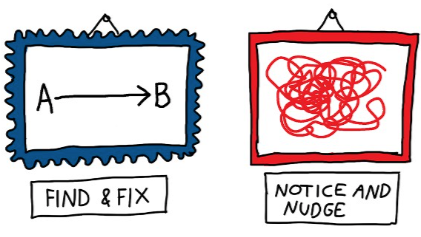
I pulled these thoughts together for the 23rd October launch of UNDP’s MEL 360 guidance on Systems MEL, where (drawing on section 4 below) I shared a two minute reflection focused on prioritizing local learning systems, and taking account of power, resources, incentives, relationships and capacities. The MEL 360 website is here, with a detailed post on the process of developing the guidance, and the complexities navigated along the way, available here. A blogpost, along with a video of the launch event, should be live in the next week or so (I will add the links). A short video of my comments for the event can be found below.
Watch on YouTube: my two-minute reflection at the UNDP MEL360 launch
1. Introduction: Nurturing living, learning and loving systems
My work explores how we can better understand and engage with complex social systems to nurture living, learning and loving systems - communities that are adaptive, reflective, and relationally rich. A key focus is exploring how collaborative learning and sense-making - supported by complexity-aware MEL - can help people navigate complexity and its associated political-economy dynamics, enabling them to take action that improves the systems and communities they are part of.
This note is, in effect, a meta-reflection on the value of collaborative sense-making and learning, for supporting the emergence of better local learning systems, across a diversity of contexts. I’m sharing it to encourage reflection on tailoring and localizing Systems MEL, and how the UNDP MEL Sandbox community can support those processes. My hope is that such reflection, and the actions it might inspire, will help ensure that UNDP’s MEL 360 Tools and Guidance, as well other systems change resources, contribute to real impact across various contexts.
2. Global ambitions and local contextual realities
I appreciate MEL 360’s ambition: enabling projects and people to navigate complexity and be more effective agents of systems change, by enhancing their capacities for sense-making and learning, so that they can, as the guidance puts it, “think, act and learn” systemically. Given that the value of any guidance depends on whether it fits with the contexts where it is being applied, this raises an important question: How can MEL 360 be tailored across different contexts, and for different types of actors, so that it will actually help people living in particular contexts to navigate complexity effectively?
UNDP’s MEL 360 Guidance website
The MEL 360 team has already been exploring this question. The guidance itself talks about adding a layer of Systems MEL rather than replacing existing practices*, and providing flexible starting points rather than one-size-really-doesn’t-fit-all recipes. The team has also been thinking carefully about the role the Sandbox community might play in an ongoing process of tailoring, sense-making and learning (see the invitation for people to register their interest in a variety of roles in the Sandbox community). That said, the question of tailoring and localizing to context - hugely important if the guidance is to make a real difference across a diversity of contexts - does merit some additional reflection.
* Although we should keep an eye out for practices that are in tension, for instance, when donors’ reporting requirements conflict with local actors’ learning priorities.
3. Tailoring and localizing, in contexts
The landscape that the MEL 360 Tools and Guidance enters into is one that is populated by a wide variety of actors, playing different roles, with varying capacities, across a diversity of professional roles and geographical settings. And - because life has always been complex, despite the linear, mechanical and control-focused mindsets that many of us have internalized - it’s a landscape rich with already-existing and ever-evolving practices with their own language and techniques for sense-making, learning and navigating complexity (see, for instance the Niho Taniwha Systems Learning Framework, from Auckland Co-Design Lab).
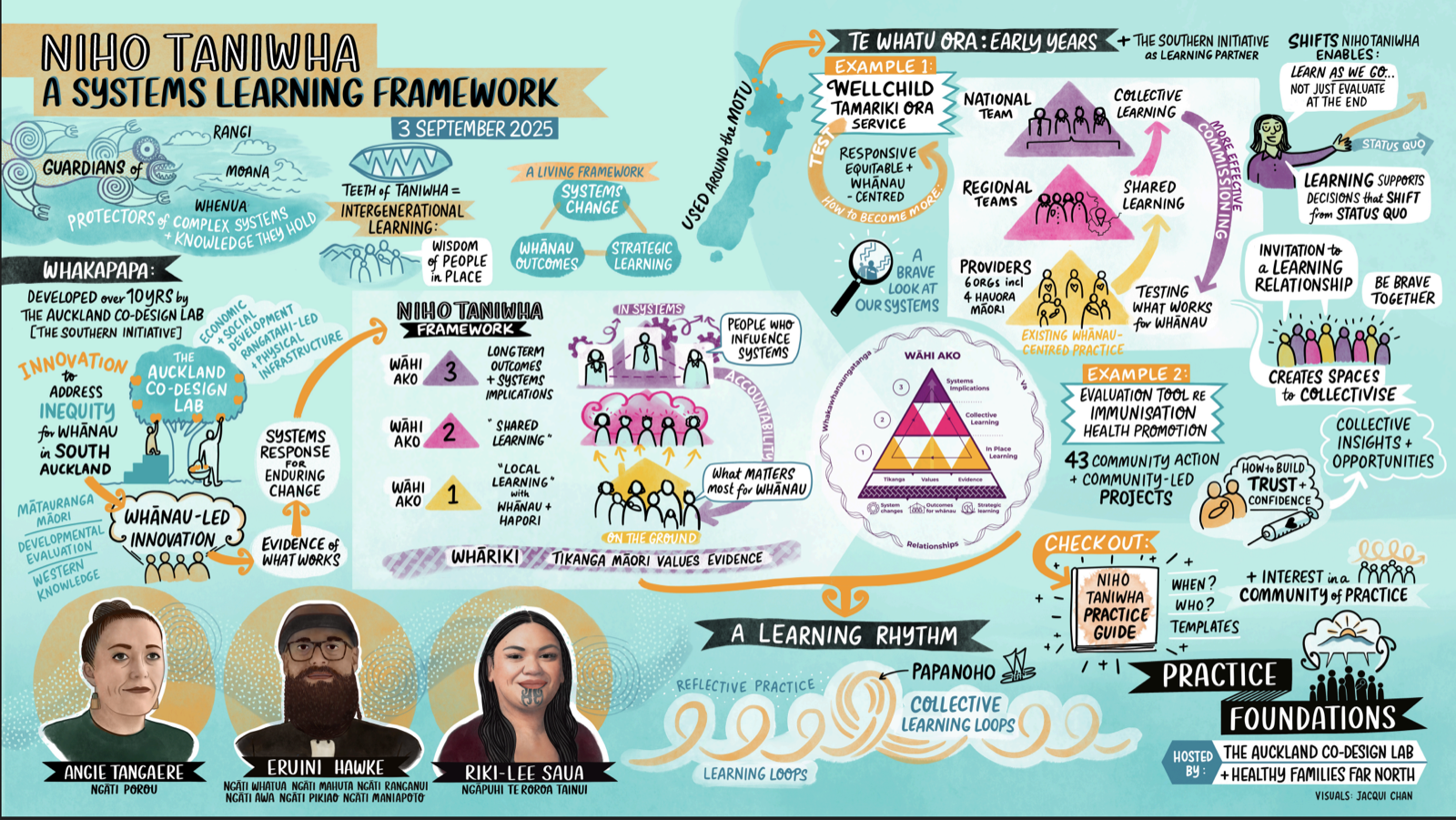
Niho Taniwha - A systems learning framework from the Auckland Co-Design Lab
Given this landscape, the path forward becomes clear: building on and learning from existing practice; tailoring the guidance to different actors and contexts; and doing this in ways that are supported by ongoing reflection and learning about effectiveness. By moving forward collaboratively - exploring whether people, projects and organizations are managing to navigate complexity effectively, finding the next right move, as the complexity practitioner Jen Briselli puts it - we can help to ensure that the guidance has an impact in the contexts where it is needed most.
4. Local learning systems and the political economy of systems change
Beyond emphasizing the importance of tailoring and localizing MEL 360 in particular contexts, two issues that are sometimes neglected warrant special attention: the prioritization of local learning systems, and taking proper account of the political economy of systems change.
Local learning systems
What matters most in achieving context-appropriate and locally-led systems change is the capacity of local learning systems - the organizations, communities and people that constitute and weave together those systems through their daily actions and inter-actions - to make sense of complexity and take effective action. In short, their adaptive capacities.
Behavioural changes and relational adjustments made by these local actors are what will nurture the emergence of systems that are tailored to their contexts and contribute to meeting their needs. So, when we’re thinking about tailoring the guidance to meet the needs of different actors, we should prioritize actions that will enhance the capacity of local systems and actors for sense-making, learning and navigating complexity.
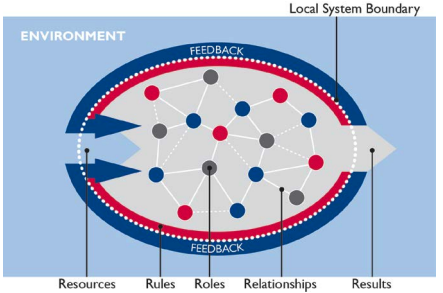
USAID’s 2016 conception of a local system, a local learning system
The political economy of systems change
However, prioritizing local actors is not enough. If MEL practices and guidance such as that provided by UNDP are to make a real difference, they need to illuminate, and enhance local actors’ capacities to navigate, the political economy aspects of the contexts where they live. Therefore, processes of tailoring and localizing must also pay attention to, and enable local actors to navigate and engage with, the systemic factors that together determine what learning happens, how it happens, whether it leads to action, and whether that action actually shifts the dynamics of complex social systems. These systemic factors include distributions of power, flows of resources, structures of incentives, patterns of relationships, and capacities to act.
It’s great that the MEL 360 guidance includes power, resources and relationships in its “domains of change”. But, as Emily Gates and colleagues’ recent review of efforts to evaluate systems change and transformation makes clear, conversations about systems practice often fail to take proper account of power, resources, and the political economy dynamics of particular contexts, which can lead to unrealistic proposals about how systems might be changed (for a similar argument, and constructive proposals, in the realm of corruption, see the work of SOAS-ACE on navigating the political economy of corruption). In addition, I would argue that such evaluations rarely give sufficient attention to how the behavioural and relational changes that will be needed to shift system dynamics might be incentivized.
This gap as regards addressing the political economy dynamics of systems change is particularly problematic because, as Emily Gates and colleagues put it, “the creation of fundamentally new structures, through which new systems emerge, implies power changes that upend the current system(s)”. If evaluation and learning that is intended to inform systems change efforts does not engage with distributions of power, flows of resources, and other features of the political economy landscape, then, despite having the best of intentions, such efforts are likely to leave a system’s dynamics and emergent outcomes fundamentally unchanged.
5. Building bridges through community
A global community of practice and learning can support this work, helping to build bridges between global ambitions and local realities by tailoring and localizing the guidance, and doing so in ways that prioritize local learning systems, and enable effective engagement with the political economy dynamics of systems change. There’s a lot to learn, from a diversity of actors, in different contexts, all around the world.
The Sandbox community - with the MEL 360 Tools and Guidance an important part of an emerging learning infrastructure - is well-placed to play a supportive role in efforts to enhance the capacities of local learning systems, enabling people to navigate complexity and co-create systems and communities that are adaptive, reflective, and relationally rich. Or, put differently, to nurture living, learning and loving systems.
I’m glad to be part of such a vibrant, diverse and well-stewarded community, and look forward to participating in collaborative learning - through case studies, peer exchanges, and reflective practice - about the ways in which local capacities for sense-making, learning and navigating complexity can be strengthened across different contexts, in ways that lead to real-world impact.
6. Further explorations
The fruits of my recent explorations of various landscapes of learning can be found here. On Power, Corruption and Complexity, they include links to, and summarized highlights from, great pieces by David Jacobstein, Duncan Green, the Asia Foundation, Orit Gal, and Dominic Hofstetter. On Adaptive Processes and Learning Systems, they include links to, and summarized highlights from, insightful pieces by Emily Gates and colleagues, Florencia Guerzovich, Indy Johar, Cathy Sharp, and Yuen Yuen Ang, as well as links to USAID’s work on local systems practice.
The recent “It Depends” podcast, featuring Emily Gates reflecting on rethinking systems change evaluation, is also well worth a listen. And, my piece from 2017, on learning and power, or, whose learning and adaptation counts - riffing off the work of Robert Chambers, up the road from me at the Institute of Development Studies - can be found here, courtesy of the wayback machine. Feel free to drop me a line if you’d like to chat. Or, if you would like to be in the loop for occasional updates about my explorations, please sign up here.
First published on LinkedIn, 23 October 2025.
Themes: Learning systems and adaptive practice, Power, corruption and political economy
Topics: monitoring, evaluation and learning, local systems and localisation, political economy, context