Summary: This quarterly update starts from how I have changed my knowledge gardening, replacing detailed learning questions that felt like a straitjacket with eight flexible Landscapes. I then share highlights from the first two, power, corruption and complexity, and adaptive processes and learning systems. It may suit people exploring complexity-aware approaches to social change who want a guide to interesting people and resources.
- My thirty-plus learning questions became too rigid, so I now organise my explorations around eight flexible Landscapes.
- A promising route on corruption is to find where integrity already exists, understand why, and amplify it.
- Effective engagement in complex systems depends on nurturing learning and adaptation more than having the right plan.
About 11 minutes to read the full piece.
Introduction: A blended approach to exploring and learning
My work involves exploring the universe of approaches to understanding and engaging with complex social challenges, in order to inform and support effective approaches to nurturing social change. As the seasons roll on, I’m constantly adapting my own practices, refining my strategy for exploring how social change emerges and can be nurtured through our actions, and enhancing the knowledge gardening practices I use to make sense of my explorations.
The reflections that inform my adaptations tend to revolve around finding a suitable balance (see Landscape 4, Polarities, Paradoxes and Conflict) between the flexibility and structure which is needed to support emergence and learning. In practice, this means that I am regularly reflecting (see, for instance, my 2023 piece on systemic meandering) on whether - in my explorations and sense-making - I’m finding a fruitful blend of a wide-ranging and free-flowing approach on the one hand, with a more focused and intentional approach on the other.
Back in 2023, I began using an evolving set of learning questions (thirty or more of them!), and topic tags (120+) to focus my explorations and organize my findings. However, over time the learning questions (but not the topic tags) fell into disuse as they were too detailed, while also - somewhat paradoxically - providing too much structure, amounting, I suppose, to self-imposed micro-management. As a result, they were not supporting my explorations or learning in the way that I wanted, providing a straitjacket rather than a fertile soil (thanks to Rituu B Nanda for our exchange) for emergence. So, I’ve now modified my approach to try to find a better blend of flexibility and structure.
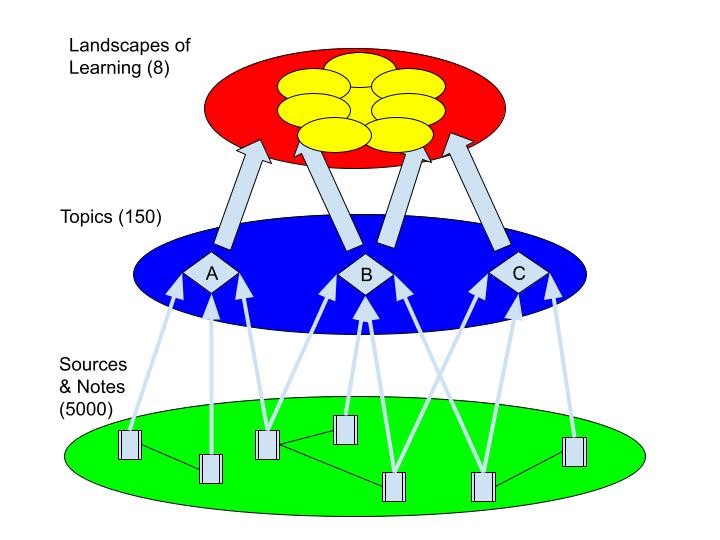
The latest iteration of my knowledge gardening practices (2025)
My modified approach, while retaining my topic tags, now involves organizing my efforts around a smaller number (eight at the moment) of Landscapes; areas that I am intentionally, and flexibly, exploring. These areas are not fixed; they may come and go, be modified, merged or replaced (I modified one just now, adding Conflict to a Polarities and Paradoxes Landscape!). They are not exclusive or comprehensive; much of the magic happens in the margins. I’m more active in some than in others, and that changes over time. And they are of somewhat different types, with some being more specific, and more immediately practical, than others.
The Landscapes I am learning about, and which are themselves communities of ongoing action and learning, are currently as follows:
-
- Power, complexity and corruption
-
- Adaptive processes and learning systems
-
- Relational practice and community
-
- Polarities, paradoxes and conflict
-
- Ecosystem funding and systemic investing
-
- Market Systems Development and political economy
-
- Health systems, corruption and political economy
-
- Knowledge gardening in complexity
I then use the names of these Landscapes to tag and curate the information that I’ve collected and cultivated in my knowledge garden, whether that comes from articles, podcasts, videos, conversations, or random thoughts I had while in the shower, cooking my dinner, community gardening, chatting with friends, or out on my bike. It’s early days in the new regime, but so far I’m finding the flexibility and structure that this provides very helpful for guiding my explorations, and for collating and making sense of the discoveries I make.
My hope is that this latest iteration of my exploratory strategy and associated knowledge gardening practices will not only guide my explorations, and help me to make sense of the patterns that are emerging, but also, and most importantly, enable me to share my findings in ways that are useful to a wider community of explorers and practitioners. Let’s see!
In this quarterly update, taking each Landscape in turn, I share the highlights of my explorations - a whistle-stop tour of interesting discoveries, scenic vantage points, intriguing diversions and rich resources - while paying close attention to the connections and relationships which make the whole more than the sum of its parts.
In what would be a new (and more richly relational) departure for me, I’m also thinking about offering spaces for discussion, where interested folks can co-explore the clusters of inter-related issues that we are individually and collectively exploring. Give me a shout if that sounds like it might be your cup of tea!
Power, Corruption and Complexity (Landscape 1)
What if the most effective way to fight corruption isn’t to attack it directly, but to find and amplify the places where integrity is already thriving?
My work in this area is intended to explore and inform efforts to understand and engage with the political economy dynamics of complex social systems, including systems of corruption, to thereby contribute to efforts to address complex social challenges, and to inform the evolution of approaches to addressing corruption and nurturing better governance. This is one of the foundations of my work, bringing focused awareness to the role that power and incentives play in shaping both actors’ behaviours and the workings of the social systems - the formal and informal rules, institutions and associated governance practices - that emerge from and subsequently shape these behaviours in a co-evolutionary loop.
Over the last few months, inspired by my earlier work with SOAS Anti-Corruption Evidence Research Consortium (see this video of the launch of the guide to the SOAS-ACE approach, or this NotebookLM if you have a Gmail address), and my FCDO-funded work on Reflective Relational Practice (see Landscape 3, on Relational Practice and Community), as well as conversations with various colleagues, I published a series of six pieces on complexity, corruption and change. In these pieces (also available as a consolidated version, or as a NotebookLM) I explore how our engagement in complex social systems - including systems of corruption - can be informed by learning from the political economy of positive deviance. (See also Landscapes 6 and 7 for applications of the positively deviant SOAS-ACE framework - in relation to market systems, and health system, respectively).
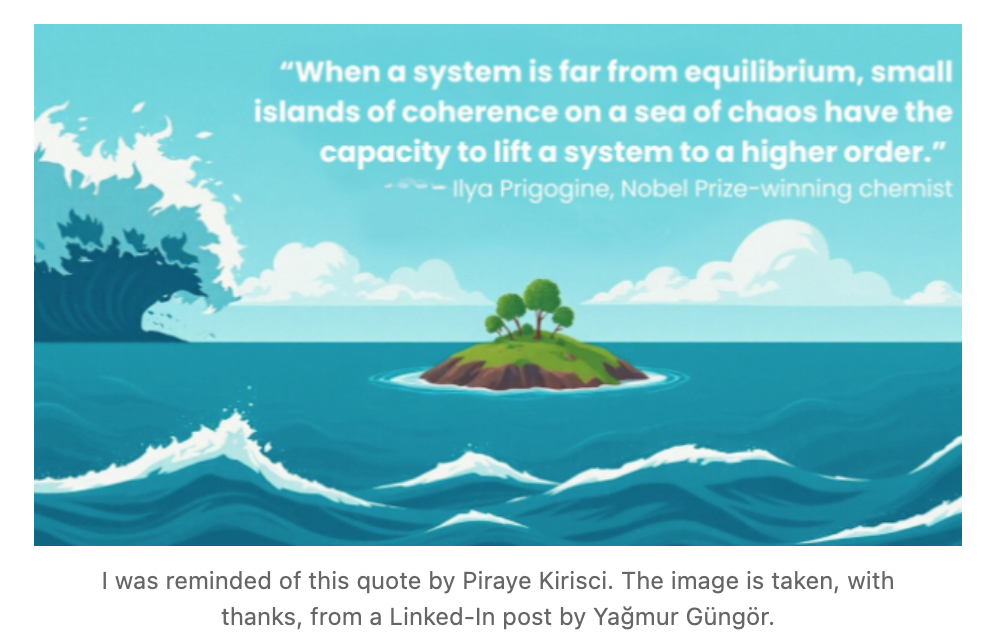
At the centre of these explorations is the idea, which is clearly illustrated in SOAS-ACE case studies from Bangladesh and Nigeria, that progress can be made in addressing policy-distorting corruption by following this three stage process:
- i) identifying sites in the system where some actors are behaving in ways that contribute to the health and vitality of a system;
- ii) understanding why that is, in terms of the drivers of actors’ behaviours and the relationships amongst them; and then
- ii) leveraging that understanding to craft policies which can amplify and extend those islands of integrity by establishing incentives that have a realistic chance of shifting actors’ behaviours and the emergent dynamics, and outcome, of the system.
I’ve also appreciated rich conversations with:
- Jen Briselli, about the potential application of the Cynefin Company’s estuarine mapping approach, to informing engagement with the political economy dynamics of systems of corruption (see her wonderful piece on finding the next right moves, as well as her letter to a young systems thinker, and an insightful note on the language we use to talk about complexity);
- Claudia Baez-Camargo, who has invited me to discuss complexity and corruption with students on the Basel Institute on Governance’s Anti-Corruption Course; and
- Drew Koleros, about strengthening connections between the Actor Based Change approach to informing engagement in complex systems, my and others’ thinking on reflective relational practice, and the wider terrain of political economy analysis.
Other highlights in my explorations of this area have included:
- David Jacobstein’s rich reflections on how the Thinking and Working Politically agenda informed the work of USAID and might inform future approaches to nurturing local learning systems that are tailored to particular political economy contexts;
- Duncan Green’s complementary take - strongly informed by the work of the Asia Foundation on Political Economy in Practice - on the past, present and future of political economy analysis;
- Orit Gal’s series of pieces which explore the potential of what she calls social acupuncture, an approach to finding leverage points, or entry points, that is informed by Traditional Chinese Medicine (see also Landscape 4, on Polarities, paradoxes and conflicts); and
- Dominic Hofstetter’s piece on the limitations of investing in universal solutions (see also his reflections and my comments, on context and the political economy of policy implementation, and Landscape 5, on Ecosystem funding and systemic investing).

The cover image from David Jacobstein’s excellent piece, reflecting on Thinking and Working Politically
Over the coming months, as well as exploring the application of the SOAS-ACE framework to Market Systems Development (Landscape 6), and in research on health systems and corruption (Landscape 7), I’m looking forward to figuring out whether and how estuarine mapping might be applied in relation to systems of corruption, and to further enriching the connections between this Landscape and various others, where complexity, and political economy dynamics are an important part of the picture.
Summarized highlights of selected pieces relating to Landscape 1, on Power, Corruption and Complexity, can be found here. (hover and click to the left of the bullets in columns two and three to expand them)
Adaptive Processes and Learning Systems (Landscape 2)
What if the key to engaging effectively in complex social systems isn’t having the right plan, but nurturing the capacity of the system and its players to learn and adapt?
My most recent writing in this area of exploration was my December 2024 piece on embracing systems practice, which shared my reflections (now tinged with sadness about what might have been) on USAID’s excellent Local Systems Position Paper. Over the course of recent months, I’ve been glad to participate in the Local Systems Community 2.0, a community established by former USAID colleagues which is keeping the flame of local systems practice alive with regular online discussions - including an excellent discussion of how USAID’s foundational 5Rs framework (Results, Roles, Relationships, Rules and Resources) for systems practice might be updated - as well as in-person meetings and coffee-chat pairings.
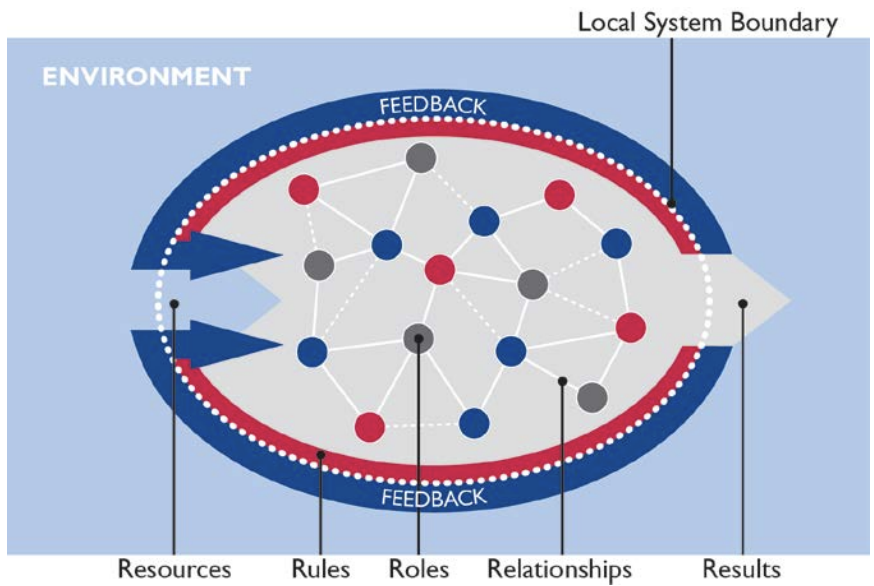
USAID’s 5Rs framework for systems practice (from 2016)
I’ve had a number of great conversations about adaptive processes and learning systems in recent months, which have explored, and blurred the lines between, evaluation of systems by relative outsiders, and ongoing learning by people who live the system on a daily basis (which reminded me of my 2017 piece on Learning and power: Whose learning and adaptation counts?). Continuing my engagement with the Human Learning Systems community, I had a rich conversation with Toby Lowe, in which he made the compelling case that establishing and stewarding a learning system - a human and relational learning system - is an essential support for effective engagement with complex social challenges.
Relatedly, having crossed paths with Barbara Befani - an evaluator who is helping to craft an approach to evaluating relational public services - at an excellent conference on moving towards more relational public services that I attended in June, at Manchester Metropolitan University, and which was full of Human Learning Systems practitioners, it was a pleasure to meet her in person. I’ve also enjoyed getting to know colleagues at the UN Food and Agriculture Organization, including Lourdes Orlando (a connection made through the UNDP MEL Sandbox) and Severin Oman, and hearing more about their efforts to support complexity-aware and learning-centered approaches to improving the workings of food and agriculture systems.
Update 8th October, cos constant gardening: The video of a UK Evaluation Society and Manchester Metropolitan University Policy Evaluation and Research Unit (PERU) session, on relational evaluation is now available, here.
Watch on YouTube: Relational evaluation: from concept to practice (UK Evaluation Society)
In terms of resources, Emily Gates and colleagues’ comprehensive review of efforts to evaluate systems change and transformation from 2011-2021 (with a part two in the works) has been a standout publication for me. I was particularly struck by their finding that little attention has been given to power and resources in systems change evaluations. As Emily and colleagues put it, this gap is particularly problematic given that “the creation of fundamentally new structures, through which new systems emerge, implies power changes that upend the current system(s).” Here, there’s a very strong resonance with the SOAS-ACE approach (see Landscape 1) to understanding how power, resources, interests and incentives shape the evolution of systems of corruption and governance.
I’ve also been inspired by a number of pieces I’ve read. These include:
- Florencia Guerzovich’s thought-provoking paper on how an architecture of nested indicators - specifically, “tonal nested indicators” that are connected through plausible logics of causality and coordination - can help to illuminate synergies in complex, multi-level and multi-perspectival systems (see also Florencia’s excellent piece on the wisdom of invisible weavers, and the associated weaving community recently established by Accountability Lab);
- Indy Johar’s intriguing reflections on learning as infrastructure and the role that such infrastructures and the relational learning they support can play in enabling collective intelligence in complex systems;
- Cathy Sharp’s heart-felt call for a democratization of research and evaluation which enables everyone to be an (action) researcher, helping the system and its participants to become “self-enquiring”, routinely learning and re-learning about the environment, themselves and the actions that they take;
- Yuen Yuen Ang’s 2021 piece on the value of moving beyond a focus on elite innovation to give greater emphasis to the ways in which people around the world use local knowledge to address the challenges that they face; and
- Jess Daggers’ series of excellent pieces on impact measurement and management in the realm of systemic investing - more on that in my review of my explorations in Landscape 5.
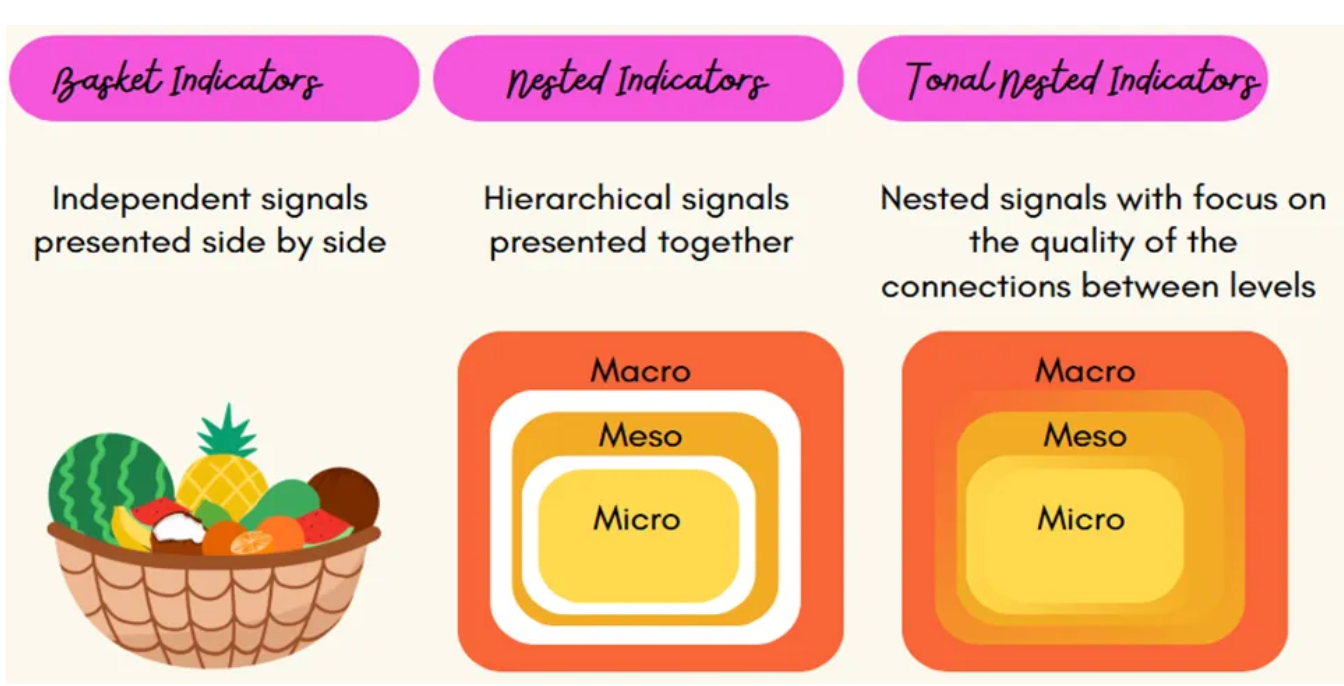
Image from Florencia Guerzovich’s insightful piece on the value of nested and interconnected indicators
Looking ahead, as well as participating in the launch of UNDP’s guidance on MEL 360 for systems change, sharing a review of Jess Daggers’ work with the TransCap Initiative, and continuing my cross-pollination between this and other Landscapes, I plan to craft a piece that sets out the key elements of an adaptive and learning-centered approach to shifting the dynamics of complex social systems. My hope is that this will provide an additional window for sharing the many resources in my knowledge garden in a way that enables a better balance (not least for me) between theory and practice. One can never be sure, but perhaps that will emerge by the Spring!
Summarized highlights of selected pieces relating to Landscape 2, on Adaptive Processes and Learning Systems, can be found here. (Again, hover and click to the left of the bullets in columns two and three to expand them).
Future fruits
Over the coming weeks, I plan to share the fruits of my explorations of other landscapes of learning, including: Relational practice and community; Polarities, paradox and conflict; Ecosystem funding and system investing; Market Systems Development and political economy; Health systems, corruption and political economy; and, more about my practices for Knowledge gardening in complexity.
If my reflections on Power, corruption and complexity, or on Adaptive processes and learning systems spark any reflections on your part, I’d love to hear from you. Please do drop me a line if you’re interested in exploring, collaborating, and learning along together, perhaps as part of a small and friendly group, over a cup of tea. And, if you would like to be in the loop for occasional updates about my explorations, feel free to sign up here.
First published on LinkedIn, 6 October 2025.
Themes: Power, corruption and political economy, Learning systems and adaptive practice
Topics: knowledge gardening, adaptive learning, emergence