Part 3 of 6 in a series, Complexity, corruption and change (July–August 2025).
← Previous: Navigating the political economy of corruption · Next: Power positive and islands of integrity →
This piece continues my exploration of how an understanding of the causal dynamics of behaviour at sites of positive deviance in complex social systems - including systems of corruption - can be used to inform policies intended to shape the behaviours and relationships that constitute such systems and drive their dynamics (Part 1, an introduction, is **here**. Part 2, on my work with SOAS-ACE on navigating the political economy of corruption, is **here**).
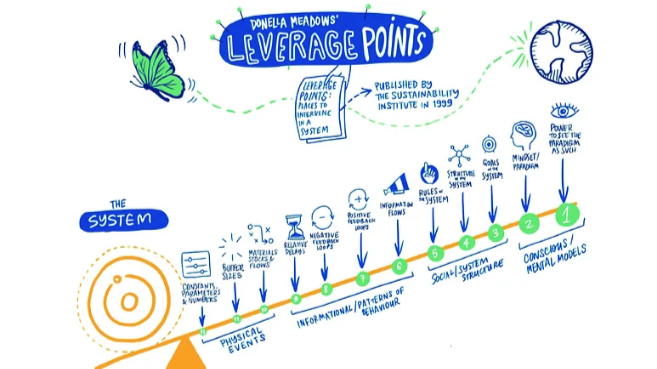
At around the same time as my collaboration with SOAS-ACE on navigating the political economy of corruption was coming to an end (see Part 2), I was also involved in a very interesting initiative led by Søren Haldrup at UNDP to develop a systemic, relational, and politically savvy approach to understanding and seeking to address transnational corruption. In a group session to develop that approach we were tasked with identifying promising entry points - which might become elements of a portfolio - for engagement in transnational systems of corruption. To note here, “entry points” seems more appropriate than “leverage points” for systems that are organic and emergent, rather than mechanical (see Jewlya Lynn and Julia Coffman’s 2024 piece on passing in the dark, as well as my piece on ecosystems, emergence and social change, for this distinction).
This was not easy. We could easily point to important parts of the system; tax havens, money laundering centres, secrecy jurisdictions, corrupt politicians and oil companies, Dubai, the City of London, weak laws on beneficial ownership, shell companies, dodgy procurement processes, and poorly regulated markets for real estate, for example. We might even be able to estimate what sorts of changes would be most impactful. However, working out where in the system it might be possible to encourage behavioural changes, and how that might be done, was much more tricky.
Shortly after the group session and with the SOAS-ACE work fresh in my mind, Søren - who is always up for reflection, learning and innovation - and I chatted about how the session had gone. We discussed the possibility that our efforts to identify promising entry points were challenging because they were not informed by an explicit understanding of what drives actors’ behaviours and relationships in a complex system of transnational corruption, and therefore where and how change might emerge in that system.
That is, we did not have a clear conceptual framework and associated criteria, to guide our search for promising entry points; we were somewhat lacking in hypotheses about how change happens and a way of making sense of the complex systems we were grappling with. This, I would suggest, is not just a problem faced by this UNDP initiative. Rather, it is a challenge that many initiatives to shift the dynamics of complex social systems face, and which few, it seems to me, do a great job of tackling.
The combination of my work with the SOAS-ACE team, discussions with Søren, and my reflections on the many other conversations I’ve been in about how one might engage effectively in complex social systems, led me to think three things:
- First, that it might help to think about the political economy of positive deviance; understanding how positively deviant behaviour (e.g. behaving in ways that do not enable money laundering, or choosing not to siphon public funds into private pockets) by particular actors emerges at particular sites in a system where the landscape of power, incentives and institutions, as well as the characteristics of the actors, allow and encourage it to emerge;
- Second, that considering the political economy of positive deviance might be relevant and useful for efforts to understand and engage with the dynamics of complex social systems more broadly rather than just in relation to corruption, including through public policy and institutional reform; and
- Third, that the SOAS-ACE approach to leveraging insights about how positively deviant behaviours emerge at sites where the configuration of actors, power and incentives is favourable - with some powerful actors following the rules rather than behaving corruptly, and encouraging others to do the same might have wider application as regards efforts to address complex social challenges.
For related explorations of identifying entry points for learning, engagement and impact in complex and emergent systems which are rich with insights, see Anna Birney on finding potential to intervene and leverage impact in a changing system, Ivana Gazibara on transition mapping, Jen Briselli on finding the next right moves, Orit Gal on social acupuncture, and Donnella Meadows’ classic on leverage points. Perhaps women tend to be more attuned to the complexities of life! My summarized highlights on all these pieces and more can be found here.
Next up, early next week, my reflections on conversations with Dieter Zinnbauer about power positive, a political opportunity approach to political economy analysis. In the meantime, have a think about approaches you’ve taken to understanding the dynamics of the challenges that you are focused on, in order to inform more effective engagement, and how that has worked out for you. Have you looked to identify bright spots? Have you been able to make sense of their complex causal dynamics? And have you been able to use that understanding to inform more effective action, including as regards public policies? Or, have you taken a different approach? Please add your thoughts to the comments, so that we can all learn along together.
PS: References and summaries of my highlights from many of the pieces that have informed my thinking are available here.
First published on LinkedIn, 25 July 2025.
Theme: Power, corruption and political economy
Topics: corruption, positive deviance, entry points and leverage points, political economy