Part 1 of 6 in a series, Complexity, corruption and change (July–August 2025).
Summary: This opens a six-part series on how change happens in complex social systems. I argue that bright spots of positive deviance, where behaviour is surprisingly good in otherwise broken systems, are vital entry points for understanding those systems. It also maps the rest of the series, and may interest anyone working on corruption or governance.
- Approaches to complex systems work best when aligned with how change actually happens, through relationships and emergence.
- Understanding how positive deviance arises can help design policies that extend it to other parts of the system.
- The later parts cover the SOAS-ACE guide, UNDP, islands of integrity, relational practice, and next steps.
About 4 minutes to read the full piece.
Introduction - How change happens: Emergence and engagement
Complex social systems change (and life happens!) through the communication, learning and adaptation that takes place in connections and relationships amongst different actors. These relationships, and the qualities of these relationships, are shaped by the behaviours of the actors involved. These behaviours are themselves shaped by the characteristics of the actors, in a landscape of power, incentives, and institutions, which those actors in turn shape through their behaviour and relationships. So it goes, it seems to me.
If they are to get traction and be effective, approaches to engaging with these sorts of systems - or contexts that can be understood in terms of complex social systems, for the systems skeptics in the house - need to be aligned with their characteristics and the emergent ways in which change happens. (See also my 2024 piece on ecosystems, emergence and social change, especially paras one and two, and page five).
This piece is itself a story of connection, communication, learning and change. It builds on a series of conversations and related pieces of work I’ve been involved in over recent months (see my review of the last six months, here), as well as several years of exploring various systemic, relational and learning-centred approaches to addressing complex social challenges, particularly in the global development space.
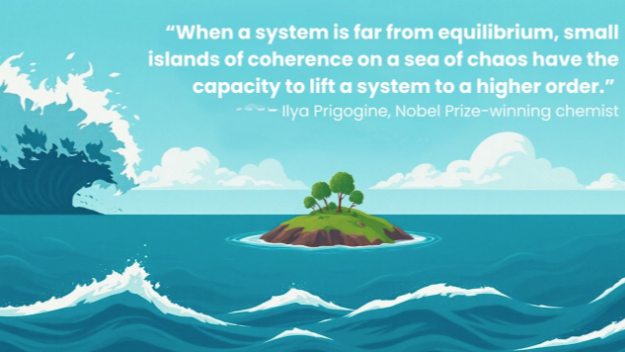
In this piece, building on the pioneering work of Jerry and Monique Sternin, and many others, I make the case that sites of positive deviance - bright spots where patterns of behaviour and relationships are surprisingly good in otherwise broken systems - provide vital entry points for efforts to understand the dynamics of complex social systems.
By developing and leveraging an understanding about how positively deviant patterns of behaviour and relationships emerge at particular sites in a social system, it is possible to design policies that can encourage, amplify and extend such patterns to other parts of the system. Put differently, by focusing on places where things are working well, we can better understand how change happens, and craft our change-making activities (and live our lives) so that they are informed by, and align with, how change actually happens, and are therefore more likely to be effective.
(For similar arguments in the anti-corruption space, made several years back, see Duncan Green’s posts on The C word: How should the aid business think and act about corruption?, and on how can the anti-corruption movement sharpen up its act?, from 2015 and 2017, as well as my 2016 piece on doing anti-corruption differently).
In the installments that follow from this introduction, I present the journey that I’ve been on in recent months in terms of four sequential acts. These acts build, not to some sort of finale, but to a patchwork of possibilities for further exploration, collaboration, and action.
- First, I reflect on the process of developing a guide to navigating the political economy of corruption with Kathy Bain and colleagues at the SOAS Anti-Corruption Evidence (SOAS-ACE) programme; (This piece, Part 2, is here).
- Second, I reflect on conversations with Søren Haldrup at UNDP on identifying entry points for learning and engagement that might shift the dynamics of transnational systems of corruption; (This piece, Part 3, is here).
- Third, I reflect on a recent piece by Dieter Zinnbauer on power positive, which makes the case for an approach to political economy analysis that focuses on identifying opportunities for change in contexts that are shaped by power and politics, as well as revisiting earlier work on islands of integrity, by Caryn Peiffer, Heather Marquette, and Rosita Armytage; This piece, Part 4, is here).
- And fourth, I reflect on my own recent work on reflective relational practice - an approach to collaboratively assessing the qualities of relationships that make social systems more than the sum of their parts - and the potential value of combining a relationships and learning lens with approaches that focus on power, incentives and behaviour. (This piece, Part 5, is here).
- Finally, I draw together the threads of my journey, and outline some avenues I am exploring and collaborations I am involved in to further develop, apply and test an approach to understanding and engaging with complex social systems that leverages learning about the political economy of positively deviant behaviours and relationships. (This piece, Part 6, is here).
The journey I’ve been on includes multiple steps, as well as a much longer back story. So, I’m putting this out as a series of posts, which I will then knit together. For those who are keen to dive deeper, along with a full list of references, I’ve also harvested a richly annotated bibliography from my ongoing knowledge gardening activities. Watch this space over the coming days as I walk through the steps of the journey I’ve been on. And, if you want to be in the loop for other resources I share, feel free to sign up for my occasional (monthly ish) updates, here. I’m always happy to connect!
First published on LinkedIn, 21 July 2025.
Theme: Power, corruption and political economy
Topics: positive deviance, corruption, political economy, emergence