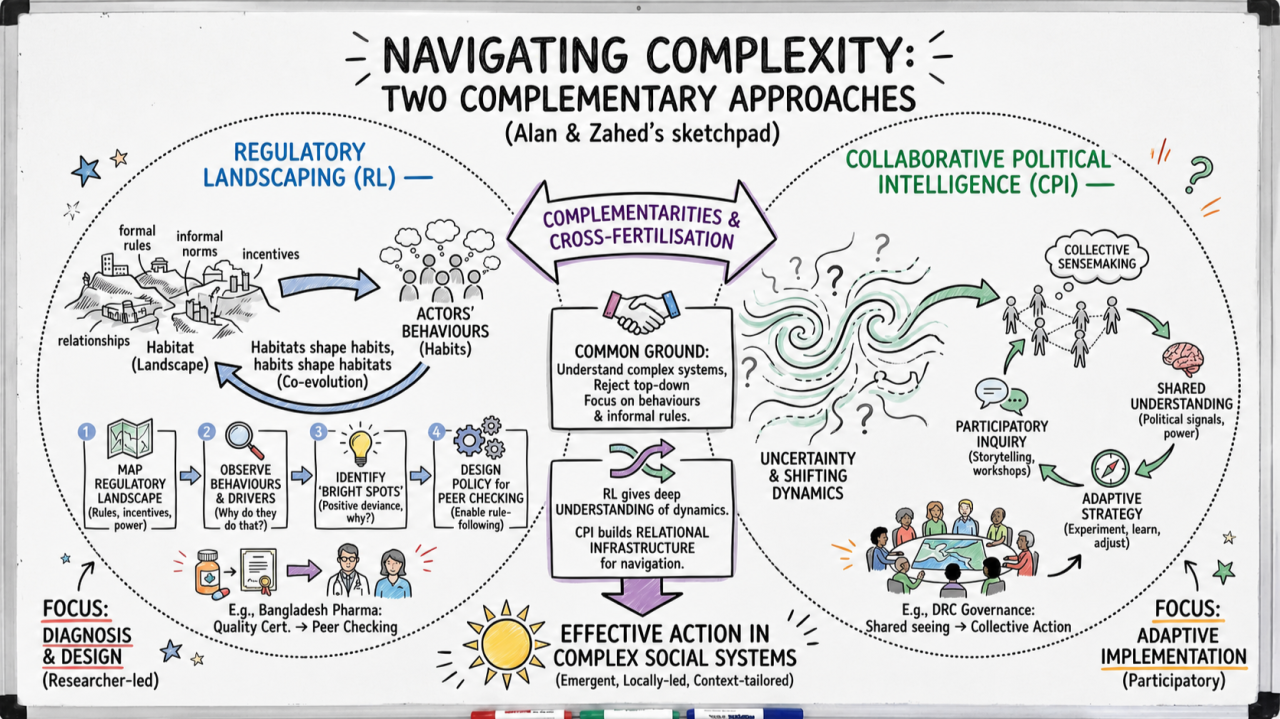
Summary: Zahed Yousuf and I co-wrote this after a June conversation in which we realised that it would be worth spending some time exploring the complementarities of our two approaches. It sets out my thinking on regulatory landscaping and Zahed’s on collaborative political intelligence, compares them, and offers three questions for shared exploration. It may help anyone working on political economy, governance reform or systems change.
- Regulatory landscaping is researcher-led and seeks reforms; collaborative political intelligence is participatory and builds adaptive capacity.
- Both make informal rules visible and see change in self-reinforcing behaviour patterns, so they complement each other.
- We pose questions on making the informal visible, working with conflict, and external actors’ roles.
About 14 minutes to read the full piece.
A shorter version of this post has been made available by Duncan Green, on the LSE website, with the title “Reading the room: Two ways to navigate political complexity”.
1. Introduction
Zahed Yousuf and I met online in early 2026 when I was synthesising forty reports on health systems corruption in Africa and South Asia using a “regulatory landscaping” framing, and Zahed was supporting governance reform in the Democratic Republic of the Congo in a way that aimed to nurture “collaborative political intelligence”. We quickly realised that our respective efforts, while different in thematic focus, were both about developing an understanding of the political economy dynamics of complex systems to inform more effective approaches to addressing social challenges. And, that while the approaches we were working with had different emphases, those differences might point to useful complementarities.
Over the course of a few months, sharing our experience with regulatory landscaping and collaborative political intelligence, we moved quickly to broaden the conversation to include others working in this area. On reflection, after challenging and constructive feedback from the participants in a conversation we hosted in early June, we realised that we had jumped ahead too quickly and failed to provide an appropriately generative framing for that discussion.
This short note aims to correct that failure, providing some building blocks to set the stage for future discussions. First, we provide an outline of what we mean by regulatory landscaping and collaborative political intelligence. Second, we compare those two ways of navigating complexity, teasing out their commonalities, differences and potential complementarities. And third, we outline some questions that might inform collaborative exploration and learning amongst people and organisations working in similar terrain.
While this piece is published initially on my LinkedIn profile, it is co-authored by the two of us, and will also be posted on Zahed’s Medium profile, where you can learn more about collaborative political intelligence.
2. Regulatory landscaping
What is the approach, and where did it come from?
Alan developed the “regulatory landscaping” framing while synthesising research on corruption in health systems that had been funded through the FCDO’s Anti-Corruption Evidence initiative, and in particular the SOAS-ACE research programme led by Mushtaq Khan and Pallavi Roy.
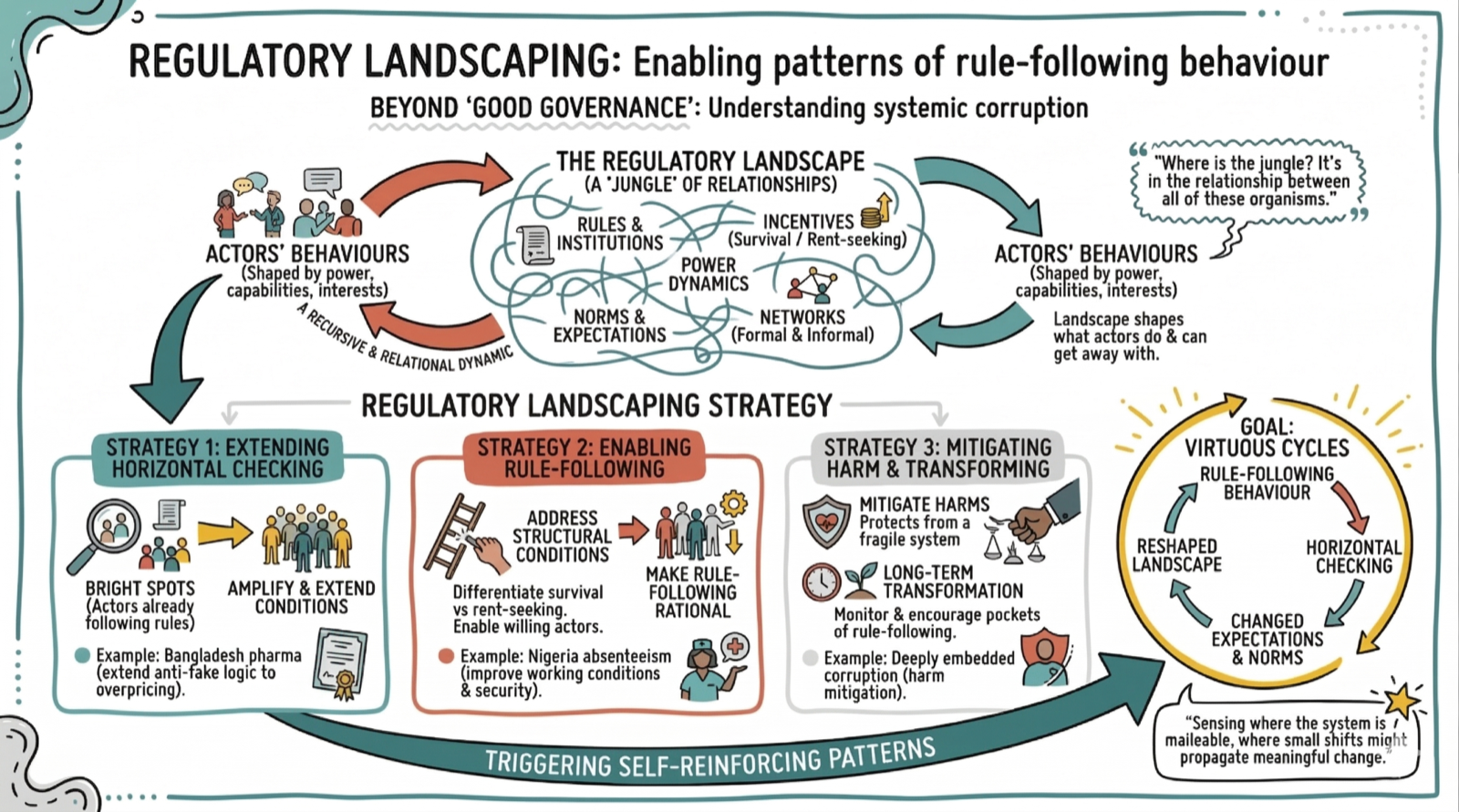
The core insight from this synthesis - an insight from the work of SOAS-ACE, and is also informed by wide engagement as regards the dynamics of complex social systems - is that patterns of corruption emerge and evolve as a result of the behaviour of actors operating in a regulatory landscape of formal and informal rules, incentives and relationships. Habitats shape habits, and habits in turn shape habitats, in an ongoing co-evolutionary process. Therefore, encouraging and enabling different patterns of behaviour in such systems requires reshaping the regulatory landscape, rather than relying on top-down enforcement and the punishment of individual actors.
Figure 1: Regulatory landscaping (From Alan’s March 2026 piece on “*regulatory landscaping*”)
How does the approach add value?
Many approaches to tackling corruption and addressing other governance challenges assume that stronger rules, enhanced accountability and normative appeals for “Good Governance” will change actors’ behaviours, including the behaviour of powerful actors who benefit from corruption and have the ability to obstruct reform and dodge accountability.
Regulatory landscaping, and a wider body of work on how change happens in complex social systems - all informed by daily observations of powerful actors behaving with impunity, in countries around the world - challenges that assumption. In these sorts of systems, behaviour is shaped by various aspects of the landscape that actors inhabit, not just the formal rules, and sustainable change happens when the landscape shifts in ways that incentivise a growing constituency of actors to adopt different, more constructive, behaviours.
As such, this approach adds value by grounding discussions of what policies might be effective in a sound understanding of how change happens in co-evolving complex systems. This helps to inform the design of policies that might be feasibly implemented given the existing configuration of actors and their respective power, capabilities and interests, rather than policies that might look good on paper but have little chance of being implemented effectively. That is, it supports the design of strategies - for SOAS-ACE, public policies - that are tailored, or adapted, to the dynamics of particular contexts.
What does it look like to put the approach into practice?
The SOAS-ACE application of regulatory landscaping involves researcher-led political economy analysis, typically carried out by local researchers with deep contextual knowledge gained through lived experience. It asks not “what rule would we want actors to follow?” but “what policy might trigger or extend self-reinforcing patterns of rule-following?” Addressing this question entails the following four steps:
- Mapping the regulatory landscape of rules, incentives, norms, institutions and relationships around a particular policy challenge and flow of resources which might be subject to corruption;
- Observing actors’ behaviours and analysing their causal drivers, paying careful attention to actors’ power, capabilities and interests and the regulatory landscapes they inhabit;
- Identifying “bright spots” of positive deviance where some actors are already following the rules, and understanding why that is, both in terms of actors’ characteristics and the nature of the regulatory landscape;
- Designing policies that enable rule-following and leverage the power of horizontal peer checking to extend pockets of positive deviance, supporting the emergence of self-reinforcing patterns of rule-following behaviour.
In Bangladesh’s pharmaceutical sector, the process of regulatory landscaping found that companies were bribing doctors to prescribe expensive brand-name drugs by exploiting the lack of reliable information about the quality of less expensive generic alternatives. Although the government regulator was too weak to stop these practices, the analysis suggested a market-based solution: requiring mandatory certification of quality for all medicines.
By demonstrating that generics met the same quality standards as premium brands, this certification allowed manufacturers of generics to challenge misleading quality claims. This change in the informational environment, in the context of a highly competitive market, triggered horizontal peer checking by actors acting in their own interests. This created a competitive dynamic amongst companies that shifted prescribing behaviors and reduced corruption without relying on top-down enforcement. (See this summary of “The overpricing of medicines in Bangladesh: Quality certification as an effective anti-corruption tool”, by Mushtaq Khan and colleagues, for further details).
3. Collaborative Political Intelligence
What is the approach, and where did it come from?
Collaborative Political Intelligence (CPI) emerged from Zahed’s work in conflict-affected and fragile governance contexts, including an FCDO-funded governance reform programme in the Democratic Republic of the Congo. Zahed’s focus on CPI stems from three related frustrations that both authors share: first, that political economy analysis is too often treated as a product to be delivered rather than a capability that supports adaptation over time; second, that governance reforms frequently fail because they do not adequately account for the political dynamics shaping how systems evolve; and third, that approaches to collective sensemaking and systems change often pay insufficient attention to questions of power, incentives and political strategy.
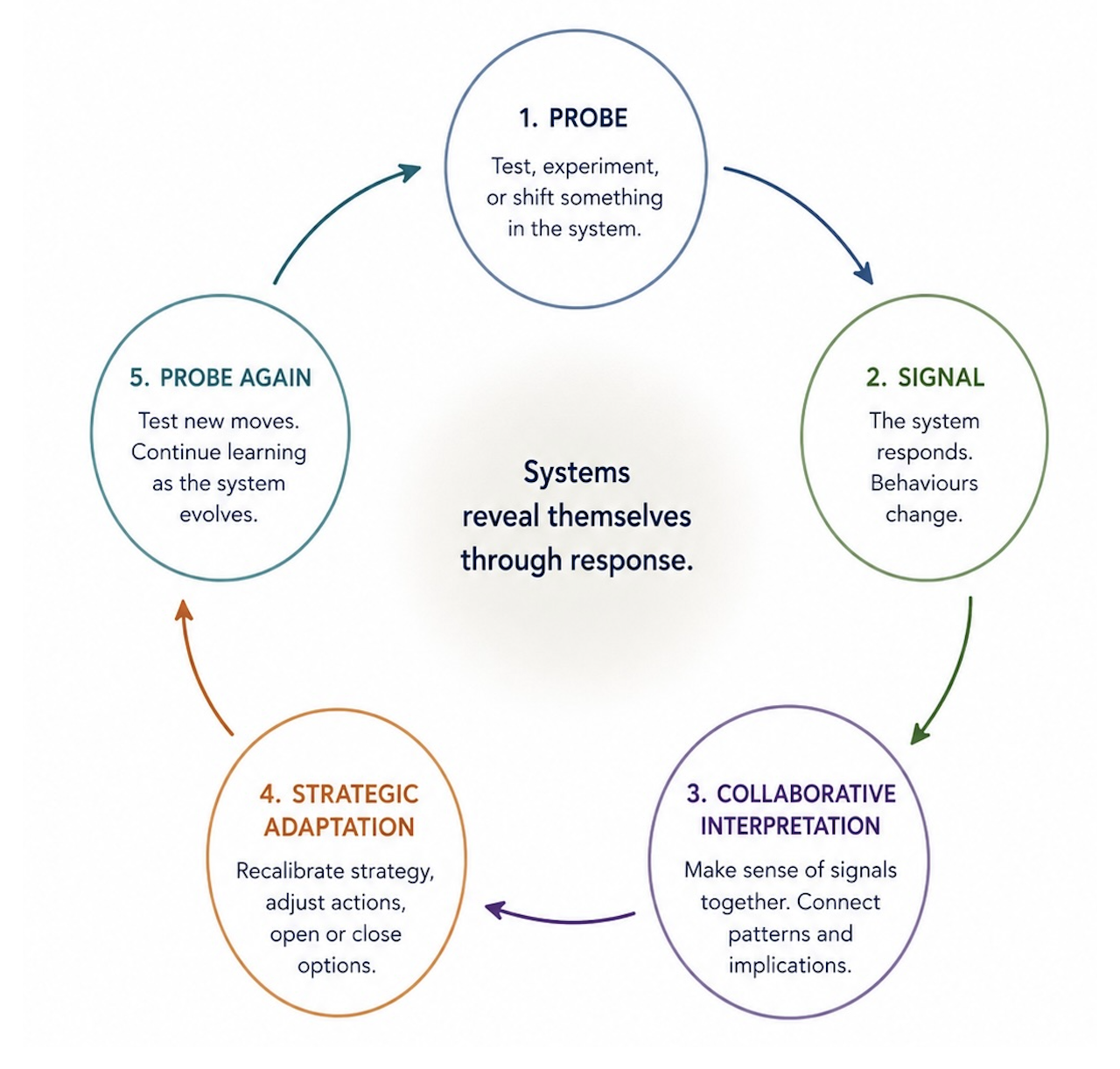
Beyond these frustrations, the core insight that motivates CPI is that actors operating in complex social systems must continually navigate uncertainty. Political dynamics, incentives, relationships, authority structures and informal practices are constantly shifting, generating signals about how the system is evolving. This raises the question of how actors can collectively interpret those signals on an ongoing basis, to understand how the system is responding, and on that basis to adapt what they are doing.
CPI is therefore best understood as a collective capability rather than a specific methodology. It seeks to strengthen the ability of diverse actors to generate, interpret and act upon political intelligence together, enabling them to adapt as conditions change. Workshops, participatory inquiry, probing, behavioural observation and collective sensemaking are not CPI itself, but are ways in which this capability can be developed and exercised.
How does the approach add value?
CPI sits at the intersection of political economy analysis and collective sensemaking. It emerged from an interest in combining the political attentiveness of the former with the participatory and interpretive qualities of the latter. The aim is to help actors collectively interpret the political realities they are part of and use that intelligence to inform action under conditions of uncertainty. Rather than relying primarily on expert analysis, it enables actors to generate shared intelligence about the systems they are part of and the uncertainties they face.
One of CPI’s notable contributions is the treatment of actors’ behaviours as data about the political - and political economy - dynamics of the system, something which, in different ways, appears in the “observing actors’ behaviours” step of the regulatory landscaping process. Rather than relying solely on formal reporting or stated commitments, it pays attention to how actors respond in practice. Patterns of resistance, partial compliance, performative compliance and sincere compliance with reform initiatives become signals that help actors interpret how the system is adapting and update their strategies accordingly.
Like the process of regulatory landscaping, CPI recognises that sustainable change rarely occurs through top-down enforcement alone. Change takes root when new patterns of behaviour, expectations and relationships begin reinforcing one another across networks of actors. CPI strengthens the collective capacity to recognise, interpret and respond to those dynamics as they unfold.
Figure 2: CPI’s adaptive cycle - How systems learn politically, through collaborative interpretation (From Zahed’s May 2026 piece on “From collective intelligence to collaborative political intelligence”)
What does it look like to put the approach into practice?
In the Democratic Republic of the Congo, the approach involved a three-day collective sensemaking workshop bringing together actors from across the public finance, health and education systems, including representatives from ministries, public finance institutions, civil society organisations, tax administrators, community representatives and women’s groups. Using structured storytelling and the Cynefin Company’s estuarine mapping framework, participants moved from individual experiences to a shared understanding of how the system functioned in practice. This process surfaced hidden codes, informal rules and political dynamics such as the governor’s parallel budget unit, unofficial teacher salary deductions and tax bills negotiated in the street.
Importantly, this was not simply an exercise in collective sensemaking. It was also a form of participatory political economy analysis. Participants developed a shared understanding of the incentives, relationships, constraints and power dynamics shaping behaviour across the system. In this respect, CPI and regulatory landscaping share a concern with making visible the landscape which shapes actors’ behaviours, although they do so through different modes of inquiry.
From this shared understanding, cross-system groups were established to experiment and learn around pressure points where power is concentrated, negotiated and defended. Drawing on ideas associated with Reos Partners’ Stretch Collaboration and Cynefin’s approach to navigating complexity, participants with differing interests, positions and perspective worked together, probing the system to generate signals about its evolving dynamics which could be collectively interpreted to adapt their strategies for engagement.
The process of building collaborative political intelligence - the shared analytical language, cross-actor relationships, and routines for behavioural observation, collective sensemaking, and adaptive decision-making - strengthens the civic infrastructure required for social change. The result is not simply better analysis, but an enhanced capacity for collective navigation under uncertainty and a stronger foundation for adaptive and emergent strategy over time.
4. Commonalities, differences and complementarities
Commonalities
Regulatory landscaping and collaborative political intelligence have much in common. They share a common goal of seeking to understand how change happens in complex social systems, in order to inform more effective action. They both focus on observing and understanding the behaviours of actors operating within a landscape of rules, incentives, norms, institutions and relationships, and associated power asymmetries. They both seek to make visible the informal rules and relationships that - along with formal institutions - shape actors’ behaviours. They both see self-reinforcing patterns of behaviour across networks of actors as the source of sustainable change. And, they both reject purely technical or top-down approaches to shaping social change.
Differences
Table 1: Key differences between regulatory landscaping and collaborative political intelligence
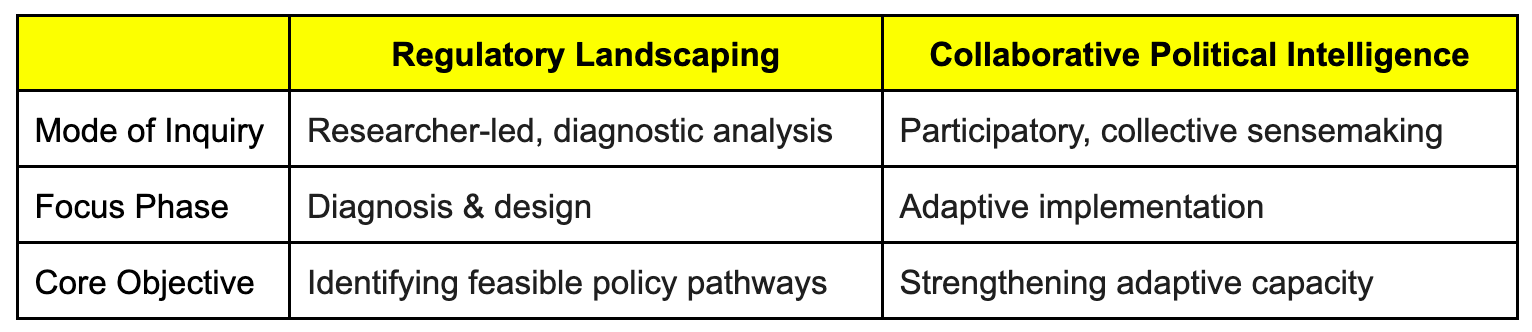
The table above highlights that while the two approaches share the common goal of supporting efforts to improve the dynamics of complex social systems, their internal logic differs across three dimensions.
Mode of inquiry
First, the two perspectives differ in their mode of inquiry; that is, the ways in which an understanding of actors’ behaviours and the dynamics of the system is generated and used. Regulatory landscaping, at least as deployed in the SOAS-ACE programme, is a researcher-led approach for understanding the landscape and informing the design of public policy. CPI, in contrast, is more participatory in nature, with a rich strand of collective sensemaking, not because participation is a good thing in itself, but because those who are actively navigating complexity are often best placed to recognise and respond to shifts in the landscape.
Focus phase
Second, CPI and regulatory landscaping differ as regards where in the process of diagnosing challenges, designing strategies, and implementing those strategies, they make their primary contributions. The SOAS-ACE approach - the inspiration for regulatory landscaping - focuses on diagnosing challenges to inform the design of public policies. While it would be possible to use the approach to support the ongoing adaptive implementation of policies and strategies, the approach is not currently configured for this purpose. CPI, on the other hand, places greater emphasis on how actors navigate uncertainty as the landscape evolves, including in response to the implementation of policies and reforms.
Core objective
These differences in mode of inquiry and focus phase reflect and support the differing objectives of the two approaches. Because regulatory landscaping is based on the insight that habitats shape habits, its core objective is to identify reforms that might feasibly reshape the habitats from which patterns of behaviour emerge. Because CPI is based on the insight that the music and the dancing never stop, its core objective is to strengthen adaptive capacity, enabling actors to collectively generate and use political intelligence to navigate complexity and the regulatory dancefloor as the music plays on.
Complementarities
While the differences between regulatory landscaping and CPI are real, they also point to deep complementarities. Put simply, regulatory landscaping contributes a rich understanding of the relational and political economy dynamics of complex social systems, while CPI strengthens actors’ capability to navigate uncertainty within those systems.
The complementarity is particularly strong around horizontal checking and the role of relationships in processes of social change. Regulatory landscaping explains how new patterns of behaviour can spread across systems, while CPI - by strengthening shared understanding, weaving the relational infrastructure and establishing routines for collective sensemaking - nourishes the soil from which these patterns might emerge.
Regulatory landscaping and CPI offer interesting approaches to informing and supporting the adaptive and emergent approaches that are needed to navigate complexity and the uncertainty that it entails. Together, they have the potential to both help actors to understand the nature of the landscape and to generate and use political intelligence to navigate that landscape as it continues to evolve.
5. Further exploration — questions for collaborative inquiry
The comparison between regulatory landscaping and collaborative political intelligence points towards a number of questions for collaborative inquiry. Going beyond points of methodology, these questions relate to broader issues of participation, conflicting interests, legitimacy and power that matter to anyone trying to support change in complex, informal and politically contested contexts, no matter what framework or approach they are working with. We offer them here as an invitation and food for thought. If you would be interested in exploring them together - drawing on your experience of navigating complexity - or have suggestions for other questions worth asking, please do drop us a line.
Q1: What does it take to make the informal landscape visible, in ways that are useful to actors who are designing strategies and taking action?
Making the informal more visible is a commitment shared by regulatory landscaping and CPI, but the two approaches, with their researcher-led and more participatory processes, make different things visible, in different ways, to different groups of actors. What surfaces through participatory processes, for instance, may stay hidden from researcher-led analysis, and vice versa. This suggests that it might be fruitful to explore, together, what aspects of the landscape it is most useful to make visible, to whom, and in what ways, in order to inform strategies and action that will support processes of social change, and to consider the consequence for the actors involved of making visible previously hidden features.
Q2: How can approaches to supporting change in complex systems work constructively with the reality of conflict?
Neither regulatory landscaping nor CPI assumes that the actors they engage with are aligned in terms of their interests. Rather, they focus on exploring what mutually beneficial deals might be possible across a landscape of diversity, when common ground may be hard to find. This points to broader questions about how emergent change can best be nurtured when - as is almost always the case - interests are not fully-aligned and actors have different views of desirable futures and how to get there. Collaborative learning about how a broader range of approaches handle the reality of conflict and competing interests, rather than assuming them away or working only with actors whose interests are more clearly aligned, could be very useful.
Q3: How can external actors play a regenerative role that supports locally-led reforms, rather than a colonial and extractive one?
Regulatory landscaping and CPI both take the view that if policies are to be implemented effectively, and if governance reforms are to take root, they need to be tailored to their contexts, with local actors in the lead as regards both ambition and approach. Our sense is that these approaches can support locally-led processes, but there are hugely important questions about the value, limits and potential harms of external engagement by actors - including well-intentioned actors - with power, resources and interests that may well be at odds with the priorities of local actors.
External actors, including actors fired-up with visions of systems change, the synergistic wonders of systemic investing (see my recent piece on systemic investing in context), or British blokes who are enthusiastic about estuarine mapping, for instance, should not be setting the agenda or dictating the approach. Exploring whether and how external actors can play a helpful role in supporting systems change that is locally-led, and emergent from context - and how in-context actors can make good decisions about whether and how to involve external counterparts - is an area ripe for further collaboration.
Cross-fertilisation and complexity
All three questions are part of a wider terrain of challenges and opportunities. Regulatory landscaping and collaborative political intelligence each combine, in their own way, the rigour of political economy analysis with the practical wisdom of collective sensemaking. Both are instances of a practice of adaptive and emergent strategy in contexts of complexity, uncertainty, informality and contested power that is, and will perhaps always be, under construction.
Our sense is that cross-fertilisation between approaches that focus on the ways in which political economy dynamics shape actors’ behaviours, and approaches that use narratives to support sensemaking about the landscapes in which people live, might be very fruitful. Our hope is that this note will contribute to opening up that wider terrain for collaborative learning that enhances our collective capacity to adapt, to navigate complexity, and to contribute appropriately to processes of social change.
First published on LinkedIn, 23 June 2026.
Theme: Power, corruption and political economy
Topics: regulatory landscaping, collaborative political intelligence, political economy