Summary: Earlier this year I synthesised forty reports on health-systems corruption, and the phrase “regulatory landscaping” popped into my head for what I was doing. I describe where the idea came from, how it connects to my work, and my embarrassment at finding it was central to my 1996 PhD. I shared it to invite connection and critique; it may interest anyone working on governance and complexity.
- Regulatory landscaping means reshaping the incentives and rules that shape behaviour, so rule-following becomes rational for more actors.
- I later realised I’d written about regulatory landscapes in my 1996 PhD and a 1998 article.
- The idea now runs through several strands of my current work and collaborations.
About 8 minutes to read the full piece.
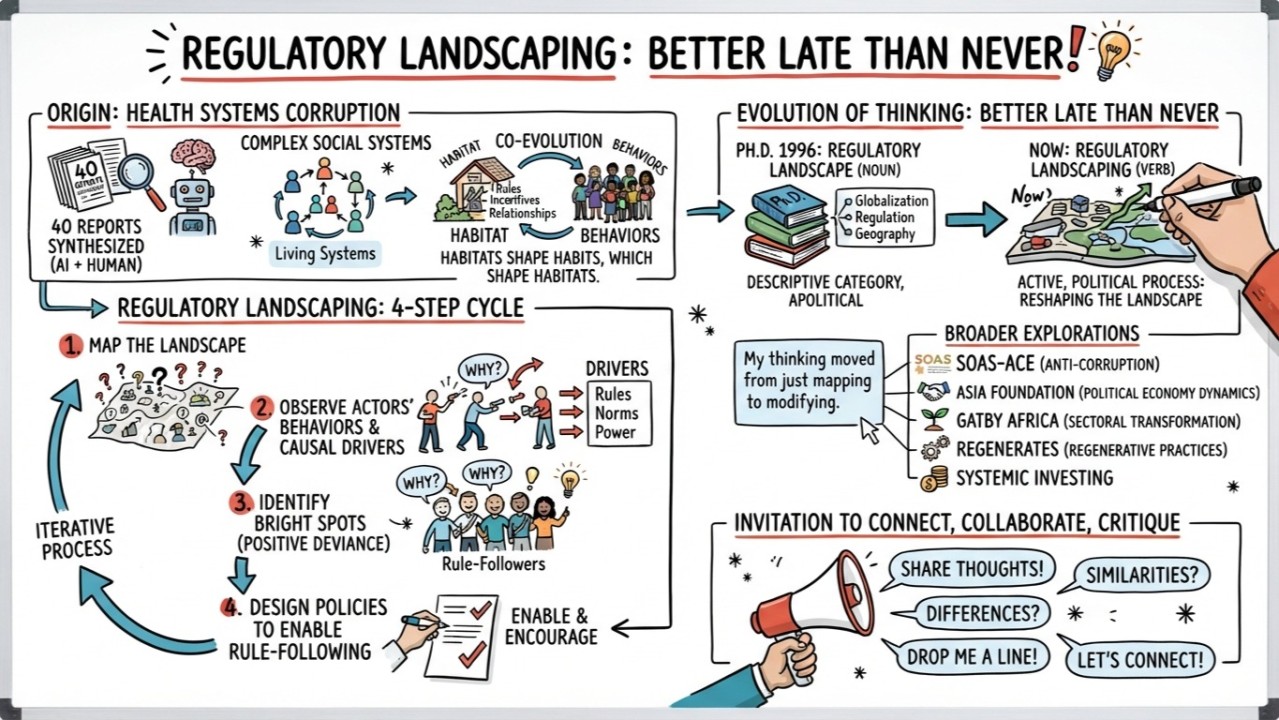
Introduction
With more things to share than I have time to fully prepare, I’ve decided to start sharing “Seedlings & Sparks” - short notes on things I’ve been doing, which are far from fully formed, but which may spark others’ thoughts and are intended to invite engagement. This piece shares some reflections on the notion of “regulatory landscaping”, an idea and set of practices that has become an increasingly important strand of my work over the last six months.
In what follows, I:
- describe how “regulatory landscaping” emerged from my work on health systems corruption;
- reveal, with a little embarrassment, that my focus on regulatory landscaping is a poorly remembered 30 year old blast from the past;
- explain how this set of ideas and associated practices is now featuring across my work; and
- outline how my thinking about regulatory landscaping continues to evolve as I explore its potential value with various colleagues, across a variety of domains.
How the concept of regulatory landscaping emerged from my work on health systems corruption
In the first few months of this year, I had the pleasure of synthesising 40 reports on corruption in health systems that had been produced by researchers with deep, lived experience of corruption in Nigeria, Tanzania, Uganda, Bangladesh and wider regional contexts, under the FCDO’s Anti-Corruption Evidence programme, and in particular through SOAS-ACE.
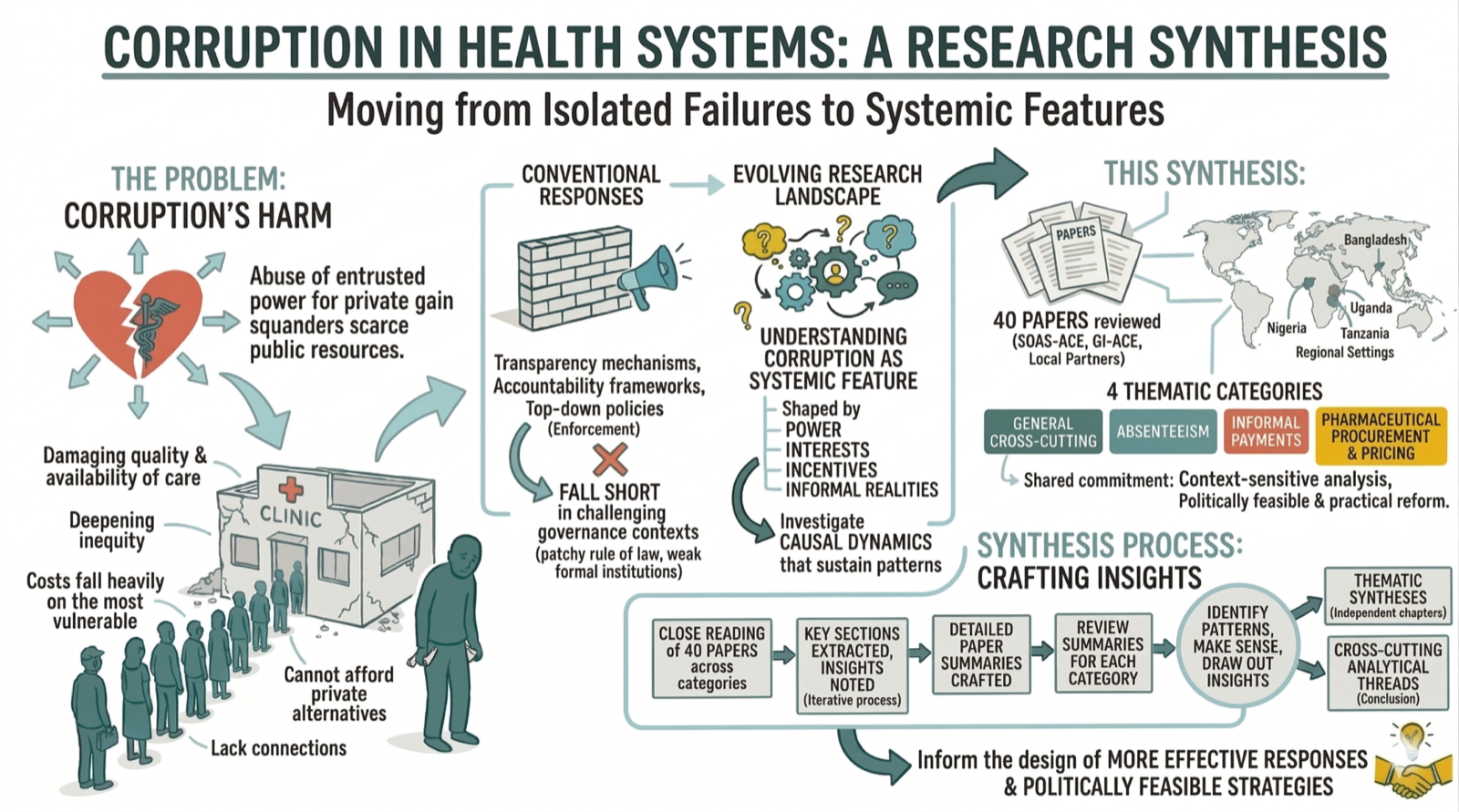
Image: Author’s own, created with Nano Banana
The synthesis report had four substantive chapters, focused on: moving beyond “Good Governance” approaches to addressing corruption; health worker absenteeism; informal payments; and, pharmaceutical procurement and pricing. A concluding chapter sought to weave things together in ways that would make the whole more than the sum of its parts. The full report is here, with a shorter summary shared by Duncan Green, here.
To get the synthesis done in the time available, to the standard required, I made use of AI to help me make sense of the data, and to ensure that the narrative I crafted stayed true to the research it was based on; see my piece on a human and some loops. I also leaned heavily on the SOAS-ACE approach to understanding and addressing policy-distorting corruption, an approach to understanding and engaging with the dynamics of complex social systems that has - alongside other approaches - become an important feature of my work in recent years. See also navigating the political economy of corruption, which Kathy Bain and I led on.
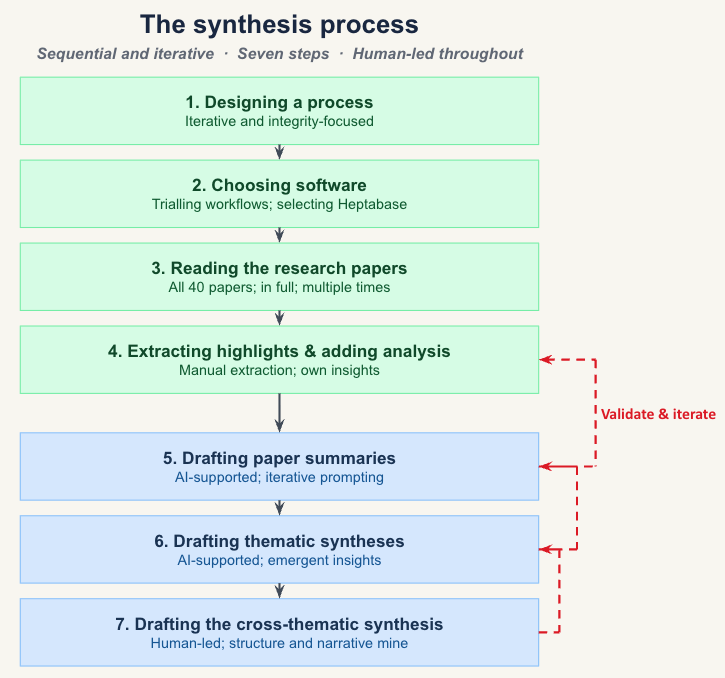
The AI-supported synthesis proces
But then, just a few weeks prior to publication, the phrase “regulatory landscaping” popped into my head, seemingly out of the blue, late one evening. I quickly realised that it might provide a useful label for a process of understanding the behavioural dynamics of complex social systems - in this case systems of corruption - in ways that inform actions that might shift those dynamics by altering the landscape in which they take place, and thereby address corruption.
The core idea here (one that is common currency in discussions of complexity, but is much less common in the sphere of governance and anti-corruption) is that in complex social systems - aka living systems, or life - change happens through ongoing processes of co-evolution between the contexts that shape actors’ behaviours and the behaviours that take place in those contexts. Habitats - that is, the regulatory landscape of rules, incentives, norms, institutions and relationships - shape habits, which in turn shape habitats.
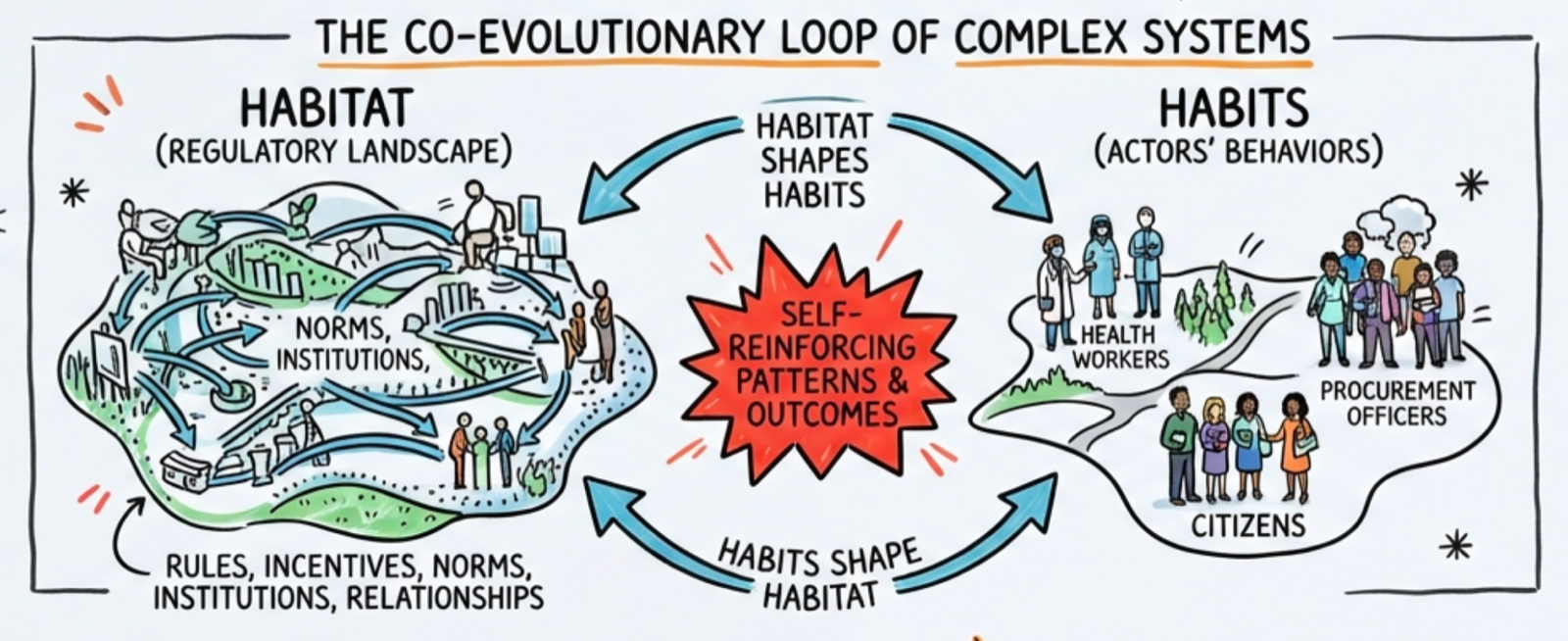
Understanding processes of co-evolution, the argument goes, can inform policies and strategies that aim to modify the context, or landscape, to encourage and enable different behaviours that might - by triggering self-reinforcing patterns of self-interested behaviour - shift the dynamics of the system and the patterns (outcomes if you prefer) that emerge. In short, the language of regulatory landscaping was intended to describe an approach to addressing corruption that involves reshaping the landscape of incentives - formal and informal - so that rule-following becomes rational for a growing constituency of actors.
As the summary piece shared by Duncan Green outlined, regulatory landscaping can be put into practice through a four-step process of:
- Mapping the regulatory landscape around a particular corruption challenge
- Observing actors’ behaviours and analysing the causal drivers of those behaviours
- Identifying actors who are already following the rules - at bright spots of positive deviance - and understanding why that is
- Designing policies to enable and encourage rule-following behaviours
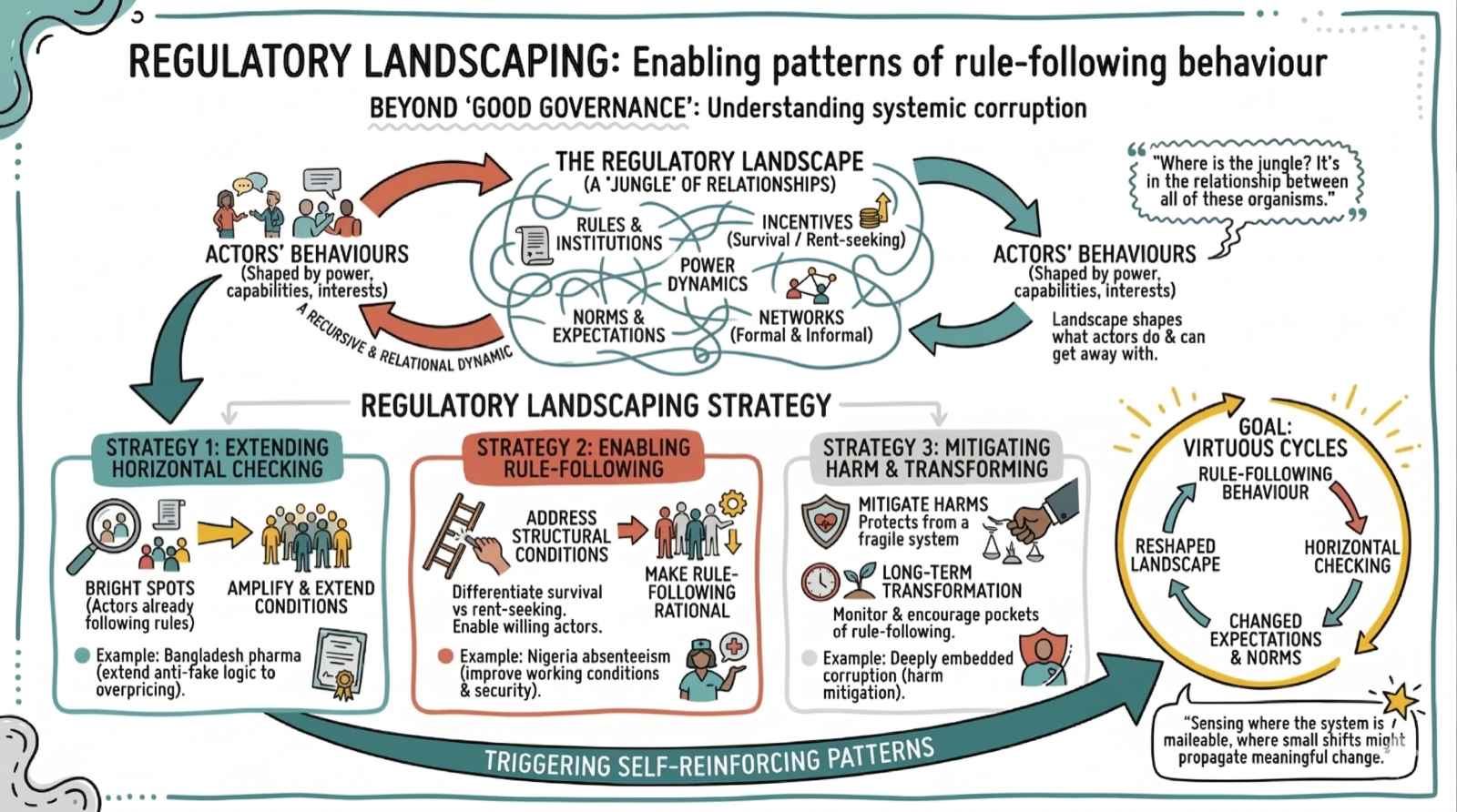
Image: Author’s own, created using Nano Banana
A blast from the past - Doh, and Double-Doh!
To my slight embarrassment, a few days later - having gotten rather excited about the potential of the “regulatory landscaping” concept - I realized that the notion of “regulatory landscape” had been central to my Ph.D., which I finished in 1996. Doh!
With the title “Globalization, regulation and geography”, my Ph.D. was about the relationship between processes of financial globalization and practices of sovereignty, with a focus on offshore financial centres hosted in the Bahamas and the Cayman Islands. So, the focus was on flows of money, crossing borders, and using claims of sovereignty, in havens that provided secrecy, to enable tax avoidance and evasion. And, the emergence of a patchwork of regulatory landscapes that actors - particularly those with power and money, or claims to sovereignty - navigate and exploit.
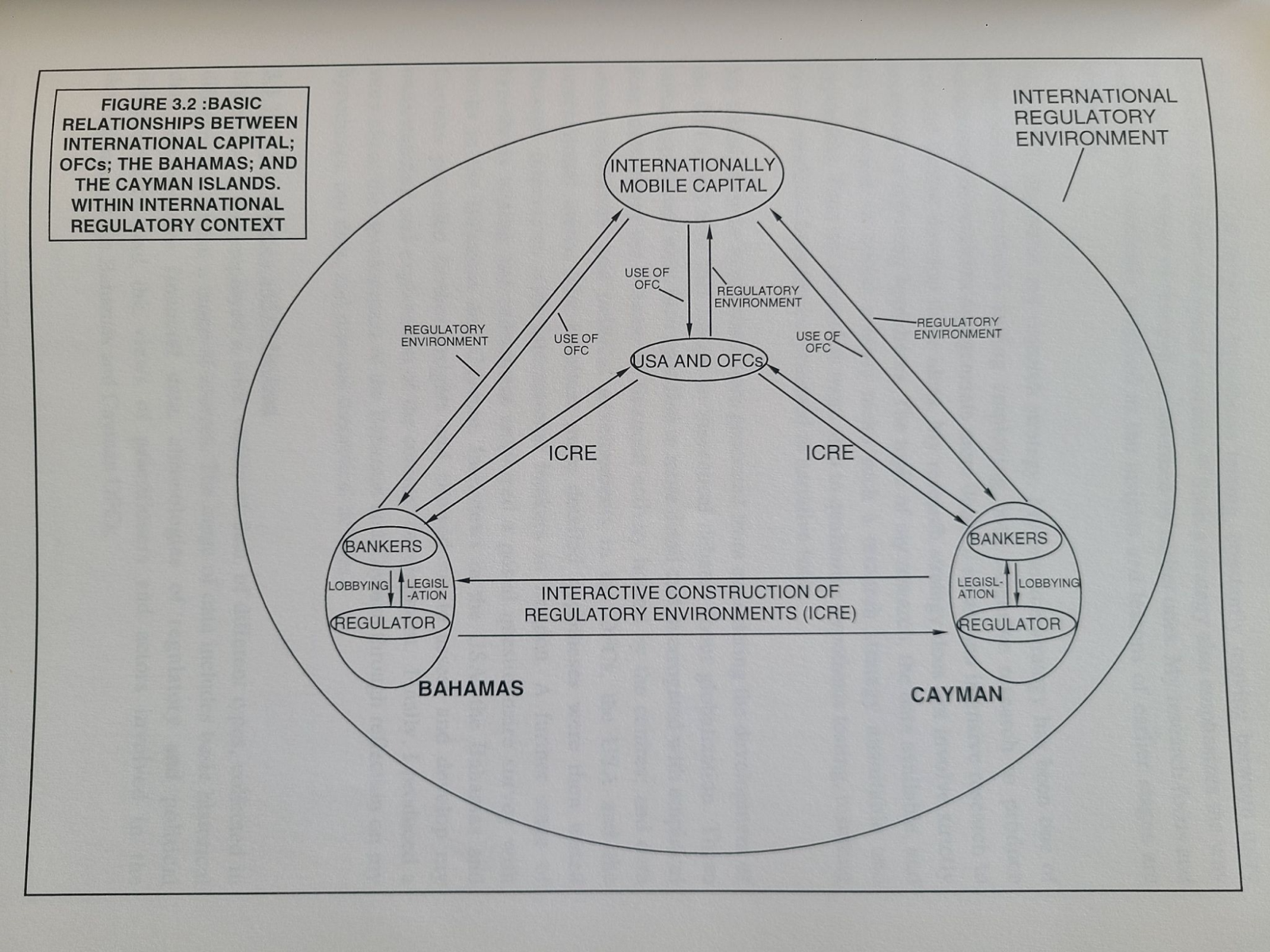
Author’s own: Diagram from 1996 Ph.D. on globalization, regulation and geography
Remembering this, I initially felt that my thinking had evolved over the last thirty years, at least a bit, moving from regulatory landscape as noun, a descriptive category, to regulatory landscaping as verb, a more active and political process of reshaping the regulatory landscape. I was glad that, better late than never, my thinking had - in line with why I left academia - moved beyond the conceptually neat but largely apolitical approach I’d adopted, with misgivings, 30 years ago. Rather than just mapping the landscape, my focus was now - belatedly - on mapping and making sense of the landscape to support efforts to modify it.
But then I remembered that I’d published a piece in 1998 on “reshaping the regulatory landscape”, and wondered - sliding doors style - how the last thirty years might have been different if I had continued to explore that path. Looking more closely, I spotted that the abstract I’d written for that piece began as follows: “Processes of globalization involve changes in the spatialities of power and social relations. This article develops a theory of regulatory landscapes, as a conceptual tool to aid our understanding of processes of globalization.” Yikes. And Double Doh! Oh well, such is life I guess.
Regulatory landscaping and related explorations
Anyway, better late than never, the idea of “regulatory landscaping” and the sorts of practices it might entail has become increasingly central to my work. And, more broadly, to my perspective on the dynamics of complex social systems and how one might contribute to the emergence of “living, learning and loving systems”. Yep, I’m registered as that - somewhat tongue-in-cheek - with the tax authorities, and am playfully serious about it.
In addition to my work with SOAS-ACE colleagues on complex systems of corruption, the notion of regulatory landscaping is now informing my work across a broader range of issues. This includes work with particular partners - clients, I guess - on research and policy engagement that takes proper account of the political economy dynamics of policy reform (with the Asia Foundation); and on sectoral economic transformation and how that might be supported by a co-evolutionary understanding of political economy dynamics (with Gatsby Africa).
It also includes my unfunded explorations of systemic investing in challenging governance contexts, of market systems development and political economy analysis with Luis Osorio-Cortes, on understanding the landscape and sensing how it moves with Zahed Yousuf and - returning to my geography roots - some initial explorations of placed-based regenerative practices with Chris Kaput and Dennis Posthumus at Regenerates.
The commonality across my areas of exploration is not the four-step regulatory landscaping process. Instead, it is the underlying world view. Habitats (regulatory landscapes) shape actors’ behaviours. Actors’ behaviours, individually and collectively, in turn shape habitats. And understanding that co-evolutionary dynamic - finding bright spots and understanding why they exist - is the key to designing interventions and taking action that works effectively with the grain of that dynamic.
As Dave Snowden’s work on estuarine mapping - an important reference for regulatory landscaping, albeit one which handles power and incentives in ways that are less explicit than political economy analysis - makes clear, the point is to get a sense of the patterns, and then “deploy policy into those patterns, because you know the ground was receptive” (noted in this post by Mick Brian). Or, as Jen Briselli puts it in her letter to a young systems thinker, “sensing where the system is malleable, where small shifts might propagate into meaningful change”.
Across the range of my explorations, the relevance and application of regulatory landscaping is different, with fresh insights emerging, shaping and reshaping my thinking and practice. So, for instance, Zahed’s “collaborative political intelligence” approach to sensing how the system moves is more participatory and adaptive - more local actors making sense of their own landscapes, collaboratively, to inform their own actions - than the research-led approach of SOAS-ACE. And, my explorations of how regulatory landscaping might connect and support regenerative practices, through engagement with colleagues who live and know the realities of regenerative agriculture in Latin America, is opening up fresh horizons and fertile terrain, including as regards the adaptive capacities of actors and systems, and the importance of attunement, signals, calibration and sensemaking.
An invitation to connect, collaborate and critique
I’m sharing these reflections not to say that “regulatory landscaping” is the bees’ knees (perhaps bee’s knees are individual?!), or an amazing new idea. My intellectual archaeology and the countless connections that got me to this point over the course of the last 30 years demonstrate that that is clearly not the case.
Instead, I’m sharing a bit about the territory I’m exploring, to invite connection, collaboration and critique. If reading this note has sparked any thoughts about similarities, differences, complementarities or conflicts with things you are doing, and perspectives you are finding useful, I’d be glad to connect. Please do drop me a line.
Please follow me on LinkedIn, or sign up here, if you want to be in the loop for occasional updates about my explorations in the landscape of complexity and social change.
First published on LinkedIn, 5 August 2026.
Theme: Power, corruption and political economy
Topics: regulatory landscaping, corruption, health systems, governance