Assessing and enhancing the quality of our relationships
Summary: Relationships are what make social systems more than the sum of their parts, yet few organisations take the time to reflect on them. Reflective relational practice offers a simple participatory way to assess the quality of relationships across four dimensions, and to use what emerges to strengthen them.
About 9 minutes to read the full page.
“The most important unit of analysis in a system is not the part (e.g. individual, organisation, or institution), it’s the relationship between the parts.” (Brenda Zimmerman, quoted in The relational work of systems change, Katherine Milligan, Juanita Zerda, John Kania)
Introduction
Reflective relational practice is an approach which enables people and organisations to assess, inform and enhance the ways in which they relate to one another.1 In this way, reflective relational practice has the potential to improve the quality and coherence of the relationships which make complex social systems more than the sum of their parts, enabling better outcomes to emerge. On this page, I outline what reflective relational practice is, why it might be useful and how it might be implemented.
Reflective relational practice is not rocket-science. Indeed, reflecting on the qualities of relationships in order to improve them is likely as old as humanity itself, and perhaps older still. It is also an approach that has developed, in different ways, with different language, across many different fields and cultures. However, while elements of the approach presented here have been deployed by other organisations in the global development and wider social change space, to my knowledge few have put such an approach fully into practice (although see the Relationships Project’s relationships heatmap).
This page is written with the aim of supporting exploratory conversations about reflective relational practice, whether it might be useful and how it might be implemented, rather than making specific recommendations about how it should be implemented. This reflects the need for additional conversations and collaboration to inform the development of this approach. It also reflects the fact that for the approach to add value to organisations and the systems they are part of, it will need tailoring to particular contexts, with that tailoring led by people who are familiar with the dynamics, challenges and opportunities that organisations are grappling with.
What is reflective relational practice?
Reflective relational practice provides a structured approach to enable people and organisations to enhance the relationships that they are in, by being intentionally reflective about those relationships, and using those reflections to inform the actions that they take. It is based on an understanding of how change happens in complex social systems, as a result of: the behaviours of a diversity of actors; their interactions and relationships; the learning, institutions and other outcomes that emerge from these relationships; and the ways in which the various patterns that emerge shape the context for future decisions, behaviour and interactions (Alan Hudson and Kathy Bain, 2023 – Systems of Corruption).
The approach’s potential lies in its simplicity and widespread applicability. Reflective relational practice is an approach that we can all put into practice to assess, inform and enhance the relationships that we are in, thereby strengthening the systems and communities that we are part of, and their capacity to address complex social challenges such as poverty, corruption and conflict. If you want to change the outcomes that emerge from a system, you need to do things that will support – directly or indirectly – changes in the relationships that shape its dynamics and capacity. Reflective relational practice helps people do just that.
Why might it be a useful component of working in systems?
Relationships are the connective tissue that make societies and systems more than the sum of their parts (Sam Rye, 2024, On relational infrastructure). Healthy relationships foster collaborative learning and action that is informed by and adapted to the local context, knitting together social systems so that they are well-placed to address complex social challenges. Dysfunctional relationships and social polarisation undermine the coherence and integrity of social systems, hindering individual and collective agency, impoverishing the adaptive capacity of such systems, and making it harder to address challenges that are complex, emergent and fundamentally social.
Healthy relationships contribute to better societies and systems in a number of ways:
- by enhancing communication, feedback and the flow of information and other resources amongst a diversity of actors who have different positions and perspectives in the social landscape;
- by building trust, strengthening cohesion and fostering a common sense of purpose amongst a diversity of actors;
- by enabling collaborative sense-making and learning, which nurtures collective intelligence and supports innovation; and
- by enhancing the agency and capacity of actors in the system, while at the same time enhancing the capacity and effectiveness of the system as a whole.
How might it be put into practice?
Implementing reflective relational practice entails a number of elements. First, deciding which aspects, or dimensions, of relationships to focus on. Second, designing a way of gathering and analysing information and insights to assess the state of play as regards those various dimensions. And third, using the fruits of that analysis to support discussions about how relationships might be enhanced by taking action in relation to the key dimensions of relationship quality.
The focus should be on dimensions that: are likely to make a significant difference to the workings and effectiveness of relevant social systems; and, might be enhanced through a process of reflective relational practice. Informed by the idea that a system’s effectiveness depends on finding an appropriate balance of autonomy and interdependence for its constitutive parts, it seems that the following dimensions – dimensions which together describe important aspects of evolving social systems – might provide a useful focus:2
- Positionality and power: How actors establish, communicate and understand their interests, priorities, power and influence within relationships and systems;
- Connections and flows: How actors are connected, including through the ways in which they access, exchange and use information and resources;
- Boundaries and conflict: How actors define, maintain and negotiate their respective interests, perspectives, and boundaries, managing points of tension and difference; and
- Actors and emergence: To what extent actors think about their positions, roles and relationships as being part of an emergent collaborative system that is more than the sum of its parts.
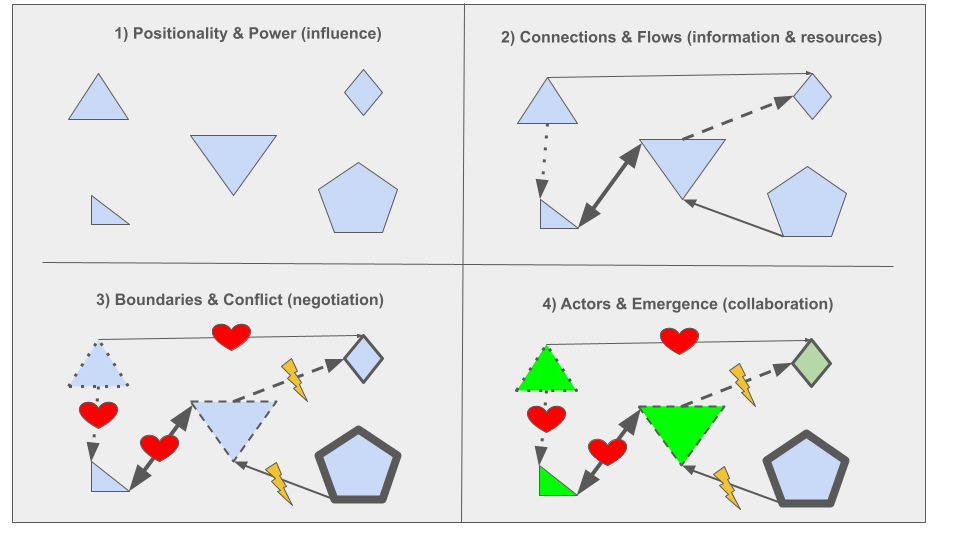
Once the dimensions are selected and fleshed out, the next step would be to develop an assessment framework or diagnostic to support gathering and analysing data about the nature and quality of relationships and the ways in which they contribute to the workings and effectiveness of social systems. The framework should not be designed to compare relationships to a context-insensitive “best practice”. The ambition instead, should be to shine a light on patterns of relational practice in particular contexts, to identify ways of relating across each of the dimensions that support the emergence of healthy social systems. Developing a rubric might be a promising approach to take.
A rubric designed to assess the health of relationships would include criteria that set out which aspects or dimensions of relationships matter (the four dimensions above, for instance), and associated standards that describe different levels of performance (for instance from unhealthy to healthy) on each of those dimensions (Julian King, 2024, Surfacing values through rubric development; my highlights here). By providing a framework that blends structure and flexibility, such a rubric would support the systematic collection and analysis of rich and nuanced evidence to inform reflection about ongoing processes of relating (see Figure 2). To ensure that it meets the needs of the organisations who are keen to reflect on, and improve their relationships, it would be important to develop – and use – a rubric, or other assessment framework, in a participatory manner that involves the organisations whose relationships are the focus for the analysis.
Figure 2: An indicative rubric for assessing the health of relationships
| Unhealthy | Stale | Healthy | |
|---|---|---|---|
| Positionality & Power | Actors are unclear about each others’ positions, interests, roles and capacity | Actors have a patchy sense of their respective positions, interests, roles and capacity | Actors clearly understand each others’ positions, interests, roles and capacity |
| Connections & Flows | Actors are disconnected and struggle to access the information and resources they need | Actors’ connectivity and ability to access the information and resources they need are inconsistent | Actors are well-connected and are able to access the information and resources they need |
| Boundaries & Conflicts | Boundaries between actors are poorly communicated, with diversity and disagreements handled poorly | The way in which boundaries are communicated, and diversity and disagreements are handled, is inconsistent | Boundaries are clearly communicated, with diversity and disagreements handled productively |
| Actors & Emergence | Actors are focused on their individual interests, with little time for others’ perspectives, learning and collaboration | Levels of participation, collaborative engagement and mutual learning amongst actors are patchy | Actors find value in shared learning and collaboration, and invest time in strengthening the system they are part of |
Those organisations will also be best placed to make decisions about an additional two sets of issues. First, working out how to deploy a process of reflective relational practice, and how to ensure that it is well-integrated with other processes for developing, implementing and evaluating approaches to supporting social change. And second, determining how the findings from the analysis might be used to support reflection and inform actions that can be taken to improve the relationships and systems that those organisations are involved in. One way of proceeding might be to use the evidence collected in a “What? So what? Now what?” process of reflection and learning, exploring how the patterns of relating might be shaped, in particular by identifying and modifying aspects of the social landscape which shape actors’ behaviours and the ways in which they relate to each other.
Developing: a second axis, levels of relational depth, from acknowledging, to sharing, to caring, to loving, sparked by conversations with Abhishek Thakore and Bodhi Sangha.
Conclusion
Reflecting on the quality of relationships will not, in itself, resolve conflicts and address challenges that are fundamentally about worldviews, resources, power and incentives. These are structural features of the social landscape that can’t be wished away. But by using reflective relational practice alongside other approaches to understanding actors’ behaviours and identifying entry points for engaging with the system, (see my recent piece on joining some dots for some pointers), we may be able to enhance the relationships that we are in, re-shape the structural features of the social landscape, contribute to healthier social systems and enable the emergence of better social and developmental outcomes.
Just as with growing a garden, nurturing a social world of healthy and flourishing relationships in a landscape beset by polarisation and conflict requires persistence and patience, and an ability to handle uncertainty and disappointment. However, the process can be hugely fulfilling and the results richly rewarding. By starting where we are, and doing what we can, with others, in and across the communities and systems that we are part of, we can definitely make a difference.
I look forward to further exploring the notion of reflective relational practice, connecting with others who are exploring similar terrain, learning from other approaches and to supporting efforts to put the approach into practice. If you’d like to chat, please drop me a line. I’ll be interested to hear your thoughts, to learn from your experience and to discuss the potential and challenges of this sort of approach.
How this practice emerged
An earlier version of this piece was produced as part of Abt Global’s FCDO-funded Portfolio Monitoring, Evaluation and Learning initiative in Nepal (listen to the Systems Practice In International Development podcast, especially episodes 1 and 2, on “From projects to portfolios”, for insights from this programme).
It is also informed by my ongoing work. This includes my engagement with:
- the SOAS Anti-Corruption Evidence programme as regards systemic and relational approaches to understanding and addressing policy implementation gaps (see the recent how to guide on navigating the political economy of corruption);
- the Human Learning Systems community as regards relational approaches to public service (see recent Insights, including as regards relational public service, and learning as a management strategy); and, with
- the Tamkeen Community Foundation for Human Development as regards their pioneering approach to strengthening communities through a relational process of collaborative and appreciative inquiry (listen to Karima Kadaoui’s conversation with Tim Logan, here).
It is also inspired by the people, organisations, publications, podcasts and videos listed in the references, all of which have provided inspiration as regards focusing on the role that relationships play in shaping social change.
Find out more
- References and further reading
- Assessing and enhancing the quality of our relationships (a shorter version, on LinkedIn, March 2025)
- Video: My presentation on reflective relational practice to the Local Systems Community, which grew out of USAID’s local systems community of practice (May 2025, 20-minute video)
- Video: A short talk on reflective relational practice at The Relationships Project’s session on relational readiness, with the accompanying note (October 2025, 6-minute video)
Footnotes
-
This piece is informed by several years of exploration and conversations, particularly since I started freelancing in 2023. Most recently, it builds on a note which was finalised in early March 2025, in collaboration with Alexandra Nastase, of Abt Global. That work was funded as part of Abt Global’s Portfolio Monitoring Evaluation and Learning (PMEL) initiative with FCDO, in Nepal. ↩
-
An alternative, or complementary, approach would be to focus on the sorts of behaviours that contribute to healthy relationships, along the lines suggested by the Relationships Project in what we mean by relationship-centred practice, and then the factors in the social landscape that influence actors’ behaviours (see below). ↩