Habitats, habits and the political economy dynamics of complex social systems
Summary: Actors’ behaviours are shaped by the landscapes they inhabit, with those behaviours in turn shaping the landscapes, which is why rule-breaking and corruption so often resists top-down fixes. Regulatory landscaping is a way of understanding why actors behave as they do, and of reshaping the landscape around a policy challenge so that self-reinforcing patterns of rule-following behaviour take hold.
About 5 minutes to read the full page.
Introduction
The concept of “regulatory landscaping” was developed as part of my work on corruption that distorts the implementation of public policy, with the SOAS Anti-Corruption Evidence programme at the University of London (SOAS-ACE). The foundational insight of the SOAS-ACE approach is that efforts to address corruption which focus on increasing transparency, strengthening top-down enforcement and punishing actors who break the rules often fail because they pay insufficient attention to actors’ behaviours and the relational and political economy dynamics that shape them. Rather than seeing corruption as the work of “bad” actors, this approach sees actors’ behaviours as rational responses to the landscapes they are part of, given their interests, and seeks to understand why actors behave as they do.
As well as being strongly informed by my work with SOAS-ACE, my thinking about regulatory landscaping has been shaped by the Cynefin Company’s work on estuarine mapping, including Jen Briselli’s Finding the next right moves.
The co-evolution of habitats and habits
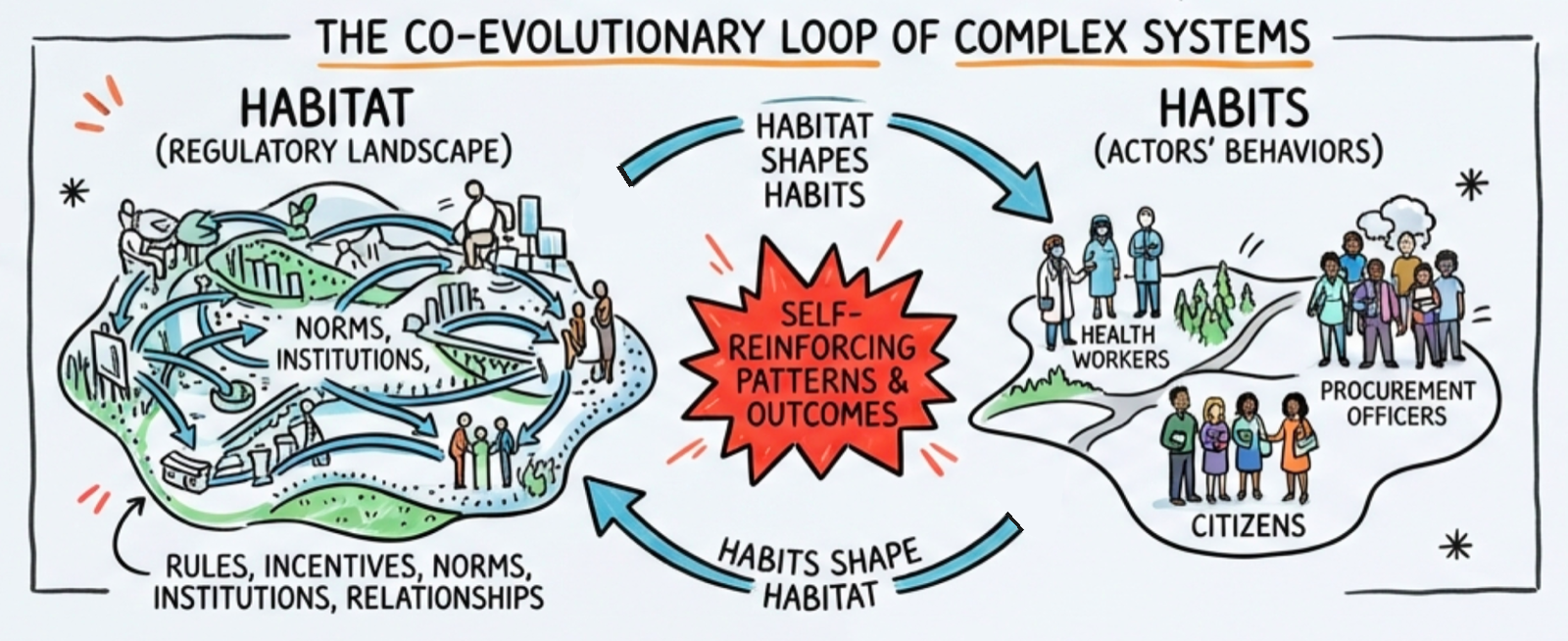
My takeaway from the work of SOAS-ACE is that actors’ behaviours are shaped by the regulatory landscapes they inhabit: rules, incentives, norms, institutions and relationships, formal and informal. Through their behaviours, individually and collectively, actors in turn reshape those landscapes. Habitats shape habits, and habits shape habitats (Figure 1, above). These co-evolutionary dynamics can lock in vicious cycles of corruption, making them resistant to top-down fixes. However, the logic runs both ways: under the right conditions, co-evolution can generate self-reinforcing patterns of rule-following behaviour.
The goal of regulatory landscaping is to inform engagement that might flip vicious cycles into virtuous ones by reshaping the regulatory landscape around a particular policy challenge in ways that incentivise and enable different behaviours. When actors who are following the rules have an interest in ensuring that others do the same, they can set in motion self-reinforcing patterns of behaviour. Reshaping the landscape to incentivise such horizontal peer checking amongst actors is the seriously systemic move at the heart of the approach.
Regulatory landscaping in practice: Four steps to feasibility
Putting regulatory landscaping into practice means asking not “what rule should we create?” but instead exploring “what rule might incentivise the changes in behaviour that are needed to trigger wider patterns of rule-following behaviour?” For a particular challenge, that involves moving through the following four steps, working with the grain of existing political economy dynamics to inform the design of politically feasible policies that might actually be effective:
- Map the actors, the policies and the resource flows that might be subject to corruption.
- Observe actors’ behaviours – actions, not words – looking in particular at bright spots: pockets of positive deviance where some actors are following the rules rather than engaging in corruption and may be working to ensure that others do the same.
- Analyse those behaviours, paying careful attention to what actors’ relative powers enable them to do, to their capabilities and interests, and to the regulatory landscapes they inhabit, to understand why some actors follow the rules while most do not.
- Design policies that support the emergence of self-reinforcing patterns of rule-following behaviour, either by leveraging the power of horizontal peer checking to extend existing pockets of positive deviance, or – where such pockets are scarce – by enabling rules to be followed, so that peer checking can then extend that behaviour.
Two examples from SOAS-ACE research: Bangladesh and Nigeria
In Bangladesh, research on climate adaptation infrastructure found that in some places embankments and cyclone shelters were built better, with less corruption. These bright spots were places where small landholders and petty traders – interested in benefiting from the infrastructure’s dual use as roads and community centres – checked that contractors were using public resources properly. The proposal that emerged from the research was to leverage this interest by requiring stronger dual-use features and allowing communities to decide where infrastructure should be built.
In Nigeria, research on health worker absenteeism found few bright spots of rule-following to build on. However, it did reveal that being absent is often an all-but-unavoidable survival response to irregular salaries, poor security and weak infrastructure. The way forward in this case was to address those drivers so as to enable some rule-following behaviour, which might then be extended to a wider group of actors through horizontal checking amongst health workers, supported by traditional rulers and women’s groups.
Beyond corruption: Regulatory landscaping in other thematic areas
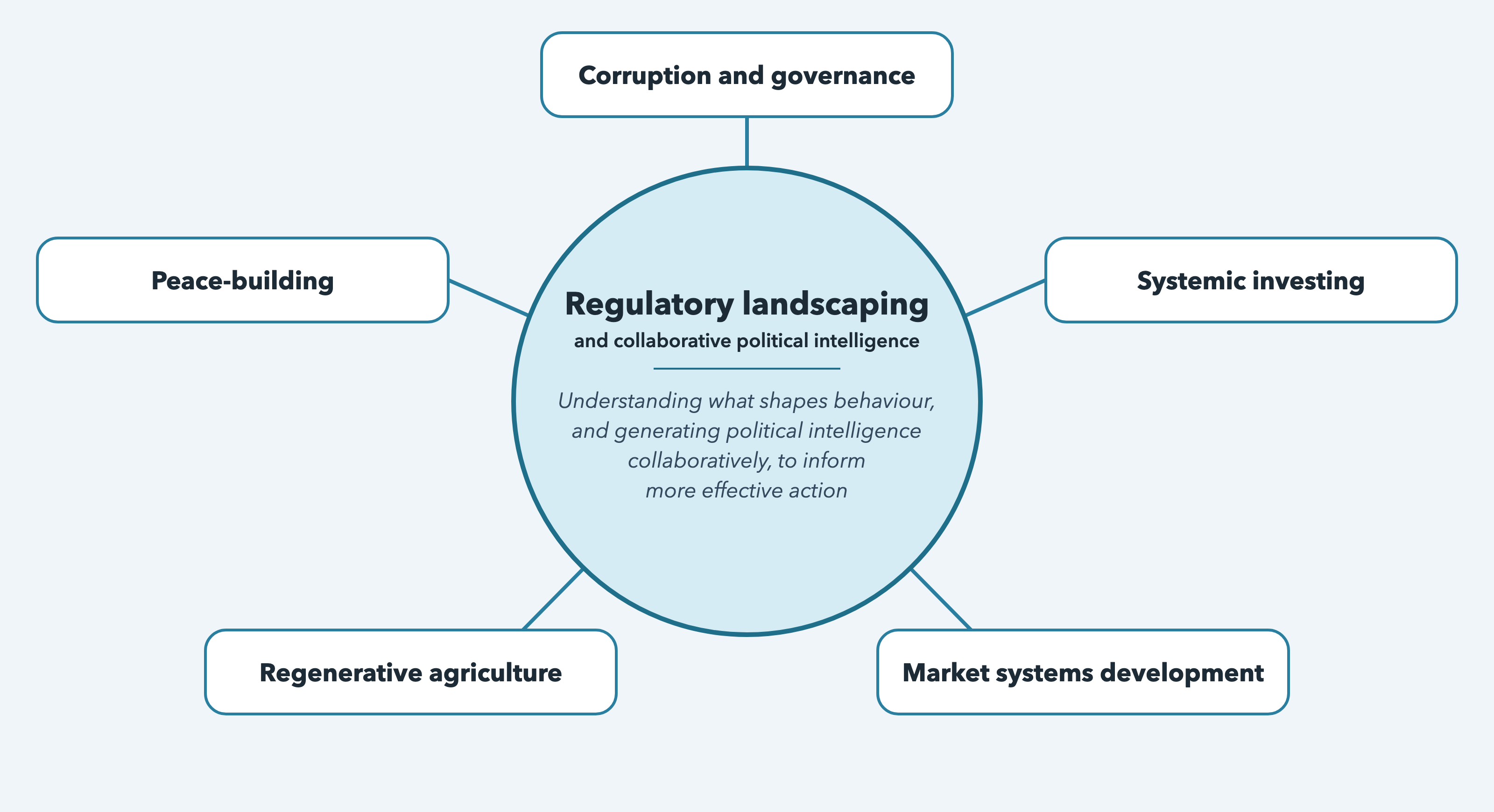
The logic of regulatory landscaping, including the use of horizontal checking to extend new patterns of behaviour, is not specific to corruption or confined to the realm of public policy. The idea that habitats shape habits shape habitats – and that social systems are complex environments, shaped by their inhabitants and their relationships, rather than complicated machines that can be engineered – is increasingly recognised in discussions of complexity. While the steps of regulatory landscaping may need to be tailored to different thematic areas, the goal is always to inform actions that reshape the landscape in ways that might lead to self-reinforcing patterns of behaviour that contribute to better outcomes.
Taking this forward, Zahed Yousuf and I are inquiring – across a range of thematic areas – whether and how approaches to supporting systemic change pay attention to actors’ behaviours and take account of the relational and political economy dynamics that shape them. Building on Zahed’s work on collaborative political intelligence, we are also exploring whether such approaches can enable the people and organisations whose behaviours bring complexity to life to participate fully in processes of change, using the signals they are picking up about how things are changing to collectively update their understandings of the regulatory landscape, so that they can adapt their actions over time, and strengthen their capacity to do so on an ongoing basis.
Find out more
- Regulatory landscaping: Better late than never! (August 2026)
- Understanding the landscape and sensing how it moves, with Zahed Yousuf (June 2026)
- Corruption in health systems: How regulatory landscaping can help (LSE blog, April 2026)
- SOAS-ACE: Corruption in health systems (2026) and Navigating the political economy of corruption (2025)
If you are grappling with complex social challenges and would like to chat, I’d be happy to connect.